
[ad_1]
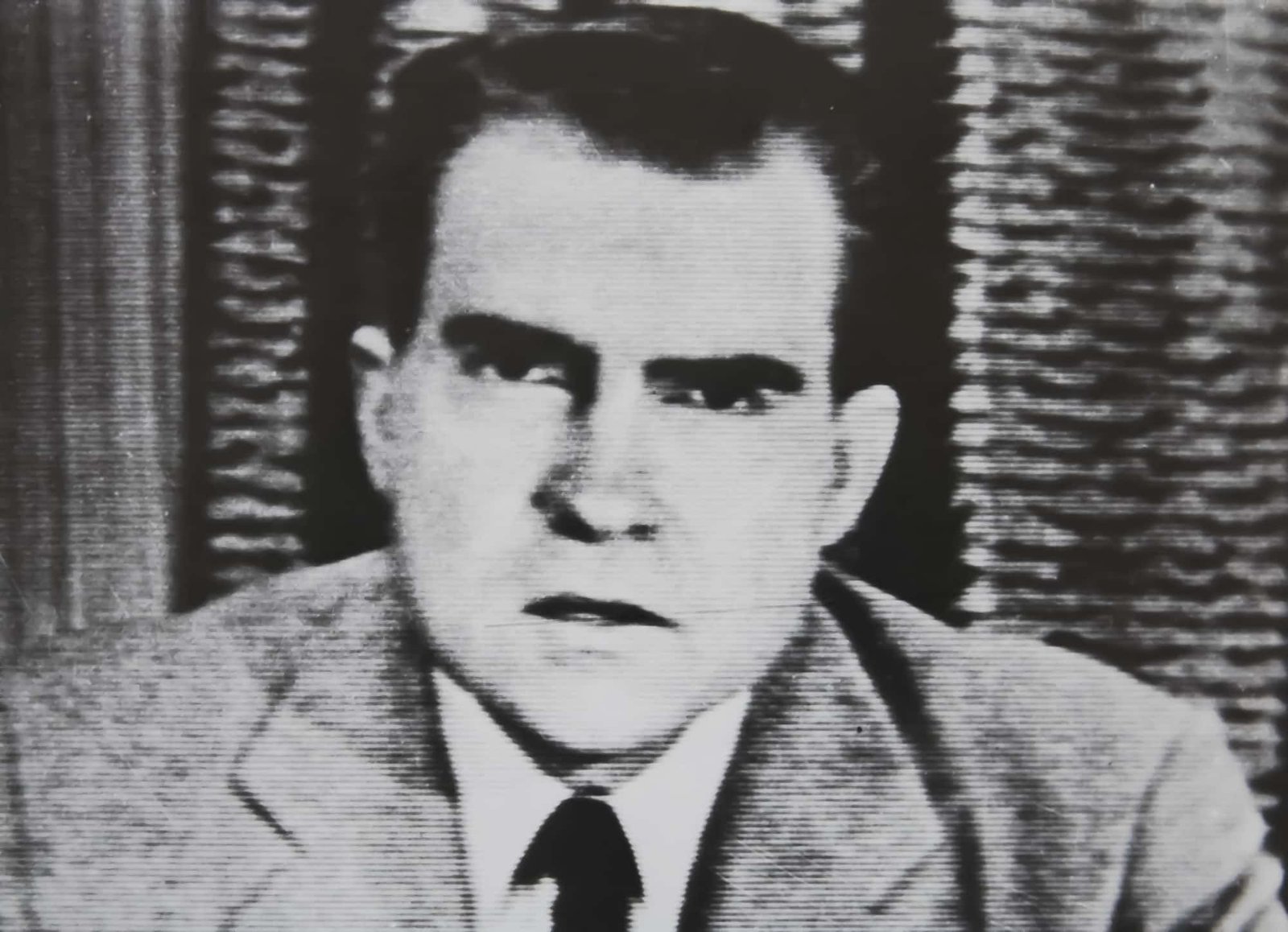
There is a lot of Richad Nixon rehabilitation going on these days. Before we get too far down that road, we should note that this month marks the fifty-fifth anniversary of one of the most pernicious acts of monetary destruction by modern presidents. On August 15, 1971, President Nixon announced a sweeping set of economic policies, his eerily Soviet-sounding “New Economic Policy.”
Today’s sympathy for the thirty-seventh president has something to do with a welcome recognition of the Deep State’s hand in his removal from office.
In June, Vice President J.D. Vance spoke at the Nixon Library, noting that his one-time predecessor’s legacy is enjoying a deserved renaissance and commenting on “how the Deep State took down Richard Nixon.”
In July, a Wall Street Journal headline proclaimed, “Young Conservatives Have an Unlikely New Icon: Richard Nixon.”
The New York Times, its hostility to Nixon long undisguised, surprised many when it prominently featured a piece of Nixon revisionism in February. The article, “Seven Pages of a Sealed Watergate File Sat Undiscovered. Until Now,” by reporter James Rosen, details a thirteen-month Pentagon spying operation against Nixon’s National Security Council.
Rosen reports that “détente with the Soviet Union, Vietnamization, Nixon’s China opening, and a reduced military share of federal spending,” created a state of alarm that had Joint Chiefs of Staff Chairman Admiral Thomas Moorer and others running an espionage operation against the White House. Nixon called being spied on by the Pentagon a “hanging offense.”
But there was more to the Deep State’s subversion of Nixon than just the Pentagon. Upon J. Edgar Hoover’s death, FBI Deputy Director Mark Felt became the recipient of Hoover’s dark “Official/Confidential” files, 17,750 pages filled with derogatory information on presidents, members of Congress, and other prominent Americans.
Felt denied to the acting FBI head that there were any such secret files. Felt was eventually confirmed to have been Deep Throat, the key source for Bob Woodward and Carl Bernstein’s take-down of Nixon in The Washington Post.
The plot thickens with information originally known to few but now going wide. Monica Crowley, a former policy assistant to Nixon and today the Trump administration’s protocol chief, recently spoke with Glenn Beck about the Deep State’s sabotage of Nixon:
“And you know who was a key member of it? One Bob Woodward, who was a Naval intelligence officer, who was read in on this military spy ring and then, through the CIA’s Mockingbird media program, was planted as a ‘journalist’ at The Washington Post, being fed all of the Deep State plans, to throw it on the front page of The Washington Post to bring down a president.”
Still, Nixon’s rehabilitation is a bridge too far for those who know how quick he was to prioritize his electoral fortunes over the national interest. He didn’t earn the sobriquet “Tricky Dick” for nothing.
August 15, 1971 figures large in his record. The post-World War II Bretton Woods Agreement designated the dollar as the central reserve currency of the postwar system with the assurance that the United States would redeem dollars for gold for foreign monetary authorities at the exchange rate of $35 an ounce. But as the printing presses rolled, it became evident that Washington was issuing dollar promises for gold it didn’t have. Dollar holders kept lining up to demand their gold claims. In August, the British ambassador showed up at the Treasury Department to convert $3 billion to gold.
It was all the fault of “international money speculators,” claimed Nixon. In an attempt to deflect responsibility from Washington, he said they were “waging an all-out war on the American dollar.” In reality Washington, like a common grifter, was writing checks on accounts with insufficient funds.
Nixon slammed the gold exchange window shut in a television address to the nation on a Sunday night. True to the politician he was, Nixon’s primary concern that night, according to aides, was not the impact of his program on the country. Advisors remember that he was more concerned that his announcement preempted the popular television show Bonanza.
The “Nixon shock” severed the last link of the U.S. dollar to gold and the discipline that gold imposed on government spending. It included a comprehensive freeze on wages, prices, and rents.
Because he served in the Office of Price Administration in World War II, Nixon knew that his price controls would fail. “The God damned things will not work. They didn’t work even at the end of World War II. They will never work in peacetime,” he said. Nevertheless, he was willing to unleash their destructive effects on the county as a whole for any short term advantage he could win for his reelection the following year.
He was right that they wouldn’t work. To meet the frozen price level, manufacturers cut quality. Retailers cut warranties to meet the artificial prices. If balancing your new tires had been free, now it was extra. If delivery had been free, now it cost. Some prices ended up higher as middlemen proliferated to evade the price controls. Other products were sold to straw men in Canada only to be sold back into the United States at the uncontrolled prices of imports. Oil passed through additional, unnecessary hands as price markups were allowed in the subsequent sales of petroleum. Lumber was drilled through and patched up so that it could be sold as a manufactured product.
In the end, Nixon’s burlesque created distortions, inconvenience, and shortages, but prices continued to rise. During the period of the controls, prices rose at an average annual rate of 6% and after they expired, prices played catch-up, hitting an annualized rate of more than 12% in late 1974.
Nixon had called wage and price controls “a scheme to socialize America.” He became part of the scheme.
Money is purchasing power. If something doesn’t preserve purchasing power, it should not be used as money. Based on the Consumer Price Index, here’s what has become of the dollar’s purchasing power since that August day fifty-five years ago.
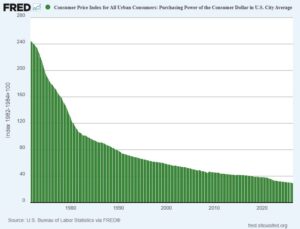 The U.S. dollar has lost 88% of its purchasing power. Gold was $35 an ounce. It has recently been trading at just over $4,000.
In the Nixon years, the monetary system was corrupted in the service of Vietnam War. It was on the heels of the costliest years of the war that Nixon ended the dollar’s ties to gold. The Federal Reserve’s fiat dollar has enabled the global American military empire ever since. Along the way the expansion of the “Empire of Lies” has hastened the exhaustion of the monetary system. And what the people should have done for themselves by ending the empire will now be done for them by the discredited money of an economy built on military Keynesianism, thanks in significant part to Nixon’s New Economic Policy.
You can oppose the subterfuge of the Deep State, and the executive arm of the global American military empire, without having to rehabilitate Richard Nixon.
[ad_2]
Source link
