
[ad_1]
Since his sudden passing, Lindsey Graham has remained an influential force in Washington. The question, “What would Lindsey do?” has acted as a comforting source of validation for interventionist Republicans, many of whom have doubled down on aggressive foreign policy stances in recent weeks by using Graham’s legacy as a cover.
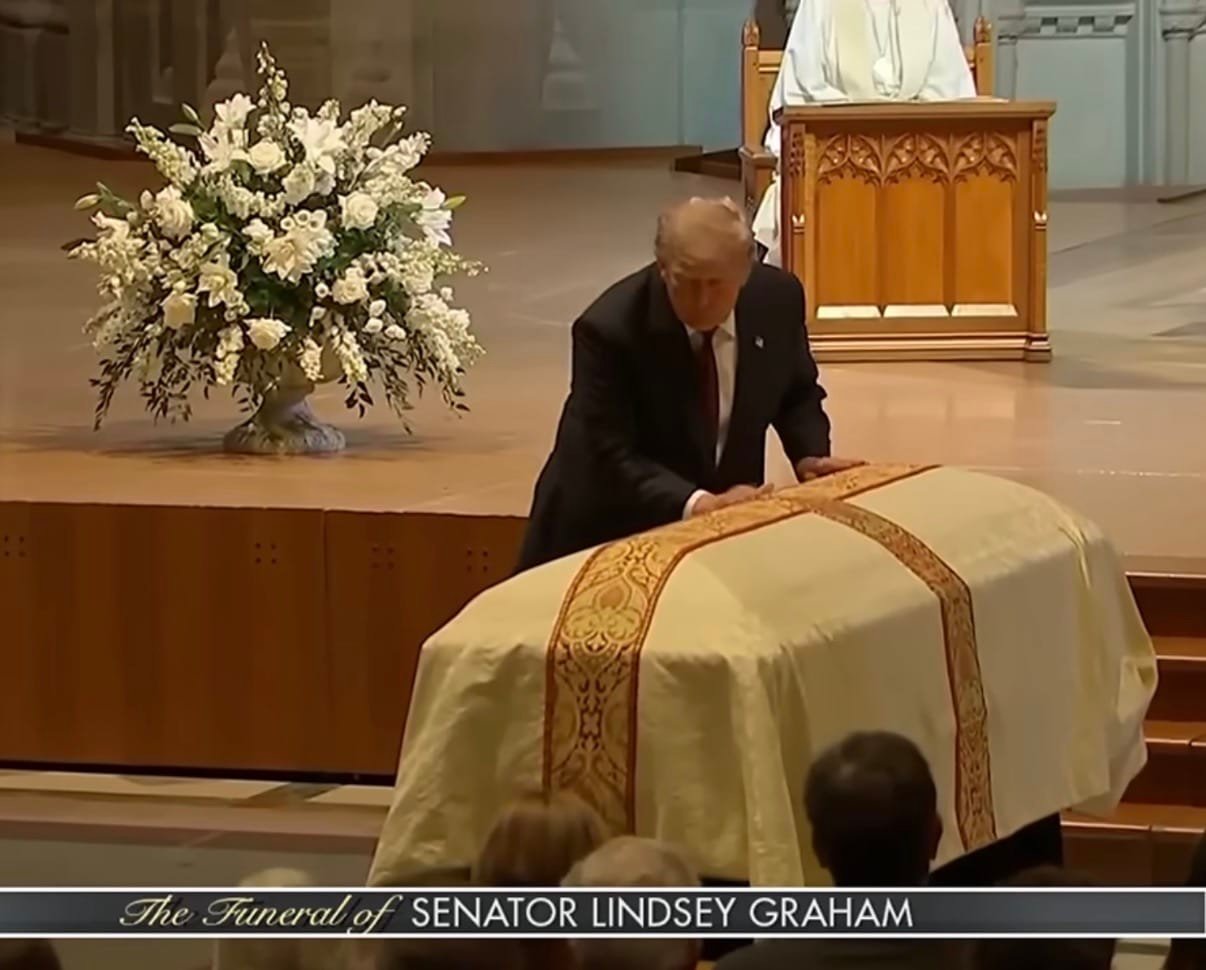
Lindsey Graham was, in the words of President Donald Trump, “extremely hawkish.” At his funeral on July 28, 2026, Trump said that the late South Carolina senator “never saw a war that he didn’t like.”
It was this fondness for foreign adventurism that made Lindsey Graham the face of militarism in the U.S. Senate. Graham’s jubilant support for Ukraine and his irrational loyalty to Israel became some of his most defining characteristics, overshadowing all interest in South Carolina, the state from which he was elected to represent.
He also had a particularly close bond with President Trump. He had been dubbed by many in DC as “the Trump whisperer.” Particularly on the issue of foreign policy, it was clear that over the course of Trump’s second term, Graham frequently had an audience with the president. Whether they were discussing Iran, Venezuela, Cuba, or even Lebanon, the senator was a loud voice in Trump’s ear advocating for intervention.
Trump’s offensive campaign against Iran could fairly be described as quintessential Lindsey Graham. In newly released documentary footage, Graham openly discusses his years-long obsessive push for war.
“Look what we’ve done here. I almost cried. How long have we been pushing this?” Graham said, bursting with excitement over the newly-launched U.S.-Israeli military campaign against Iran. “I talked to Trump this morning,” he added, “he’s jacked. This is the best thing I’ve ever done.”
Graham was also uniquely connected on the global stage. His relationships with Israeli Prime Minister Benjamin Netanyahu and Ukrainian President Volodymyr Zelensky became crucial in later years, as Graham stood as the most ardent supporter of these leaders and their respective nations, both embroiled in conflict.
At his funeral, Graham’s transnational ties were on full display. Leaders from around the world gathered to pay their respects. Both Zelensky and Netanyahu, who benefited greatly from Graham’s unceasing advocacy, were in attendance, as well as Reza Palahvi, the wanna-be leader of Iran and the son of the nation’s deposed monarch.
Now, in his absence, Republicans are left wondering who will fill Graham’s shoes as the Senate’s top war hawk.
Senator Ted Cruz (R-TX) is a name that comes to mind. He has been active in the weeks following Graham’s passing, doing media hits expressing his admiration for Lindsey both personally and politically. Cruz, much like Graham, has an extreme and quite puzzling love for Israel.
“Growing up in Sunday school, I was taught from the Bible those who bless Israel will be blessed,” Cruz explained in a 2025 interview with Tucker Carlson, “and those who curse Israel will be cursed.” The Texas senator said that the foundational basis for his support for Israel is that he seeks to “be on the blessing side of things.”
This sentiment rings eerily similar to remarks made by the late Senator Graham. When discussing his passion for the U.S.-Israel bond, Graham’s rationale was almost identical to Cruz’s.
“If America pulls the plug on Israel, God will pull the plug on us,” Lindsey Graham said at a 2025 speech for the South Carolina Republican Party.
Another outspoken proponent of Graham-style militarism is Senator Tom Cotton (R-AR). A longtime Russia hawk, Cotton has been a key figure in the Senate pushing for more American aid to Ukraine.
“For Ukrainian forces to defeat Putin’s invasion, Ukraine needs at least equal access to the weapons Russia already uses against them, like cluster munitions,” Cotton argued after the Biden administration announced it would be supplying Ukraine with cluster munitions in 2023. “Providing this new capability is the right decision.”
Cotton, like Graham, is also a fierce supporter of Israel. He is the architect of a recent project in the senate to further expand U.S. and Israeli intelligence sharing, a move that ignores—and seeks to circumvent—the issue of sinking support for Israel among the American citizenry.
Senator Tim Sheehy (R-MT) has served as a young face parroting old, tired neoconservative talking points in support of President Trump’s war on Iran. He, like Graham before him, repeatedly invokes the notion that Iran, not the United States, started this war, and that they did so forty-seven years ago.
Sheehy gained attention online in early March when he assisted the U.S. Capitol Police in breaking the arm of anti-war protestor and U.S. Marine veteran Brian McGinnis, a move Sheehy claimed was in an effort to “deescalate the situation.” In reality, the clash was a manifestation of the culture of fear in Washington, where any dissent against the war machine is swiftly dealt with.
Sheehy has made the case for escalating the war with Iran in ways that would make Lindsey Graham blush. In a recent fiery speech on the Senate floor, Sheehy warned his colleagues that the Iranians are “lunatics, who want us all dead.”
He went on in greater detail, saying that the Iranians not only want all Americans dead, but that they “want us to be raped, burned alive, and cut into pieces.”
The implication of this description is that diplomacy with Iran is not only impossible, but suicidal, and the only true solution is military force. This is the argument of Cruz and Cotton as well, both of whom have advocated for similarly aggressive policy towards Iran for years, culminating in this most recent war.
The Republican Party as a whole has decided on a way to memorialize Lindsey Graham, and that is by building on his interventionist legacy. On July 28, the Senate voted 86-12 to advance Graham’s bill to impose new sanctions on Russia and extend existing sanctions against Iran. The bill also gives President Trump the power to impose tariffs on nations that buy Russian oil, a move that will impose financial costs on the American consumer.
Senator Rand Paul (R-KY) put it correctly in a recent Fox News op-ed when he described why this bill is counterproductive to the supposed aims of its proponents.
“It is foolhardy to think that Russia, having sustained some 1.4 million casualties, thousands of economic sanctions and over four years of economic isolation, will now come to the negotiating table because the United States decides to tariff third countries,” Paul explained. “Moscow may in fact welcome the United States inflicting unnecessary economic self-harm and further degrading its relations with many of the world’s other great powers like India, whose rise could serve U.S. interests in our competition with China. Instead, we may drive India into the open arms of the People’s Republic.”
Overwhelmed by the emotions surrounding Graham’s passing, every Republican senator besides Rand Paul voted to advance this sanctions bill. The vast majority of Democratic senators felt similarly, and sought to honor Graham by passing his legislation.
Senate Minority Leader Chuck Schumer (D-NY) felt that advancing this bill was a tribute to the late Graham, saying “Lindsey Graham spent his final days trying to help Ukraine achieve victory. We ought to do the same in the days, weeks and months ahead.”
Lindsey Graham’s death leaves vacant the role of the U.S. Senate’s “chief hawk.” Unfortunately, thanks in large part to an older, less war-weary segment of the conservative base, there remains a demand for a Graham-like figure to preach the virtues of war.
Certain senators have tried their best to continue where Graham left off. Even if none of them are quite able to fill his shoes, the pro-war crowd can be comforted in knowing that despite their cheerleader having passed, the institution he worked for will still move heaven and earth to continue his legacy of foreign entanglements and endless military conflict.
[ad_2]
Source link
