
[ad_1]
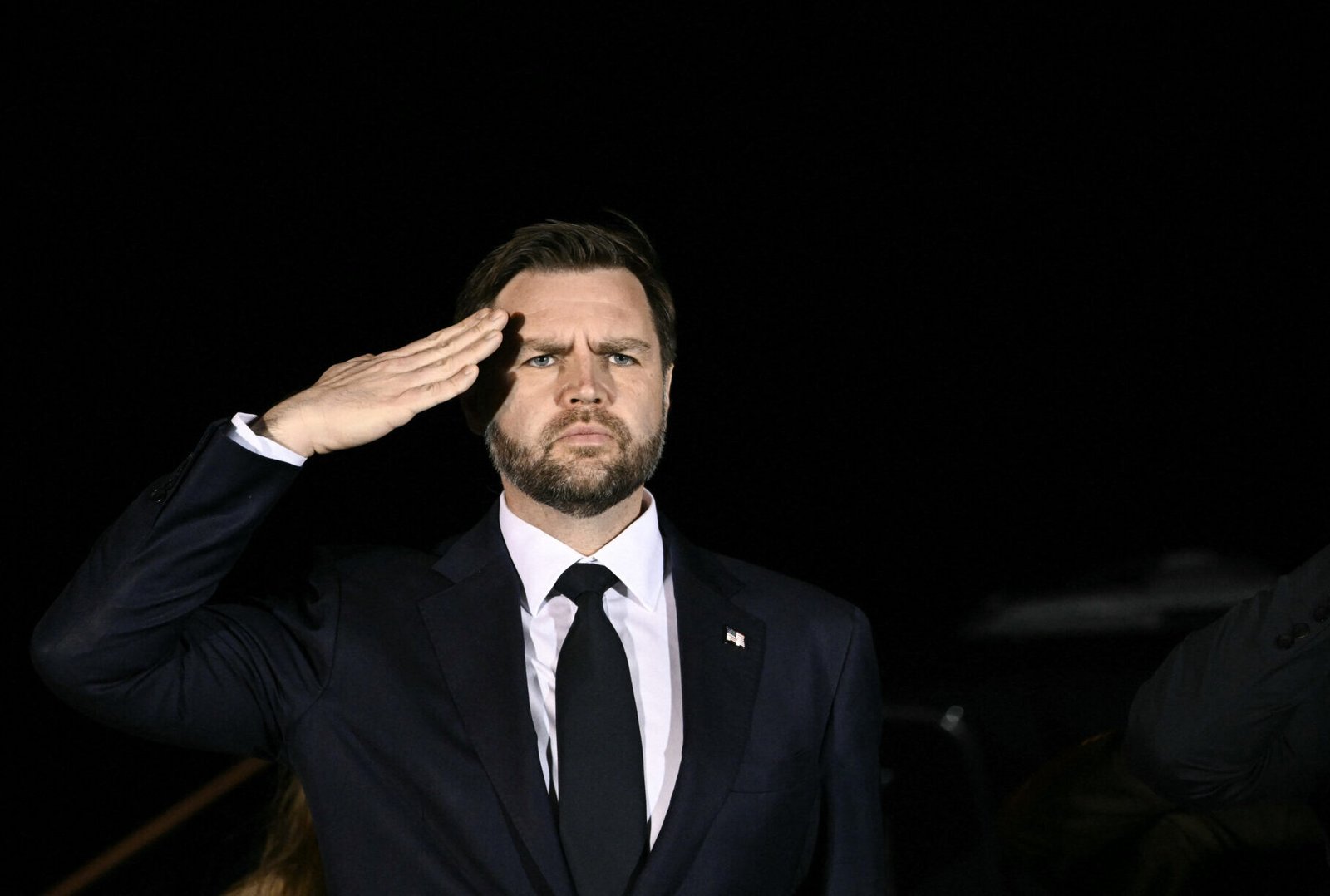
While waiting for Vice President J.D. Vance—who as Senator Vance was among the corporal’s guard of war skeptics in that body—either to regain his voice or to reclaim his cojones from a safe-deposit box buried deep within the bowels of Trump Tower, patriots in the administration’s foreign-policy division might examine how their forebears answered the question, “Should I Stay or Should I Go?”
In Resignation in Protest (1975), the political scientists Edward Weisband and Thomas M. Franck wondered why, despite Vietnam and Watergate, there had been so few “courageous public defections of key disaffected members of the Johnson and Nixon administrations.”
One man’s careerist weasel is another man’s team player. The meretricious lure of power, the shame of being labeled a “quitter,” and the near certainty of vindictive reprisal have made bold resignations by presidential appointees almost as rare as transits of Venus. (Joe Kent, who resigned as Trump’s director of the National Counterterrorism Center, is an exception to this rule.)
Consider two very different men who disagreed strongly with the boss’s bellicosity: the populist Nebraska Democrat William Jennings Bryan and the Cold War-era establishmentarian George Ball.
Bryan—whose defeat in 1896 by William McKinley was a pivotal event in the transmogrification of these United States from shining republic (however imperfect) to empire—was secretary of state in the Woodrow Wilson administration as Europe was committing suicide in the Great War.
A sincere if inconsistent proponent of beating of swords into ploughshares, Bryan stood out like a rose in concrete as he held fast to the Washington—Jefferson doctrine of noninvolvement in European affairs, even after the Germans sank the Lusitania, a British passenger ship bearing munitions. Over a thousand souls perished at sea, including 128 Americans. A “ship carrying contraband should not rely upon passengers to protect her from attack,” said Bryan. “It would be like putting women and children in front of an army.”
Secretary Bryan resigned rather than support the Anglophilic administration’s retreat from neutrality. A believer in arbitration, he proposed that there “be no declaration and no commencement of hostilities until the matters in dispute have been investigated by an international commission, and a year’s time is allowed for investigation and report”—a cooling-off period that would have saved 118,000 American lives.
Bryan would not go quietly into retirement: “Already the jingoes of our own country have caught the rabies from the dogs of war; shall the opponents of organized slaughter be silent while the disease spreads?” (In our day he would be ridiculed as a hopeless pussy by those big strong He-men Lindsey Graham and Pete Hegseth.)
Bryan explained, in a simple sentence that must strike the Mike Johnsons and Chuck Schumers as the drooling of a demented child: “A man in public life must act according to his conscience.”
Ball, undersecretary of state to Presidents Kennedy and Johnson, warned early against the commitment of U.S. forces to Vietnam. “Within five years we’d have 300,000 men in the paddies and jungles and never find them again,” he told JFK, who didn’t listen.
But Ball neutered himself by delaying, for several months in the crucial 1964–65 period, transmission of a blunt memo to LBJ arguing that Vietnam was an “unwinnable war” from which the U.S. should disengage.
He was less reticent with his peers. After Dean Acheson, John McCloy, and others of the risibly denominated “Wise Men” urged LBJ in a July 1965 White House meeting to press on, Ball exploded: “You goddamned old bastards… remind me of nothing so much as a bunch of buzzards sitting on a fence and letting the young men die.”
Subscribe Today
Get daily emails in your inbox
Shortly before his death, Ball was asked why he did not quit on principle and cause a public splash. He responded, “I knew the Johnson administration very well, and I knew how the president operated. If there had been any intimation that I might resign, the president would have passed the word out through the White House leaks that Ball had proved a total failure. That he had been quite incompetent, and that he was going to have to leave.”
Such objurgations would be pronounced upon any principled man or woman who resigned from the current administration, though they would be in the form of taunts one might hear from a particularly stupid schoolyard bully. He or she would be called “a Loser with a capital L.”
Secretary of the Treasury William McAdoo, President Wilson’s son-in-law—a sharper tool than Jared Kushner—told William Jennings Bryan that resignation would ruin his career. Bryan replied, “I believe you are right. I think this will destroy me; but whether it does or not, I must do my duty according to my conscience, and if I am destroyed, it is, after all, merely the sacrifice that one must not hesitate to make to serve his God and his country.” The J.D. Vance of Hillbilly Elegy might have made such a speech.
[ad_2]
Source link
