
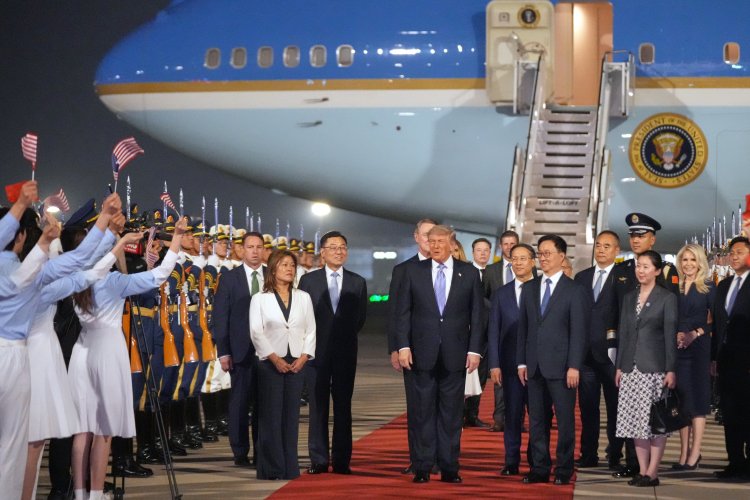
President Trump’s trip to Beijing is the first state visit to China by the sitting president since November 2017 – nearly a decade ago.
Since then, the U.S.-China relationship has changed dramatically. China’s military buildup has continued unabated – eroding the margin of U.S. military superiority in Asia. And despite an economic slowdown, China’s dominance in rare earths and leadership in some tech sectors challenges America’s place atop the global economy.
Nevertheless, when President Trump lands in Beijing he will be the most powerful president that Xi has encountered during his 13 years ruling China.
President Trump will enjoy an upper hand because since returning to office he has launched a decisive assault against the axis of aggressors – a partnership between China, Russia, Iran, North Korea, and formerly Venezuela, aimed at weakening the United States in their respective regions. Xi has spent years buttressing other poles of the axis of aggressors to divide and distract U.S. attention and resources away from Asia.
Xi’s efforts exacerbated the simultaneity problem – a scenario in which the United States would find itself in multiple conflicts in separate theaters simultaneously. But over the past 15 months, the administration has made great strides weakening the axis and improving America’s ability to manage the simultaneity problem. For Xi, the investment in the axis is one component of setting the conditions to realize his larger goal of seizing Taiwan. Xi wants his military to have the ability to take Taiwan by 2027, and he is counting on partners in disparate theaters that he can call upon to constrain U.S. forces elsewhere if he decides to invade.
Whether in the Western Hemisphere, Europe, or the Middle East, President Trump has seized the advantage reducing the scale and scope of the simultaneity problem.
In the Western Hemisphere, Operation Absolute Resolve delivered a serious blow to the axis by capturing Nicolás Maduro and installing a regime in Venezuela that looks to D.C. instead of Beijing. The United States has always relied on a benign Western Hemisphere to project power beyond its borders. Maduro’s Venezuela was a hub for Russia and Iran to sow chaos throughout the region, while it offered discounted oil to China and Cuba in exchange for economic and political protection. In ousting Maduro, President Trump removed an important outpost for the axis to distract the United States close to home instead of focusing on China’s or Russia’s periphery.
There is encouraging progress in Europe too. NATO members are beginning to make substantial increases in their defense budgets, amounting to hundreds of billions in new funding to buy new tanks, aircraft, and munitions to restore continental deterrence. Meanwhile, Russia’s battlefield momentum in Ukraine is slowing and its long-term economic outlook is bleak, while the war has hollowed out its society. Moreover, spring 2026 marked Ukraine’s most significant battlefield gains in two years, liberating 400 square kilometers. While Russia poses an existential threat in Eastern Europe, NATO and Ukraine are increasingly capable of managing the threat and reducing the simultaneity risk for the United States.
Operation Epic Fury exposed the perils of the simultaneity challenge. The USS Lincoln – on deployment in the Indo-Pacific – was the closest aircraft carrier when Iranians poured into the streets demanding freedom. Tragically, insufficient U.S. force presence failed to deter Iran from killing 36,000 of its own citizens.
Yet over the course of Epic Fury, the U.S. has mitigated the simultaneity problem, weakening Xi’s hand. Epic Fury has seriously diminished the threat emanating from Iran. Instead of Tehran aiding China by distracting U.S. forces in the Middle East during a potential China contingency, Xi finds himself burdened with a weakened and diminished ally relying on Chinese support to simply survive.
Still, more needs to be done to counter the threat posed by China. Supporting our allies while conducting operations in the Middle East has revealed that munitions stockpiles and industrial base shortfalls are America’s weakness. The president’s $1.5 trillion defense budget request promises record investment in the ships, aircraft, and munitions needed to rebuild a military capable of being present in the critical regions of the globe simultaneously. Moreover, funding programs like Golden Dome and Drone Dominance signify a commitment to preserving U.S. technological superiority over our adversaries. For the first time since China began its 30-year-long military buildup, the United States is responding in kind.
President Trump and Xi are both preparing for high stakes negotiations over rare earths, AI, and other issues at the heart of the U.S.-China rivalry. However, over the last year it is Xi who has grown weaker watching China’s allies suffer successive and devastating blows. President Trump arrives in Beijing ascendant and in position to negotiate from a position of strength.
