
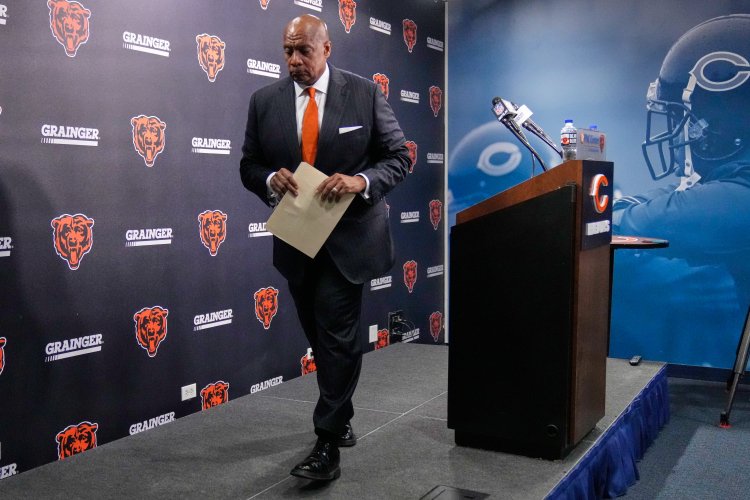
Say this about the Chicago Bears: They’re going to eat taxpayers, but at least either Indiana or Illinois will get a stadium.
I say this having spent decades analyzing state efforts to lure sports teams and businesses using taxpayer dollars. Illinois and Indiana are competing over the Bears – a team worth an estimated $8.2 billion. The NFL team could move out of Chicago proper into the Indiana suburbs if lawmakers pony up enough taxpayer cash to build a new stadium.
Make no mistake: This is not the economic development opportunity that both states say it is. The economy will not grow because of a new stadium, as decades of research clearly show. But it could be worse. Most taxpayer-funded attempts to lure businesses don’t even get a stadium out of the deal.
Going back decades, public officials across America have offered untold billions of dollars to convince companies to build factories and offices in their states. Good Jobs First, a think tank that keeps track of deals that get $100 million or more in tax breaks, subsidies, and other government assistance, pegs the figure at $76.8 billion over the past decade alone. This is an enormous transfer of wealth from taxpayers to special interests.
And what do taxpayers get in return? Next to nothing. In my home state of Michigan, I have documented that companies receiving billions of taxpayer dollars between 2000 and 2020 created just 9% of the promised jobs. That’s a paltry number given the huge payouts these companies received. Despite the lack of results, the recipient companies didn’t make taxpayers whole.
The story’s no different in other states. Foxconn in Wisconsin hasn’t gotten anywhere close to the 13,000 jobs announced when the state’s $4.8 billion in subsidies, tax breaks and other assistance were signed. The Amazon headquarters project in Northern Virginia was supposed to create 25,000 jobs and thus far has only reached a third of that amount. Cerner in Kansas City was supposed to create 13,000 jobs for its $1.6 billion in taxpayer support, but it had only 6,400 jobs as recently as 2024, and the company has announced further layoffs since. Guaranteed, similar stories exist in every state, with more added every year.
Lawmakers also promise that stadium subsidies will lead to economic growth. Yet that’s an illusion. Stadiums sit empty most of the time and employ few people. The entertainment districts they are supposed to anchor have little effect on a city’s economic prospects. Indeed, the claims of broad-based improvements to the local economy come from economic impact assessments that multiply benefits and ignore costs – i.e., shoddy research that only exists to tell politicians what they want to hear. Officials who say that stadiums will generate thousands of jobs and hundreds of millions in economic activity are either misleading the public or mistaken themselves.
Whether it’s a multinational corporation or a sports franchise worth billions of dollars, these special interests shouldn’t get a cent of taxpayer money. Some sports prove it’s possible. The Golden State Warriors, the Los Angeles Chargers, and the Los Angeles Clippers have all built new stadiums in the past decade without taxpayer money. Stadiums can and should be built without taxpayer support; so should factories and other business facilities.
So why do they get so much taxpayer cash? The simple answer is that lawmakers want to show that they’re doing something, anything, about “jobs.” They announce big subsidies with equally big promises of job creation and economic growth. But once the headlines fade, people forget. The companies or sports teams don’t deliver on the promises, yet they still reap the financial rewards with little to no public pushback or consequence.
With stadium subsidies, at least local residents get a stadium. That’s not nothing, but it’s also not the promised economic boom. A taxpayer-funded stadium is no more than a spectacle, whether it’s in Illinois, Indiana, or anywhere else. Maybe taxpayers should start asking whether a spectacle is really worth their hard-earned money, starting with the Chicago Bears.
