
Dozens of people have e-mailed me about a recent article in the New York Times Magazine on the interstitium. The reason is not because of the interstitium itself, but because it is being used to retcon an alleged explanation for acupuncture. The discussion of the interstitium itself is fine, but then the author veered off into gratuitous pseudoscience.
The interstitium was proposed in 2018 based on a study showing that the interstitial connective tissue spaces around organs and other tissues in the body are not separate spaces but all appear to be connected. Essentially the authors propose this is a body-wide fluid filled space in the body through which fluids flow and communicate. This adds to the other fluid systems in the body, such as the lymphatic system (which drains excess fluid from tissues), the circulatory system (which distributes oxygen and nutrients and carries away waste), and the spinal fluid system (which is inside and surrounds the central nervous system). Later studies have supported the evidence for one continuous interstitial space.
Of course, the more we know about how the body works the better we will be able to understand disease processes and design treatments. Cancer cells, for example might spread through the interstitium, resulting in distant metastasis.
The NYT, however, decided to tack onto this interesting update in our biological knowledge with a bit of rank pseudoscience. The author starts with the statement that Thiese, one of the original researchers, was approached at a talk in China by a practitioner of Traditional Chinese Medicine who said, “We’ve been talking about it for 4,000 years.” He accepted this third hand information uncritically. Um…no they haven’t. No ancient culture had any significant knowledge of human anatomy. They didn’t know basic things about how the body works, such as how blood circulates. They didn’t know what all the organs did. They didn’t even know that tissues are made of cells until the 1800s. All this person was doing was taking a basic concept, like the body is connected, and applying it to this knew anatomical knowledge. It’s meaningless.
Further, what we currently know as acupuncture is actually only about a hundred years old. It was created by fiat to unite the various Chinese medical traditions, which were mutually exclusive, into one system. They were not using filiform needles 4,000 years ago. We don’t know what they were doing. The first text which describes something like acupuncture is from 100 BC. But there was no unified theory or practice at this time. Needles were more like lances, and likely were used for multiple purposes. Acupuncture sometimes involved blood letting or lancing, and other times involved “chi”. However, there was also the belief that blood is what spread chi throughout the body, so they were not entirely distinct. Again, these various traditions were not brought together until the early 20th century.
In fact, descriptions of acupuncture from the 19th century bare little resemblance to the modern version. These did not always involve points or meridians, used large needles deeply inserted into tissues, usually at the point of pain or injury.
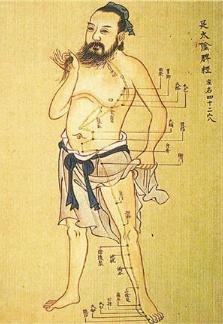
The notion of chi, or an energy vital force, which spreads through meridians seems to go back about 2,000 years in some traditions. But this had nothing to do with any knowledge of anatomy or physiology. In fact, for about 2,000 years, until 1923, dissection of dead bodies was banned in China, so they had very little knowledge of anatomy. The meridians were therefore not based on anatomy, but on their cosmology. It was essentially astrology. It is therefore completely pseudoscientific and ahistorical to argue that Chinese acupuncturists had detailed knowledge of the interstitium 4,000 years ago – this is nonsense from beginning to end.
The NYT author then provides some reference to studies apparently showing an alignment between the interstitium and acupuncture meridians. These studies all come from China, which has a documented history of poor science relating to acupuncture. But even taken at face value, the evidence appears worthless. Essentially, dye spread up the arm when pressed, and there is a meridian that goes up the arm. Wow. They don’t even closely align. It would be amazing if dye did not spread in a way that could be so loosely correlated with some meridian.
There is no credible evidence that meridians exist – and they were never meant to represent anything anatomical. There is no evidence that acupuncture points exist, and acupuncturists cannot even agree on where they are or what they do. There are different traditions of acupuncture that use entirely different systems of points. This is all culture, with no underpinning reality.
So no – the interstitium does not provide an explanation for how acupuncture works. That is all blatant retconning. Further, there is no credible evidence that acupuncture even works. After thousands of studies researchers have failed to definitive reject the null hypothesis. The best clinical studies show no difference between true acupuncture and sham acupuncture – it is all placebo. The media, however, has mostly bought into the propaganda, and continues to gullibly spread this pseudoscience.
