
[ad_1]

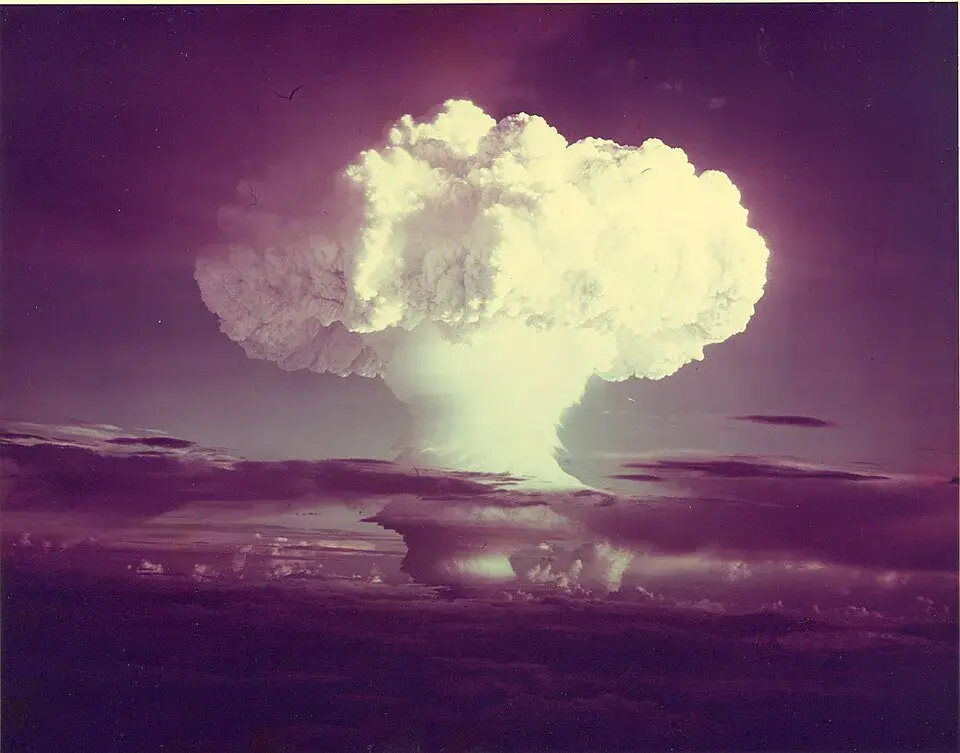
The Ivy Mike test of the first hydrogen bomb took place Nov. 1, 1952 in the South Pacific. Far more devastating than the atomic bombs that preceded it, the race to the hydrogen bomb was triggered by another event that took place this day 81 years ago, July 16, 1945, when the first atomic weapon was tested at Alamogordo, New Mexico. That set off a logic of power that would place humanity’s future at risk, a danger only increasing in our world today.
Today is the 81st anniversary of the most fateful day in the 300,000 years of our human species existence. We have always fought each other. On July 16, 1945, the prospect we could fight ourselves nearly to extinction came into view.
On that date, the first atomic weapon was exploded at Alamogordo, New Mexico. The culmination of the Manhattan Project, the Trinity test opened the nuclear age that was to be announced to the world 3 weeks later with the detonation over Hiroshima. I have said it before. I’ll say it again. This is the day the world should have changed, when humanity crossed a threshold to an entirely new situation. For the first time, we could wipe ourselves out, or nearly.
Instead the world moved on to build mass numbers of nuclear weapons, first atomic, then thermonuclear, made possible by implosion of hydrogen with atomic weapons. We have learned since that even 100 Hiroshima-size atomic bombs can cause a nuclear winter collapsing agricultural production and killing billions. A full-scale nuclear war might cause a winter leaving few alive.
This day, July 16, 2026, it seems that not only has humanity not learned the lesson – It is plunging further into danger. This Trinity anniversary is the first in 55 years there is no agreement among nuclear powers to limit the numbers of weapons. In February, the NewSTART Treaty between the U.S. and Russia expired. So a condition that lasted for around two-thirds of the nuclear age is now defunct. Today the U.S. and Russia each keep around 1,800 nuclear warheads on alert to be delivered by submarines, missiles and bombers. With the end of NewSTART they are free to bring weapons out of storage. The U.S. has 3,700, Russia 4,400. Spaces in missile tubes and bomb bays can be readily filled.
Meanwhile, China is moving from keeping its estimated 620 nuclear weapons on reserve to full alert, the same dangerous launch-on-warning protocol followed by the U.S. and Russia. At the same time, it is building up active warhead numbers to roughly the level of the other two powers.
Nuclear dangers are increasing even as wars in West Asia and Europe are escalating. These seemingly irreconcilable conflicts have no clear end, and the possibility of crossing nuclear threholds is being raised in both by serious observers. Of course, the nuclear issue is at the center of the conflict in West Asia. Israel and the U.S. claim that Iran is seeking nuclear weapons, using that as a justification for their preemptive war. Iran has been well capable of developing nuclear weapons for decades, but has repeatedly said it is not seeking them on religious grounds. If anything, the war has given the Iranians incentives to finally acquire them, while weakening leadership forces that stood against this. Israel itself has its own arsenal estimated at anywhere from 90 to 400 weapons, and has not hesitated to threaten use. Some sources indicate it used this threat to strongarm the U.S. into attacking Iran, otherwise it would do so itself.
At one level, it all seems deeply irrational. It is hard to see continuation of current trends without some catastrophic blow-up. This gets to the fundamental issue, why humanity did not learn when we unlocked the secrets of nuclear power 81 years ago, why we continue on a path with good odds to produce disaster. It is the contradiction between short-term pursuit of power and long-term survival. The incentives and drives that motivate the political and economic systems of the world are conditioned on that short-term drive. If one side doesn’t pursue powers that may be available, even with potentially devastating consequences, the other side will. That is why both the U.S. and Soviet Union raced to develop hydrogen bombs in the 1950s knowing how much more destructive they are.
In a parallel way, it is why AI researchers concerned it could wipe out humanity nonetheless have the gas pedal all the way to the floor. The first to create AI superintelligence will dominate, so it must be us, goes the thinking. If it decides humanity is a bad idea, that is a risk we must take, the developers believe. This is even as the wars are illuminating another arms race, that of drone warfare. AI is being brought to bear, so the automated killer robots of the Terminator movies are becoming reality.
The world picture presents yet another irrationality created by a similar logic. Consider that the conflict between the U.S. and Iran now centers on control of the Straits of Hormuz. This is the chokepoint through which around 25% of the world’s seaborne oil and 20% of its liquid natural gas flow. Control represents a global superpower which the U.S. can ill afford to lose to Iran. Yet it has already lost it. That is part of the irreconcilable nature of this conflict with incredibly dangerous implications.
In the same world picture, Northwest Europe is suffering an unprecedented and deadly heatwave. Fires are breaking out in France and Britain. Heat domes are popping up in North America and around the world. An El Nino warming event is mounting in the Pacific Ocean, feeding global heat and transmitting impacts to all corners of the planet. Crucially that includes food production. Wildfires burning in Canada are sending smoke plumes choking the northeastern U.S.
This is all happening while the ship of fools known as the Trump Administration is doing all it can to dismantle climate science and clean energy development. It is actively pursuing a policy it openly describes as energy dominance. The U.S. is now by far the world’s biggest oil and gas producer, and the administration seeks to leverage that keep the U.S. as global #1. The actions against Venezuela and war on Iran are key elements of that strategy.
It would be hard to find a more pronounced case of short-term power seeking over long-term survival. Control of energy resources is indeed one of the keystones of power over people and nations. The short-term logic is clear. The long-term reality is calamitous. Humanity gained tremendous evolutionary advantage when it mastered the use of fire. Now we may be consumed in our own, whether the rapid conflagration of nuclear war or the slower but still deadly rise of heat caused by fossil fuel burning.
Yet that short-term pursuit of power continues because that is the logic of the political and economic systems that rule the world, and the logic that people who rise in those systems must follow to rise. It is a self-feeding cycle that must be broken. It’s going to take more than a peace movement, or a climate movement. It is going to take a movement that questions the very assumptions of power driving the system.
Power is an element of everything in life. We must ask what power is for. What does it serve? I believe the fundamental flaw in prevailing systems is the pursuit of power as its own end, whether dominance by nations and states, or bottom-line profit by corporations. Power must be constrained within the context of broader goals, none more central than long-term survival. That involves a vision for the whole beyond the interests of any one group, nation or organization. It may in the end involve something as basic as infusing the golden rule into all institutions. Do unto others as you would have them do unto you. All the world’s great religions have some version of this.
Today, I fear we are sleepwalking toward catastrophe, driven by leaders of the baby boom and younger generations who have forgotten the horrors of the last global war, which ended in 1945. Driven as well by ignorance of the long-term consequences of fossil fuel combustion, often deliberately by those who have interests in its continuation. I wonder what it will be to wake us up. Mushroom clouds rising somewhere on Earth? A climate mass casualty event that cannot be denied?
I hope we get it soon. Cause the world is becoming more dangerous, and we clearly have not learned the lesson that we should have this day 81 years ago.
This first appeared on Patrick Mazza’s Substack page, The Raven.
[ad_2]
Source link
