
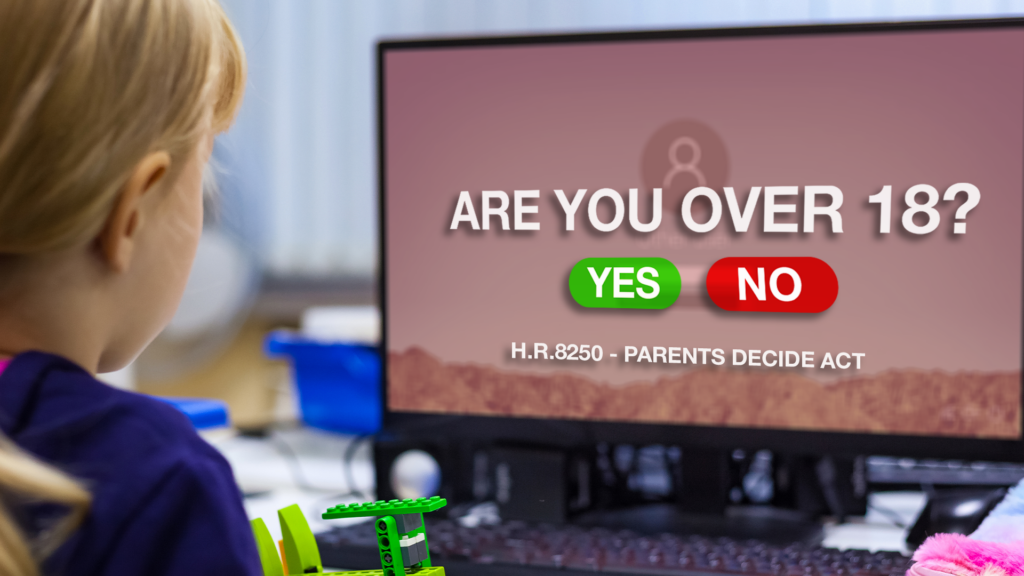
Social media platforms. App stores. And next—computers and smartphones? If some lawmakers get their way, Americans could have to show IDs or submit facial scans to so much as open a laptop or power up an iPhone.
You are reading Sex & Tech, from Elizabeth Nolan Brown. Get more of Elizabeth’s sex, tech, bodily autonomy, law, and online culture coverage.
A bipartisan federal bill called the Parents Decide Act would require age verification at the operating system level. That means most computers, smartphones, and tablets would all be age-gated.
The Parents Decide Act was introduced earlier this month by U.S. Rep. Josh Gottheimer, a New Jersey Democrat. It’s co-sponsored by New York Republican Rep. Elise Stefanik.
Gottheimer and Stefanik’s bill defines operating system as “software that supports the basic functions of a computer, mobile device, or any other general purpose computing device.”
It would mandate that any operating system provider “require any user of the operating system to provide the date of birth of the user” in order to set up an account or use the operating system. And “if the relevant user of the operating system is under 18 years of age, require a parent or legal guardian of the user to verify the date of birth of the user.”
It would also require operating systems to share “any information as is necessary…to verify the date of birth of a user” with app developers.
How exactly would people have to provide their dates of birth? How would things work when minors are concerned—would parents have to upload a copy of their children’s birth certificates, or would their word alone be enough? And how would parents have to prove they are the parents, or even prove that they are adults?
The Parents Decide Act does not answer any of these questions—and it would not require members of Congress to hash out any such details before passing this measure.
The Federal Trade Commission (FTC) would be tasked with deciding on those details at a later date.
So, rather than a large body of elected representatives deciding how this would work before it becomes law, a small group of unelected, politically appointed commissioners would do so. What could go wrong?
It’s no secret I oppose legally requiring age verification to use certain websites.
But I’m doubly opposed to legally requiring age verification to simply use a computer! https://t.co/paxrdecrNj
— Nico Perrino (@NicoPerrino) April 20, 2026
The Parents Decide Act is part of a bigger problem in federal lawmaking these days. Members of Congress pass bills with broad mandates and leave the details to regulators. Members of Congress are directly accountable to voters; regulators are not. FTC commissioners are nominated by the president and can be highly partisan. Leaving it up to them to say how a law like this would work is just another step toward abrogating congressional power and concentrating it in the hands of the executive.
The bill is also part of a bigger panic around young people and technology that has settled upon carding everyone as a solution.
It started with porn.
In a time-honored tradition, politicians started acclimating people to a massive and intrusive new regulatory scheme by promising that it was just going to target sexually oriented material. After all, who could be against stopping children from looking at porn?
But, of course, it was never going to stop there. And no sooner had some state legislatures proved that age verification for online porn platforms could pass than lawmakers began expanding their designs. Soon, social media age-verification bills became all the rage. We started seeing age-verification measures aimed at app stores.
Now here we are with lawmakers proposing age verification in order to use a smartphone or computer at all.
No matter what becomes of this particular bill, I don’t think this is the last we’ll see of this idea. It’s the logical endpoint of an age-verification mania sweeping politics and advocacy and threatening to end online anonymity and privacy. We’ve been watching the Overton window on all of this shift rapidly. And as people have begun to accept the idea that the internet should not be free and open, that we should adopt a “papers, please” mentality toward all sorts of digital spaces, it’s no surprise that this would extend to the very devices we use to access these spaces.
SCOOP: I got internal photos/videos of McClatchy’s Claude-powered “content scaling agent” tool roiling its newsrooms. It’s an AI product executives made because “we need more stories and we need more inventory,” and journalists “defiant” about using it “will fall behind.” 1/6 pic.twitter.com/p1SLz1VioO
— Corbin Bolies (@CorbinBolies) April 21, 2026
Condom prices are about to go up, according to Reuters. And we can blame President Donald Trump’s war in Iran.
“Malaysia’s Karex Bhd, the world’s top condom producer, plans to raise prices by 20% to 30% and possibly further if supply chain disruptions drag on due to the Iran war,” Reuters reported yesterday. “Karex is also seeing a surge in condom demand as rising freight costs and shipping delays have left many of its customers with lower stockpiles than usual, CEO Goh Miah Kiat told Reuters in an interview.”
Increased legal liability for chatbot advice could backfire, write Jess Miers and Ray Yeh.
Over a million people are using general-purpose chatbots for emotional and mental health support per week. In the US, those that use chatbots in this way primarily seek help with anxiety, depression, relationship problems, or for other personal advice. As conversational systems, chatbots can sustain coherent exchanges while conveying apparent empathy and emotional understanding. Many chatbots also draw on broad knowledge of psychological concepts and therapeutic approaches, offering users coping strategies, psychoeducation, and a space to process difficult experiences.
In a study of more than 1,000 users of Replika — a general-purpose chatbot with some cognitive behavioral therapy-informed features — most described the chatbot as a friend or confidant. Many reported positive life changes, and 30 people said Replika helped them avoid suicide. Similar patterns appear among younger chatbot users. In a study of 12–21-year-olds — a group for whom suicide is the second leading cause of death — 13% of respondents used chatbots for some kind of mental health advice, of which more than 92% said the advice was helpful. >>
But politicians want to make tech companies liable every time someone does something stupid or risky after chatting with a chatbot. Or they want to entirely ban chatbots from having mental health conversations. And this “risks derailing this breakthrough in support, creating more problems than it solves,” suggest Miers and Yeh.
Hospitals are using AI in transformative ways to help professionals and patients, and to speed up care
new California bill would ban this pic.twitter.com/95pMpUif8S
— Shoshana Weissmann, Sloth Committee Chair 🦥 (@senatorshoshana) April 20, 2026
• “As much as I want to protect my kids from technology’s potential harms, I need to protect them from do-gooders in government even more,” writes Abundance Institute CEO Christopher Koopman in the Wall Street Journal. “The chattering class is fully on board with the notion that politicians, not parents, know what’s best for kids—even among conservatives who have long opposed state intrusion into family life.” But this has dangerous implications for parental consent, privacy, and technology access more broadly.
• “Economics is the study of decision-making under constraints, i.e., scarcity. If advanced AI brings material abundance—if machines can produce many if not all forms of human production at very low marginal cost—does economics become irrelevant? No, we will still have scarcity, but the kind of scarcity that matters will change,” writes Alex Imas. Here’s what that means for the future of work.
• “Sometimes, things are not just one thing — they’re also another thing. This sentence construction (‘It’s not just this — it’s that’) has become so common in AI-generated writing that now, it’s no longer just a clue that a piece of writing may be synthetic — it’s almost a guarantee,” writes Amanda Silberling at TechCrunch. A new report finds that use of this construction in corporate communications is way up.
• In defense of tween screen time: “Plenty of what circulates on TikTok, Instagram and YouTube is funny and inventive, made by girls for other girls, surviving precisely because it doesn’t require a corporation’s approval,” writes Katya Ungerman. “My favorite recent social media fad is tweens and young teens designing their own countries, complete with flags, customs and governing aesthetics.”
• A new bill would ban AI use in children’s toys.
