
[ad_1]
Invoking George Washington, John Quincy Adams and the American abolitionist tradition, Jeffrey Wernick argues that permanent foreign attachments and endless war have pushed the United States far from the values it claims to defend.
Joshua Scheer
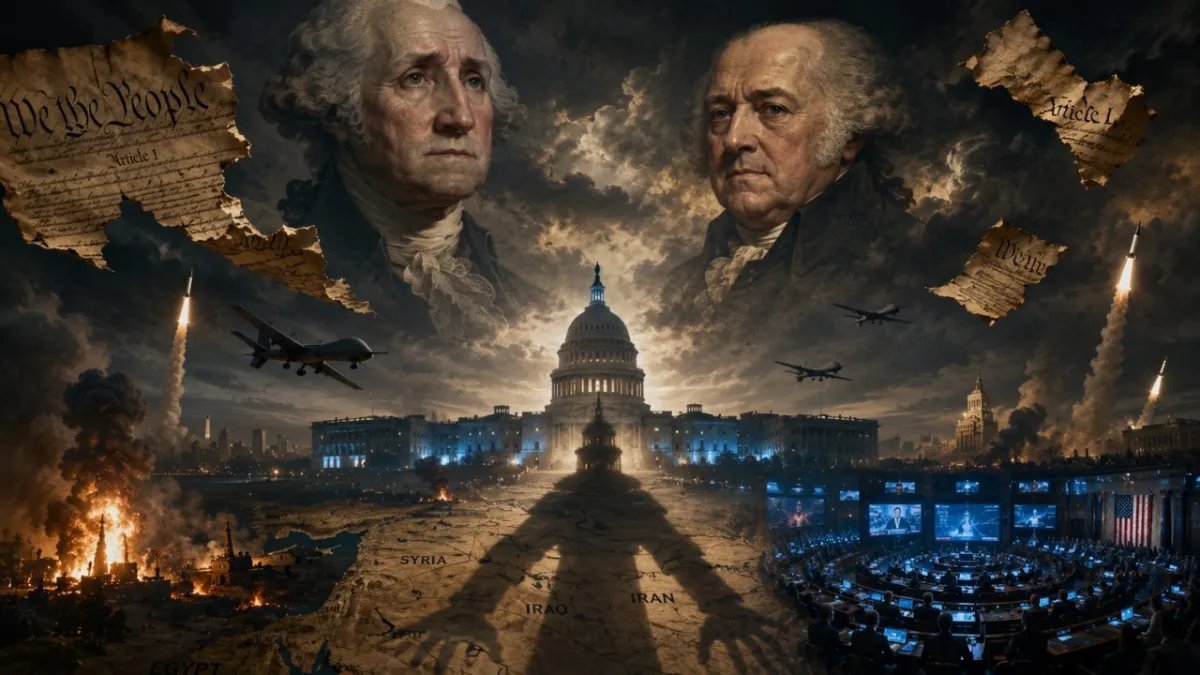
Jeffrey Wernick delivers a sweeping and deeply provocative meditation on American foreign policy, arguing that the United States has abandoned the very principles its founders warned were essential to preserving the republic. Drawing on George Washington’s farewell address and John Quincy Adams’ warning that America “goes not abroad in search of monsters to destroy,” Wernick contends that modern U.S. policy has become defined by permanent alliances, military entanglements and moral contradictions that the founders would have viewed as dangerous to both liberty and republican government.
At the center of the speech is a sharp critique of America’s relationship with Israel and the broader logic of interventionist foreign policy. Wernick argues that U.S. support for occupation, military domination and endless regional conflict cannot be reconciled with the founding ideals of consent of the governed and universal human equality. At the same time, he rejects the cynical argument that America’s own historical crimes somehow excuse present injustices. Instead, he insists that the nation’s history of slavery, colonialism and war should deepen the obligation to resist repeating those patterns — not normalize them.
Moving between constitutional argument, moral philosophy and historical reflection, Wernick frames the current moment as a crisis of American identity itself: whether the country will continue down a path of empire and permanent war, or recover what he describes as the original American tradition of diplomacy without domination, commerce without conquest and principles applied universally rather than selectively.
Transcript
Jeffrey Wernick
In 1796, George Washington gave a farewell address to the American people. In it, he gave one specific warning: avoid permanent alliances with any portion of the foreign world.
He didn’t say avoid trade.
He didn’t say avoid diplomacy.
He said avoid the permanent attachments — the standing commitments that would entangle America in disputes that weren’t its own, generate domestic factions whose loyalties divided, and corrupt republican judgment with what he called:
“Sympathy for the favorite nation, facilitating the illusion of an imaginary common interest in cases where no real common interest exists.”
That sentence was written 230 years ago. Read it again. It describes our present moment with uncomfortable precision.
Twenty-five years after Washington’s address, John Quincy Adams stood as Secretary of State and faced calls for America to intervene on behalf of the Greek War of Independence against the Ottoman Empire. The Greeks were a sympathetic cause. They were fighting for freedom. They wanted American support.
Adams refused.
And the words he used to refuse have come down through American history:
“She goes not abroad in search of monsters to destroy. She is the well-wisher to the freedom and independence of all. She is the champion and vindicator only of her own.”
He went further. If America went abroad in search of monsters, he warned:
“She might become the dictatress of the world. She would be no longer the ruler of her own spirit.”
This was the American foreign policy tradition at its founding.
Not isolationism.
Commerce with all nations.
Diplomacy with all nations.
Temporary cooperation when American interests required it.
But no permanent attachments.
No going abroad to fight other people’s wars.
No identification of American interests with the interests of any particular foreign country.
That tradition has been almost entirely abandoned in modern American foreign policy.
And it wasn’t abandoned through democratic deliberation. It was set aside quietly through executive arrangements and political pressure until departing from it required explanation, while maintaining it became invisible.
When we accept the modern framework as the natural baseline, certain questions become almost impossible to ask — the very questions Washington and Adams considered foundational.
Should the United States maintain treaty-equivalent commitments to foreign countries without ratified treaties?
Under the founders’ framework, the answer is obviously no. The Treaty Clause exists precisely to prevent permanent attachments from forming without Senate deliberation.
When such attachments form anyway through executive agreements, lobbying pressure and political momentum, they bypass the constitutional architecture designed to prevent them.
Should American military resources be expended defending another nation’s territory when that nation has chosen not to enter a treaty that would create reciprocal obligations?
Again, under the founders’ framework, no.
Adams would call that “going abroad in search of monsters to destroy” on behalf of someone else’s quarrel.
Should American political and diplomatic capital be spent supporting actions taken by another government that do not serve American interests narrowly understood?
That is the precise corruption of republican judgment Washington warned about — the imaginary common interest doing the work.
These are not fringe questions. They are the questions the American founding tradition would consider central.
The fact that they sound radical in current discourse tells you how far the discourse has departed from the tradition it claims to inherit.
Let me be specific about one relationship, because the principles apply most clearly when you can see them in operation.
The United States has no treaty with Israel. There is no ratified mutual defense obligation.
The relationship operates through memorandums of understanding, “major non-NATO ally” designation and executive branch policy. None of these required Senate ratification under the Treaty Clause.
This isn’t because Congress would necessarily refuse to ratify such a treaty. It’s because Israel has historically declined to enter one. A treaty would constrain Israeli operational discretion in ways Israel has not been willing to accept.
The relationship was deliberately structured to provide treaty-equivalent support without treaty-level constraint.
This is openly acknowledged by people who have worked inside the relationship. It is not a secret. It is simply rarely stated plainly.
Recent reporting from The Washington Post, citing U.S. defense officials, indicates that during the current war with Iran, the United States fired more than 200 THAAD interceptor missiles — approximately half the Pentagon’s total stockpile — defending Israeli airspace.
American forces have expended more strategic missile defense ordnance defending Israel than Israel itself has expended defending itself.
This is in service of a war Israeli leadership reportedly pushed the United States to join.
Iran is not invading the United States.
Iran has no capability to invade the United States.
Iran signed the Nuclear Non-Proliferation Treaty in 1968 and accepted the most intrusive nuclear inspections regime ever applied to any country under the JCPOA.
Israel has not signed the NPT, has no IAEA inspections, and maintains an undeclared nuclear arsenal.
The state that accepted inspections is treated as the proliferation threat.
The state that refused inspections is treated as the legitimate party demanding constraints on the inspected one.
This is not hidden information. It is openly acknowledged in arms control literature. But it is almost never stated plainly in American policy discourse because doing so makes the policy difficult to defend on consistent principles.
This is what Washington was warning about.
Not Israel specifically — Israel did not exist — but this kind of relationship:
Permanent attachment to a foreign country without treaty obligations, generating American expenditure of American resources in service of that country’s regional interests, while “shared values” rhetoric obscures the actual basis of the arrangement.
But strategic and constitutional questions, however important, are downstream from a more fundamental question.
The American founding asserted that all men are created equal, that they are endowed by their Creator with certain unalienable rights, and that governments derive their just powers from the consent of the governed.
These were not decorative phrases. They were the moral foundation of the American project itself.
If consent of the governed is the standard by which the American Revolution justified itself, then any system that rules a population without their consent fails that standard.
The principle either applies universally or it is merely self-serving rhetoric.
Permanent military rule over millions of people who have no voting rights in the government controlling their lives, no freedom of movement, no citizenship and no realistic political path to acquiring any of these — that is government without consent of the governed.
Exactly the kind of illegitimate rule the founders identified when they applied the analysis to themselves.
When American policy provides military, diplomatic and political support to such a system, that policy stands in tension with foundational American principles.
Period.
Defenders of the current arrangement generally do not make a principled argument that such rule is legitimate. They make instrumental arguments:
Strategic necessity.
Regional stability.
Terrorism prevention.
Historical complexity.
Security requirements.
Each is a pragmatic justification, not a principled one.
And there is something deeper still that deserves direct naming:
When the people being ruled are framed and treated as categorically different from the rulers — when their deaths are counted differently, their grief acknowledged differently, their testimony weighed differently — that is a specific moral failure.
It is the cognitive architecture that makes political subjugation sustainable.
This pattern is not unique to any one country or conflict. It is how subjugation has always worked.
Enslaved Africans were rendered three-fifths in the Constitution because full humanity would have made slavery morally insupportable.
Indigenous peoples were described as savages so dispossession could be framed as civilization advancing.
Colonized populations were described as requiring European tutelage so colonization could be framed as a gift rather than extraction.
The pattern repeats across centuries and continents.
And when someone raises this argument, a familiar deflection appears almost immediately:
“America has done worse. America’s hands are dirty. Who are we to judge?”
That deflection deserves to be named for what it is: a bad-faith rhetorical maneuver designed to avoid engaging the present moral question on its own terms.
So let me concede the historical premise plainly.
Yes. Our hands are dirty.
The slave trade was real.
The Trail of Tears was real.
The Philippine-American War was real.
Jim Crow was real.
Vietnam was real.
Iraq was real.
American history contains horrors no honest accounting can erase.
But this concession does not do the deflection’s work. It does the opposite.
Past wrongs are an argument against repeating them — not an argument for them.
If historical wrongdoing licenses present wrongdoing, then the more wrongs a country commits, the freer it becomes to commit additional wrongs.
That is not moral reasoning. It is the collapse of moral reasoning.
We do not apply this logic to individuals.
A person who has lied before is not licensed to lie again. If anything, we scrutinize them more closely because we know they are capable of it.
Nations should not be treated differently.
The proper relationship between historical wrongs and present action runs in the opposite direction:
Awareness of past wrong creates additional obligation to avoid present ones.
The Americans who supported westward expansion in the 1830s did not possess the full historical record of what removal policies would produce.
We do.
We know what permanent occupation does to occupiers and occupied alike.
We know what dehumanization in political discourse produces.
The knowledge unavailable then is available now.
That makes present support for similar policies less defensible — not more.
The abolitionists understood this.
They did not claim American innocence. They claimed American values, properly understood, condemned American practice.
They invoked the Declaration of Independence against slavery itself.
The Civil Rights Movement did the same thing.
Martin Luther King Jr.’s “I Have a Dream” speech was not a rejection of American principles. It was a demand that those principles be applied consistently to people long denied them.
The genius of the movement was holding America accountable to its own stated commitments.
Vietnam War critics did the same thing.
Every genuine American moral advance has worked this way:
The principle remains.
The practice gets dragged toward the principle.
Usually too slowly.
Usually with immense resistance.
But eventually.
What the deflection demands instead is surrender.
It asks us to abandon the principle because practice has failed it.
To accept that American values are whatever current American behavior happens to be.
That is not moral seriousness. It is capitulation.
So let me ask the question plainly:
Is it an American value to conquer, occupy and permanently subjugate another people?
Is it an American value to treat some human beings as less than fully human?
No.
That cannot be reconciled with the American founding tradition without doing violence to that tradition itself.
The founders held that consent of the governed was the standard of legitimate government.
That standard either applies universally or it applies not at all.
They believed it applied universally.
That tradition is still available to us if we are willing to claim it.
Anyone defending present arrangements must do so on grounds other than American values, because American values — properly understood — do not support them.
The instrumental arguments can be debated.
The moral defense cannot honestly be made.
Our hands are dirty.
That is true.
We carry the weight of slavery, dispossession, colonial wars, Vietnam and Iraq.
We do not get to pretend otherwise.
We do not get to claim innocence.
We do not get to lecture the world from a position of moral purity we do not possess.
But that is no excuse to make our hands even dirtier.
The fact that we have done wrong before is not a license to do wrong now.
It is the opposite.
It is the strongest argument we have for refusing to do it again.
The Washington-Adams tradition warned this would happen if we abandoned it.
Permanent attachments would corrupt our judgment.
Sympathy for favored nations would generate imaginary common interests.
We would go abroad in search of monsters to destroy — and discover too late that the monsters we resembled most were our own.
That is where we are.
But we are not trapped there.
The tradition is still available.
The principle is still recoverable.
The standard still applies.
Our hands are dirty.
That is no excuse to make them dirtier.
That is not a partisan position.
It is not a fringe position.
It is the American founding tradition speaking as clearly now as it spoke in 1796 and 1821.
The tradition still applies.
We simply stopped listening.
Editor’s Note: At a moment when the once vaunted model of responsible journalism is overwhelmingly the play thing of self-serving billionaires and their corporate scribes, alternatives of integrity are desperately needed, and ScheerPost is one of them. Please support our independent journalism by contributing to our online donation platform, Network for Good, or send a check to our new PO Box. We can’t thank you enough, and promise to keep bringing you this kind of vital news.
You can also make a donation to our PayPal or subscribe to our Patreon.
Please share this story and help us grow our network!
[ad_2]
Source link
