
[ad_1]
In his new book, Roger Hallam of Extinction Rebellion provides tools for effective resistance to climate collapse under repressive systems.
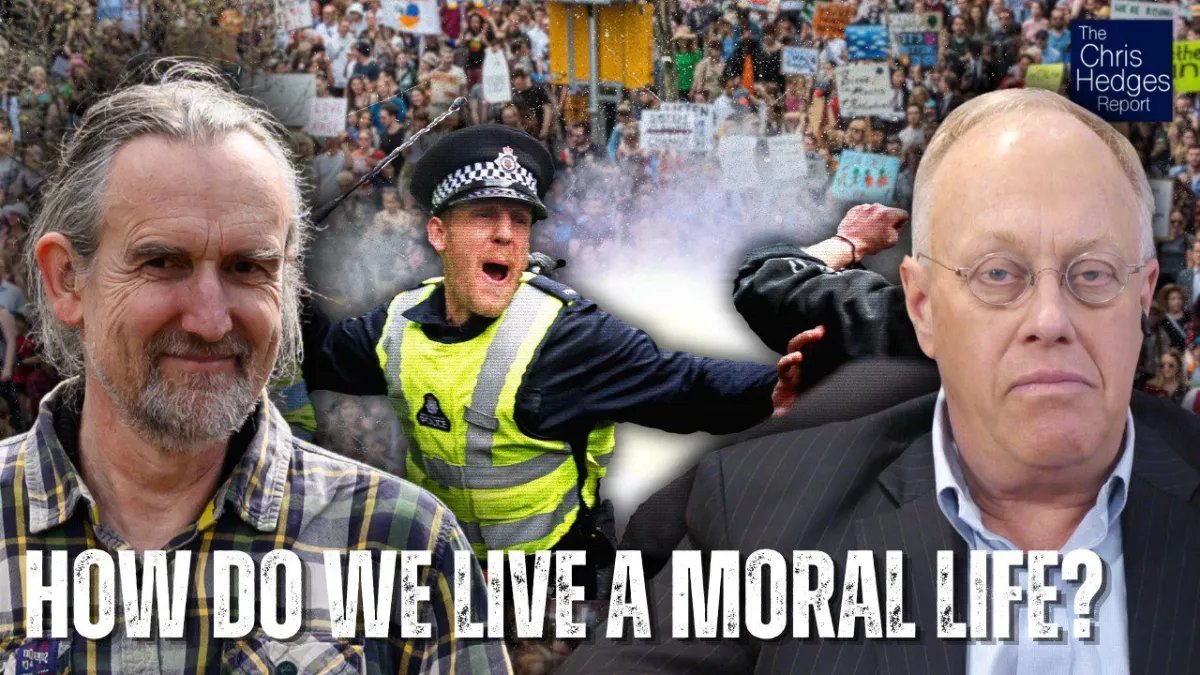
We are living in an age of climate collapse, which will most likely result in mass displacement and death, warns Roger Hallam, co-founder of Extinction Rebellion in the United Kingdom on this episode of The Chris Hedges Report. . And while that reality is hard to accept, it is an honest assessment of what lies ahead that must be addressed as we decide how to navigate what Hallam calls humanity’s “darkest hour.” In his new book, “Suicide: The Political and Legal Implications of Creating Endless Mass Death,” written while he was in prison for climate action, Hallam shares his background in academic sociology and organizing for social change to provide tools for resisting under the current repressive legal and political systems.
People often respond to repression with greater courage and resolve to resist it. Hallam’s experiences in prison and elsewhere taught him that “we always have that opportunity to choose how we’re going to react and how we’re going to live our lives in response to the involuntary hell that’s imposed upon us by the powers that be.”
Hedges and Hallam explore the ways that societies can fracture as they are collapsing, tending towards violence or hedonism. Some people may “retreat into crisis cults” as demonstrated by the growth of the Christian Right in the United States. They emphasize the necessity of a form of spiritual or moral grounding that transcends the individual and awakens our sense of connection, of being part of something greater than ourselves, of being willing to ask difficult questions and to make sacrifices. It is through organizing and collective action that people can confront the power structure effectively and build a different society.
Finally, Hedges and Hallam analyze the state of social movements and what it takes to create a popular revolution. They call out the liberal class, including mainstream climate organizations, that “perpetually undermines the ability to bring along the objective revolutionary conditions, which are strategically and ethically undeniably necessary at the present time.” They point to the dire need for revolutionary demands and prophetic leaders who will guide social movements. In the end though, Hallam points out that social transformation is the result of door-to-door organizing in our communities, building support systems and challenging power in the streets.
Chris Hedges
Executive Producer:
Max Jones
Intro:
Margaret Flowers
Transcript:
Margaret Flowers
Crew:
Nawelle Mouihi
Chris Hedges: From a cell in Wayland Prison, Roger Hallam, co-founder of Extinction Rebellion and Just Stop Oil, while serving a five-year prison sentence, wrote his book, “Suicide: The Political and Legal Implications of Creating Endless Mass Death.” It is a searing indictment of a legal and political system that is designed to punish those who resist, while protecting those who propel us towards mass extinction.
In the age of climate collapse, telling the truth has become a criminal act. He and his four co-defendants, who each received four-year sentences, were convicted for hosting a Zoom call in 2022 to organize activists to climb onto bridges over the M25, the main motorway that circles Greater London. The short-term aim was to stop traffic. The long-term aim was to force the government to stop new oil and gas licenses. This was not a symbolic protest, exemplified by protesters hurling tomato soup at Van Gogh’s sunflowers preserved by protective glass in the National Gallery in London. It was a protest designed to disrupt, as it did, commerce and the machinery of state. Although even the protesters who tossed soup at the painting, which was not damaged, received harsh prison terms of nearly three years, Roger, like a reviled biblical prophet, warns that we are already experiencing fundamental shifts in climate patterns that are destroying the foundations of human society. Our infrastructure and social structures are increasingly based on climate models that no longer exist. Seas are rapidly rising, tens of millions of people once considered safe from coastal flooding, are now considered at risk. Global warming has nearly doubled in only a decade. Ocean overheating is accelerating. Over a two-year period, ocean heat waves with temperatures up to three to five Celsius above normal lasted for 500 days nonstop, covering ninety-six percent of the world’s oceans. Antarctica is undergoing the fastest glacier collapse ever recorded. Thawing permafrost is belching out greenhouse gases.
“If greenhouse gas emissions are not reduced by 50% within the next six years, by 2030,” Roger writes, “average global temperatures will exceed 2 degrees Celsius, displacing an estimated 1 billion people. That’s 20 times the number of homeless at the end of World War II, amounting to one in eight people on Earth. There’s a fifty percent chance the Atlantic Meridional Overturning Circulation will collapse by 2050, causing temperatures in Europe to drop by ten to thirty degrees Celsius. The Arctic is expected to be ice-free in summer between 2030 and 2035, and by 2040, forest fires may destroy twenty percent of woodland annually. This is just the beginning.”
Joining me to discuss the climate crisis and his book, “Suicide: The Political and Legal Implications of Creating Endless Mass Death,” is Roger Hallam. So, Roger, as you know, I wrote the foreword to this book. So, I have to be upfront about that. It’s a great book. I wouldn’t have written for the foreword if it wasn’t. When I was in London, of course, I visited you in prison. I wondered how that prolonged period in prison changed your perspective, if it did, not just on your social role, but also on British society.
Roger Hallam: Well, yeah, I was in prison for about fourteen, fifteen months and then I was in prison on remand for about four months. So, I’ve been in and out of prison basically for three or four years now for various matters. I mean, how it’s affected me is I’m just a lot stronger. And people might think that’s peculiar or unusual, but I don’t think it is. I think there’s been a recent study come out that people who’ve been to prison, and about 250 people have been put in prison in UK, so that’s the equivalent of 1,500 plus in America, if you take in the increase in population. The study showed people come out more committed, not less committed. And there’s reasons we can discuss why that’s the case. But it certainly gives you a visceral sense of what an authoritarian state looks like now and in terms of doing action on the mass death projects that we face, we’re already in an authoritarian state in the UK and obviously similarly in America.
Chris Hedges: I remember Craig Murray, he’d spent much less time in prison or jail than you did, but I remember when he got out, he told me he was just stunned at the bankruptcy, if that’s the right word, of the kind of lives that many of those who were incarcerated led – the lack of opportunity, the poverty, the even illiteracy. It may not have come as a surprise to you. I’m just curious whether it gave you a window into this rapidly expanding social inequality, which defines certainly the United States and the UK.
Roger Hallam: Yeah, I think it does. It didn’t particularly surprise me or strike me this time. It’s the seventh time I’ve been in prison. I went to prison in the 1980s when I was 19, 20 for the peace movement. So, I’ve had plenty of experience with the British class system, let’s put it like that. And British society has been characterised by extreme inequality for centuries. And that’s sort of baked in, I suppose. I think what we need to understand though is that people have the opportunity and the courage to deal with their circumstances. Not always, of course, and often terrible tragedies and great injustices happen in prison, as you of all people are aware, Chris. But at the same time, people get on with their lives, and people are capable of taking control of themselves and living with some dignity in spaces of extreme provocation and deprivation. And I think this is what we need to understand.
As you know, I have a generally positive attitude of the human. We are capable. We’re not just pieces of dead matter that get hit on the head. We are capable and very capable of fighting back, both internally and externally, and otherwise history wouldn’t happen as we know. So, for me, it was a place of reflection really and admiration really for some of the guys that I was incarcerated with.
I was on a corridor with people, “Lifers,” as this they call them in the UK. I don’t know if that’s the word in other places, but you know, people that been sent to prison 25 years plus. So many of these people had done terrible things. No two ways about that. But many of them had decided they were going to live their life anyway. And they were very spiritually solid. Not all of them of course, but a lot of them were. And this for me was a lesson that whatever the bad guys do to us, we always have that opportunity to choose how we’re going to react and how we’re going to live our lives in response to the involuntary hell that’s imposed upon us by the powers that be.
Chris Hedges: You have long made this point, which of course is correct, that you have the what’s called the liberal wing of the political establishment that will acknowledge the reality of the climate crisis, but essentially do little to nothing, perhaps symbolic gestures, and then you have the Trump-like climate denialists, but both sides of this political equation are dangerous. Explain.
Roger Hallam: Well, I’m with Martin Luther King, as you know, Chris, right? The enemy is the liberal moderates, not the Ku Klux Klan, as per the letter from a Birmingham prison. And I don’t mean that in some provocative way just to get attention. I mean it from the heart of my being that what makes me furious beyond words is not the evil people in the world. There’s always evil people in the world, as various people have said. The problem is those people that facilitate that evil in full-in knowledge that it is evil and pretend to be good while they do it, right? And this is the liberal class. And this is the class that perpetually undermines the ability to bring along the objective revolutionary conditions, which are strategically and ethically undeniably necessary at the present time, given the objectivity of the number of people who are going to die in the next 20, 30 years due to the whole shit show of things that are going to be brought down upon us that everyone listening to this knows about, right?
The problem is the lack of leadership, the lack of revolutionary leadership, which will call out the liberal class and make clear that if people are not going to die, then they need to join together to create a revolutionary movement. And again, I don’t mean that in some romantic put a poster on your wall way. I mean in the classical 20th-century civil resistance way, right? Of having a leadership structure, having a mass organization, having an explicit strategy of regime change and having a rhetoric of rage and determination. And until we get those things in place, we will be continually sabotaged by what I would call the administrative class, you know. And I’ve recently been mobilizing in inner city London and this is the problem, right? There’s so many people that are furious, like just about everyone that you speak to, and I’ve knocked on the doors of thousands of people in the last eight months. The problem is that all the vast majority of the campaign spaces, the vast majority of the deliberative spaces are basically controlled by this administrative class, which exists to prevent any collectivization of resistance. And as soon as you do that, they’re down on you, right? And they use various methods to make sure you’re not successful. And that’s the problem.
I’m not interested, as you know, on coming on podcasts and saying how bad Donald Trump is. It’s like we’ve done that. We’ve been there. What we need to do is organise. And we need to understand how you organise. And we’ve got a 200-year tradition of organising since the French Revolution. And we need to start being humble enough to realise people in the past used to do it a lot better than we did. Rather than thinking we can just mess around on social media and such like these are. Anyway, there’s a bunch of things to be discussed there, I guess.
Chris Hedges: Well, I think you have pointed out quite astutely that this organization requires that you show up, that you invest significant time in speaking to various groups in programs of education. That it’s not done online. That it’s done through personal connections, and that it’s labor and time intensive.
Roger Hallam: It is, and there’s no sort of mystery about why that is the case. Humans are functions basically of what’s happening around five meters around them at any one time. In other words, what the other humans are doing within your immediate space. And I did years of research in academia about this before I co-founded Extinction Rebellion. And I’m not saying anything unusual, there’s 40, 50 years of psychological research. Individuals don’t read books and then decide to do A. What they do is they talk to people who they respect and if they are doing X, they’ll do X as well. And if they’re doing Y, they’ll do Y. So, people can be enormously courageous and enormously evil, depending upon what’s happening around them. So, the role of the revolutionary is to design those spaces. We don’t need to talk about individuals, we need to talk about spaces and dynamics.
There’s different units of spaces. What you say to people on the doorstep. What you say to people in assemblies. What you say to people in interviews like this and such like. And they all need to come together. And the big message needs to be if we don’t join together, we’re going to die. And I mean that literally, right? I don’t mean you get together and say, “Hey guys, we’ve got some problems, and Trump’s a terrible person and various like abstract nouns.” We need to say, “You are going to die. And your death is going to be appalling. And you need to go through your dark night of the soul and come out of the side and become a mature human being, like millions and billions of people were in the past, who confronted the same situation.” This is nothing unusual in the human experience, as you know.
What’s unusual is we’ve had 30 years where we’ve fooled ourselves, do we don’t face mass death? And now we do because we’re in 2025. So, it’s a matter of getting over ourselves. And this is the role of prophetic leadership. And there’s not enough prophetic leaders out there because that sort of function is not valued. There’s this idea everyone will spontaneously join together, they won’t unfortunately. Which doesn’t mean I’m justifying some patriarchical, traditional, top down, crap leadership sort of model. What I’m pointing to are the great leaders of the past who stood up and died for the cause, as we know, which is what usually happens. But again, that is not a problem.
If I had thirty years of saying, “We don’t want leaders because they end up getting shot.” Well, obviously they end up getting shot. That’s what the life of the human involves is sacrifice. We haven’t ended history. We’re still in the midst of it and we’re about to come to the final chapter of it. And one of the reasons we’re going to fail is because we pretend the old logics don’t apply, which is, you live a good life and if you get shot, so be it. That’s the way we need to approach the future.
And that’s not going to happen unless people act like me and you, Chris. We’re one of the few people in the Western world that gets up and tells people. And this is what Larry Kramer did, who I think is the most important American of the last hundred years, not Martin Luther King. It’s Larry Kramer, who got up and said, “Get out in the streets, otherwise you’re going to fucking die.” And he said it again and again. And as you know, he turned around the campaigns against AIDS and the obscenity of what was happening in in the late 80s with gay guys dying in corridors. He turned that around. How did he turn it around? By getting fucking angry. It’s not complicated. You just need to get a grip and do what you need to do, really.
Chris Hedges: Is there a parallel between the faster we move towards ecocide, the harsher the repression becomes? That certainly seems to be your experience.
Roger Hallam: Yes, it is, but we take the wrong message from that. We take the materialistic capitalist message, which is life isn’t an accounting system, and you’ve got ten dollars, Chris, and I take five from you and you’ve only got five left. This is what the Left does all the time to get colonized by neoliberal capitalistic logics. If you get put into prison, it doesn’t mean you’ve lost five dollars and you’ve got five left. It means whatever you want it to mean. You see what I mean? Humans are not accounts. When the neoliberal liberal left says, repression is really bad because that means people cannot rebel, not only are they betraying the essence of what it is to be human, they’re just talking empirical bollocks, as you know. History is absolutely full of societies becoming more authoritarian. And because they’re more authoritarian, people rebel, not despite because it’s an obscenity. I mean you’ve got Trump in America and what are the numbers? Like five, ten million people have been out on the streets. Why’s that? It certainly isn’t because of the repression, despite the repression, it’s because of it, isn’t it? People didn’t all rush indoors in Minnesota going, “Dear, there’s a chance I might I might lose my liberty or whatever.” They were going, “Fuck this, let’s go,” because some things are more important, right? Which is self-respect and all the rest of it.
Chris Hedges: How do you see the movement moving? We have had movements that embrace this kind of radical response, confrontational response, essentially become domesticated. Most of the environmental movements, the mainstream environmental movements, Sierra Club and all already have. But how would you kind of judge or explain the health of our radical movements in terms of confronting power?
Roger Hallam: Well, I think we’re in the darkest hour before the dawn. That’s my analysis. I think the state of the radical movements is massively immature in the presence of the objectivity that we face. But the important thing to understand is this is nothing new.
There’s a cycle of resistance in response to repression. And you can have a cycle of resistance and then everything collapses because you can’t keep that level of energy up for a long time. And what we’ve got now is in many ways like the last spasm of denial, right, before it becomes absolutely obvious what’s going on. In the words of a university professor, whose name I’ve forgotten, he was on social media last week saying, “Everything won’t change until white people die.” And this was a professor from an elite university, right? Obviously, he was retired. He wouldn’t say that if he was in a job. But that’s the fundamental tipping point, as we know. And white people will start dying. Obviously, I’m talking about rich white people here as well. They will start dying because the climate crisis is a suicide prospect, which is why my book is called “Suicide.” My book isn’t called, the ruling class are going to do us in and they’ll be fine and we won’t.
Chris Hedges: They think they’ll be fine. Don’t they?
Roger Hallam: This is a unique moment in the human experience because since 1945, you’ve had the capacity to destroy every human on the planet. It’s not like previous ruling classes were worse than this one. Obviously, they would have destroyed themselves as well. The point is this ruling class will destroy all of us and also they’ll destroy themselves. And by ‘destroy’ I mean we’re going extinct and they will go extinct. And, we can have little obscene conversations about whether a few of them survive in the bunker for a few decades, but that’s not the point. The point here is that the whole way our civilization sees reality is intricately combined with why we’re going extinct.
And what we need is a fundamental new way of seeing what it is to live a human life. And this sounds ridiculous at the moment because we’re at the darkest hour before the dawn, but I can a hundred percent guarantee that in ten years’ time there’ll be a revolution in the ways in which we see the nature of our civilization, in the ways that prophetic explosions have happened at times of extreme distress in human history. There’s nothing unusual about this. What’s happening at the moment is it’s like we’re having the last dance in Hitler’s bunker before the Russians arrived, you know what I mean? That’s the logic that’s being promoted by the liberal left, and in the conservative spaces is, let’s forget about reality for another ten years, pretend, and then we’ll have to deal with death.
Chris Hedges: And yet there are movements within societies that face imminent death – the ghost dance or something – where people retreat into crisis cults. I look at the Christian Right as a crisis cult. You unplug yourself from reality. You embrace magical thinking. That’s also a phenomenon of an overwhelming existential crisis.
Roger Hallam: Yes. I mean, as you know, I’m not some madman, Chris. This is going to happen and it’s all really straightforward. I’m a sociologist, as you know, right? And it’s not complicated. This issue is not complicated. It’s emotionally appalling, but analytically it’s not complicated, which is in times of massive distress, a society will fracture along several key lines. One of them is towards internal destruction – personal suicide, nervous breakdown, domestic violence. Another fracture will go towards external hedonism – live now, forget the future. And another element will go into some form of collective cult-like behaviour or some fascistic worship of death, which is what fascism basically is. And the last fracture will be the fracture that turns towards the prophetic love of life and the human. And obviously, it’s the last one that we’re putting our bets on, right? But it’s naive to think that the others won’t exist. The point is everything will be up for grabs.
And any of those fractures could become hegemonic. But no one can predict beforehand how it’s going to go, right? That’s the point. But what we can predict with absolute certainty is the centre will collapse. And it is collapsing. It’s a zombie space already, as we know. It’s only there because of institutional support. So that’s the prospect in the next two decades.
Chris Hedges: Let me ask a little bit about the climate crisis itself. As it accelerates, you, of course, see the solidification of climate fortresses. This is what Europe is doing. What the United States is doing, essentially locking out those who are fleeing northwards. Talk a little bit about the crisis itself and the increasing pressure it’s bringing on human societies.
Roger Hallam: Well, first of all, we need to deal with the liberal left idea that the climate crisis is complicated, right? There’s lots and lots of talk shows and podcasts about the climate crisis and what’s communicated is this is just a vague idea. There’s nothing vague about putting CO2 into the atmosphere. There’s three facts we need to just establish, and then we can just move on to what’s going to happen on the human scale, right? We’re at 1.5. No one can dispute that. We’re going up 0.4 per decade. So, we’re going to be hitting 2 around 2035, maybe a bit before, maybe a bit after.
At 2 degrees, we trigger all the tipping points in the Earth system. Again, maybe 1 or 2 will be earlier, maybe 1 or 2 will be afterwards. That will create runaway climate collapse. Everyone knows that. That means we’ll go up to 2.5 and 3 and 3.5 and such like. And once we pass 2 degrees, a quarter of the world’s population will be on the move. Again, not immediately, not all of them, but who’s counting, right?
As you said in the introduction, that’s two billion people. That’s two billion people on the go. And in the future decades, it will rise. There is a get out clause, which is revolution that collapses the carbon, which is why I am revolutionary, because that’s the only way out. And then there’s a technological fix, geoengineering and such like. So, it’s not a hundred percent guaranteed that we’re going extinct, but we have to accept that’s now the main scenario, because it’s quite difficult to have a revolution and there’s no guarantee geo-engineering will work. But if you want to be a realist out there, if someone’s listening to this and they think, “Okay, I’m a realist,” then you have to be a revolutionary and you have to consider geoengineering. That’s it. And obviously added onto that we’ve got AI and nuclear war and various sort of wild cards. But this isn’t a wild card, it’s physics. It’s like you drop a ball and it drops to the ground, right? You put CO2 into the atmosphere, it warms up and we’re at 1.5 and we’re going to reach 2.
So, once we’ve got that established, then we can look up what it means to have a billion people on the move. And we know what that looks like because 50, 100 million people were on the move in World War II. And basically, it destroys the world economy. That’s the first thing to say. There’s going to be no pensions. The second thing to say is unless there’s a revolutionary religious transformation, there’ll be genocides of a scale many, many times greater than what happened in the 20th century because we know what fascists do is they kill the outsider. And that’s what’s coming down the line. And they’ll kill those who try and prevent it.
So, we’re going into a period of history where unless we do something fundamental with ourselves and our society, we all plunge into the greatest spasm of horror the human race has ever experienced. And it’s super important that people don’t avoid that, because the only way we’re going to avoid it is by facing it, which means facing up to death. And this is why I’m spending more and more of my time talking about religiosity in the widest sense of the word that unless you come to face what it is to be a human, i.e., a conscious entity that’s going to die, and accept that reality whenever it’s going to be, you’re never going to grow up and be able to be fully human in the face of horror. And it’s entirely possible to do that, right? But it’s not going to happen by avoiding the realities that we face. And this is difficult, to put it mildly, but it’s not impossible.
Chris Hedges: Well, consumer society is completely oriented towards the fantasy of eternal youth. I mean we’re fighting against a culture that essentially does everything it can to mask or hide the fact of our own mortality.
Roger Hallam: Which is why we’ve got a massive mental health crisis because the mainstream culture is saying, “You can live forever.” That’s the subliminal message. I know we sort of know that in actuality, but that’s the message, the idealization of youth, the idealization of life without death, which is a contradiction in terms, obviously. And then we’ve got the reality, which is people below 30 are facing a slow death by starvation and death in social breakdown and all the rest of it. And the solution to that is prophetic witness, as it always was in the past. And this is why the new movements that are going to emerge, which are going to be in a position to actually concretely deal with the crisis materially and spiritually, have not yet been born, to be honest with you, Chris. They’re going to come out of the edges of the social space.
And the reason I come onto shows like this is not to talk to the ninety percent. I’m talking to the one percent of people who have at the back of their mind that they’re going to be the people who are going to provide the prophetic witness. And there’s nothing wacky or weird about this. I had a chat with Paul Engler, you may know, who’s one of the most skilled movement organizers in the States, and we both compare notes every now and again because I do similar work in Europe. And we both agreed. The single biggest determinant of movement growth is prophetic leadership. You need someone to go around and say, “You’re going to fucking die. Get out there.” You don’t want people to start giving you facts and figures. When I do talks, I do that, what I’ve just said. It takes two minutes to tell everyone where we’re up to. After that, the key question is how do you want to live your life? The key question isn’t what are we going to do? That’s like a machine question, right? You know, Lenny was a machine revolutionary. It’s like, no, the question isn’t what are we going to do. We’re not dealing here with a broken car engine. We’re dealing with a spiritual being called the human and the key question is how are you going to live your life? And the great thing about that question is, it doesn’t matter what the outcome is because the outcome is above your pay grade, as we all know. It’s only like humanist arrogance that thinks we control this world. We most certainly do not control this world, which isn’t to say we shouldn’t give up a good life. But the reason we live a good life is because we believe in the good. And if you don’t believe in the good, you get mentally ill.
It doesn’t take long to put your ducks in a row. You know what the ducks in a row look like, Chris, right? And many of your viewers and listeners know what having your spiritual ducks in a row looks like. But someone needs to go out and talk about this rather than why the rich are terrible and all the rest of it. Obviously, the rich are terrible. People don’t need to be told the rich are terrible. They’ve known that for the last 5,000 years. What they need to know is what is it to live a good life?
Chris Hedges: Well, you mentioned the word religiosity and I know that that’s important to you, as it is to me, not in an orthodox kind of way, but I think it is vital for a successful movement where one is judged not by the outcome finally, but by one’s integrity and commitment to justice and I wondered if you could kind of flesh that out.
Roger Hallam: Yeah, well the first thing to establish is orthodoxy, as you called it, is what secularity is imposed upon us. Like the whole idea of religion is a modern concept, as I think you know, and many of your listeners may know. The word religion didn’t come in until the modern period. Before the modern period, the notion of religiosity, as you might say, was impregnated in all aspects of life. And what modernity did, what secularity did, what the capitalist regime did, is stick religion as a noun and stuck it as something that happens on Sunday and some weird belief in some concrete other called ‘God’. Right? That’s nothing to do with religion. That’s like what secularity has done. And the tragedy and the appalling criminality of secularity is to prevent people engaging in the sense of the transcendent and the enchantment of what life is, because they’re told that’s child’s play and all the rest of it, and it’s some weird belief, as if secularity and modernity isn’t a belief itself, right? The outlier is modernity. For 99% of the human history, people have believed in transcendent phenomena or the transcendent within the material, and other related ideas. And even in today’s world, for the sake of argument, 80% of the world’s population is aware there’s something other than going out and making money. You see what I mean? Like we need to understand there’s history here, just as there’s history in imperialism and there’s history of the oppression of common people, there’s also the history of the stripping of a sense of the transcendent from culture. And this is the primary reason why we are not resilient, why people burn out because they think they’re just themselves. But being just yourself is just some weird cult idea of Newtonian physicists. It’s obvious that we’re not just on our own. We’re part of some universal thing that’s beyond words. And just because something’s beyond words, it doesn’t mean it doesn’t exist. Just go and read some quantum physics, for God’s sake. You see what I mean? So, we need to start battling back, and this is a big battlefield, of saying it’s obvious and it’s natural and it’s absolutely needed that we start understanding what it is to be who we are, which is to be part of something greater than what we are, because that’s objectively what we are. It’s not some postmodern whim, it’s a reality. We are objectively part of something bigger, and we always are and always will be. And once we start engaging with this, and I’ve got great hopes that the younger generation, younger 30s, are ready for this because it’s intolerable to live in a world where there’s just you on your own. So, people will be looking for it. And if we don’t provide a progressive pro-social orientation of what the transcendent is, we know what will happen is the Nietzschean Nazi space will come and gobble everyone up and get everyone to worship death and destruction as some sort of perverted form of transcendence.
So, the race is on, but the idea this is just about inequality that the secular left is just appallingly self-sabotaging. People need to believe in something greater than themselves. And it’s already there, right? I mean better people than me, no doubt, will design what that looks like over the next 20 years. But there’s absolutely no question that we’re not going to win by pretending we’re dead matter because we’re not.
Chris Hedges: So just to close, ideally, what does this revolution look like? How is it built? How does it come about? And how are the ruling global elites dethroned?
Roger Hallam: Well, first of all, by not asking the question. I mean, if you ask the question, Chris, without doing the spiritual work before you ask the question, you’re going to burn out in six months. This is why Gandhi said you have to go and like do self-purification before you go into battle. Everyone does this for the last 2,000 years. You can’t send your troops into battle thinking you’re going to hit the left wing and then the right wing and then do X, Y, and Z. First of all, you have to pray to God. The praying to God is the important bit, right, because that gives you the courage to do everything else. So that when it looks like you’re losing, you don’t turn and flee, because if you do, then everyone dies. I mean obviously that’s the military version of it, but there’s a nonviolent Gandhian version of it as well. So, as I said, the first question is to ask the question with other people in some form of collectivity, in an assembly, what do we want to do with our lives? What are our obligations to our parents and our children? What’s our obligation to our countries? What is it to be good? Those are the key questions. Only when you’ve spent a decent amount of time asking those questions and you’ve got a practice that reintroduces you to those questions on a regular basis, can you then go into battle?
And when you go into battle, then there’s a few basic rules, right, which is to concentrate all your resources in one time and space. In other words, you have to create a mass collectivity. You have to elect or choose who your leadership, your generals will be, who will go, “Go there. We’re going to go to Washington on the 2nd of October. We’re not going to go to Washington a little bit in September and a little bit in November and a little bit in December.”
Someone needs to make the big strategic decisions, and you need to choose wise people to do that, obviously. But you can’t avoid that. And then, once you go into battle with the powers that be, then you need to have a positive message of what you’re going to do afterwards. You can’t have all the neoliberal civil resistance movements of the last 20 years that overthrow some dictatorship in Egypt or Ukraine and then just reinstitute liberal capitalism, which morphs into monopoly capitalism. You have to have a fundamentally revolutionary demand. And that revolutionary demand is sortition, which is the original meaning of democracy, which is people selected randomly from the population in order to make the decisions of the society, which is what they did in Athens and what they did in Florence, right?
It was only the last 200 years we’ve got this perverted idea that voting in elections was democracy. It’s not. That’s aristocracy. It’s oligarchy. And you only need to look at America to see how it works out. So, we’ve just been told a big lie that we’ve got a democracy, we haven’t. But there’s no point complaining and trying to make voting better. You need a whole new system, which is you select people by sortition randomly. So, 70% of the people in the decision-making assemblies are working class people because 70% of people in the population are working class or whatever you want. And that’s a whole new other discussion, of course, Chris, right? But the point is that’s the revolution for the 21st century. And unless you make it explicit, then people obviously degenerate back into liberal logics and then you’ll have fascism because obviously there’s no point voting for the Democrats or the Labour Party. It just facilitates a bigger fascist surge next time round. And this is why you need strategic and prophetic leadership, otherwise people will go, “Yeah, let’s give the Democrats one more chance.” Like those days have gone. Haven’t they?
Chris Hedges: Yeah. Well, they went a long time ago. But the liberal class is quite good at herding people in every election cycle back into the dead embrace of the political system. I mean that’s probably why they’re there.
Roger Hallam: Yeah, which is why, if you want to talk concretely, after you’re doing your spiritual preparation, what do people do? You need to organise in your communities. Simple as that. And everyone thinks this is a hard grind. Obviously, it’s a hard grind. But also, it goes nonlinear at a certain point. Like in the community that I’ve been organising, we organised about five or six of us, three or four nights a week and then we started a community campaign, and we had twenty, thirty percent name recognition within six months. This is my day job, right? It’s not like I’m making this stuff up. My day job is how to organize mobilisations, but that’s what needs to be done. There’s no point going to conferences or sitting on social media. That’s just going to let the fascists win because the fascist strategy is to get out into communities and organise those communities. And if you don’t organise them, then the fascists will organise them, and this is one of the biggest problems with the secular left is they don’t actually like human beings, right? You know what I’m saying? I mean you need to decide whether you’re a Democrat or not. If you’re an elite anti-human leftist, then fair enough, but at least be honest about it. And if you actually genuinely love the common people, you need to go out and talk to them, for God’s sake. You see what I’m saying? You need a hundred thousand American young people to do a big freedom summer, which is spend the summer knocking on the doors of working class districts, listen to people, get them into assemblies, allow them to create their own political realities like Paulo Freire did in Brazil, and then put their candidates up, organize mutual aid projects, organise local campaigns, aggregate them, build a mass movement, and then off you go. It’s really not rocket science, right? Sitting around moaning about it is just like a suicide strategy, as we know.
Chris Hedges: Right. Thanks, Roger. And I want to thank Max, Thomas, and Nawelle, who produced the show. You can find me at ChrisHedges.Substack.com.
Editor’s Note: At a moment when the once vaunted model of responsible journalism is overwhelmingly the play thing of self-serving billionaires and their corporate scribes, alternatives of integrity are desperately needed, and ScheerPost is one of them. Please support our independent journalism by contributing to our online donation platform, Network for Good, or send a check to our new PO Box. We can’t thank you enough, and promise to keep bringing you this kind of vital news.
You can also make a donation to our PayPal or subscribe to our Patreon.
Please share this story and help us grow our network!
[ad_2]
Source link
