
[ad_1]
Israel’s recent decision to formally recognize the World War I-era Armenian genocide deserves a skeptical eye. After decades of silence, the Netanyahu government’s vote to recognize the Ottoman Empire’s atrocities is less a belated act of moral clarity and more a calculated move to isolate Turkey by weaponizing a historical tragedy. (The resolution still needs to be ratified by the Knesset.)
Foreign Minister Gideon Sa’ar framed the gesture in lofty terms: “It’s never too late to do the right thing… Thus, Israel joins 32 countries that have fulfilled a moral duty by recognizing the historical truth, and rejecting attempts to deny it.”
For decades, successive Israeli governments avoided this recognition. It was a matter of diplomatic maneuvering, the roots of which lie in Israel’s “periphery strategy”—the historic doctrine that sought to balance the hostility of Israel’s immediate Arab neighbors with an outreach to moderate, non-Arab Muslim states.
Kemalist Turkey was a key pillar in that strategy, alongside Iran during the time of the Shah—hence Israel’s refusal to anger Ankara, which does not recognize the Armenian genocide and treats such moves by other countries with heightened sensitivity.
The Iranian Revolution of 1979 and the breakup of the Soviet Union a decade later reshaped Israel’s strategic environment. Revolutionary Iran was increasingly framed as an enemy, while Azerbaijan, on its northern border, with a strong irredentist anti-Iranian agenda of its own centered on the so-called “South Azerbaijan,” emerged as Israel’s new partner. Azerbaijan is also a close ally of Turkey, and since the early 1990s American policymakers sought to boost the trilateral Ankara–Jerusalem–Baku alignment as a counterweight to both Moscow and Tehran.
That Israeli-Azerbaijani relationship has deepened over decades, with Israel providing high-tech weapons that enabled Baku to defeat Armenia over the disputed Karabakh region, in exchange for Azerbaijani oil (covering around 40 percent of Israel’s needs) and an intelligence foothold on Iran’s borders. Baku’s military victory was compounded by the expulsion of the region’s roughly 100,000 indigenous Armenian Christians in 2023. The “moral duty” Sa’ar mentions was conspicuously absent then—according to the Israeli newspaper Haaretz, Israel’s fingerprints were all over this event.
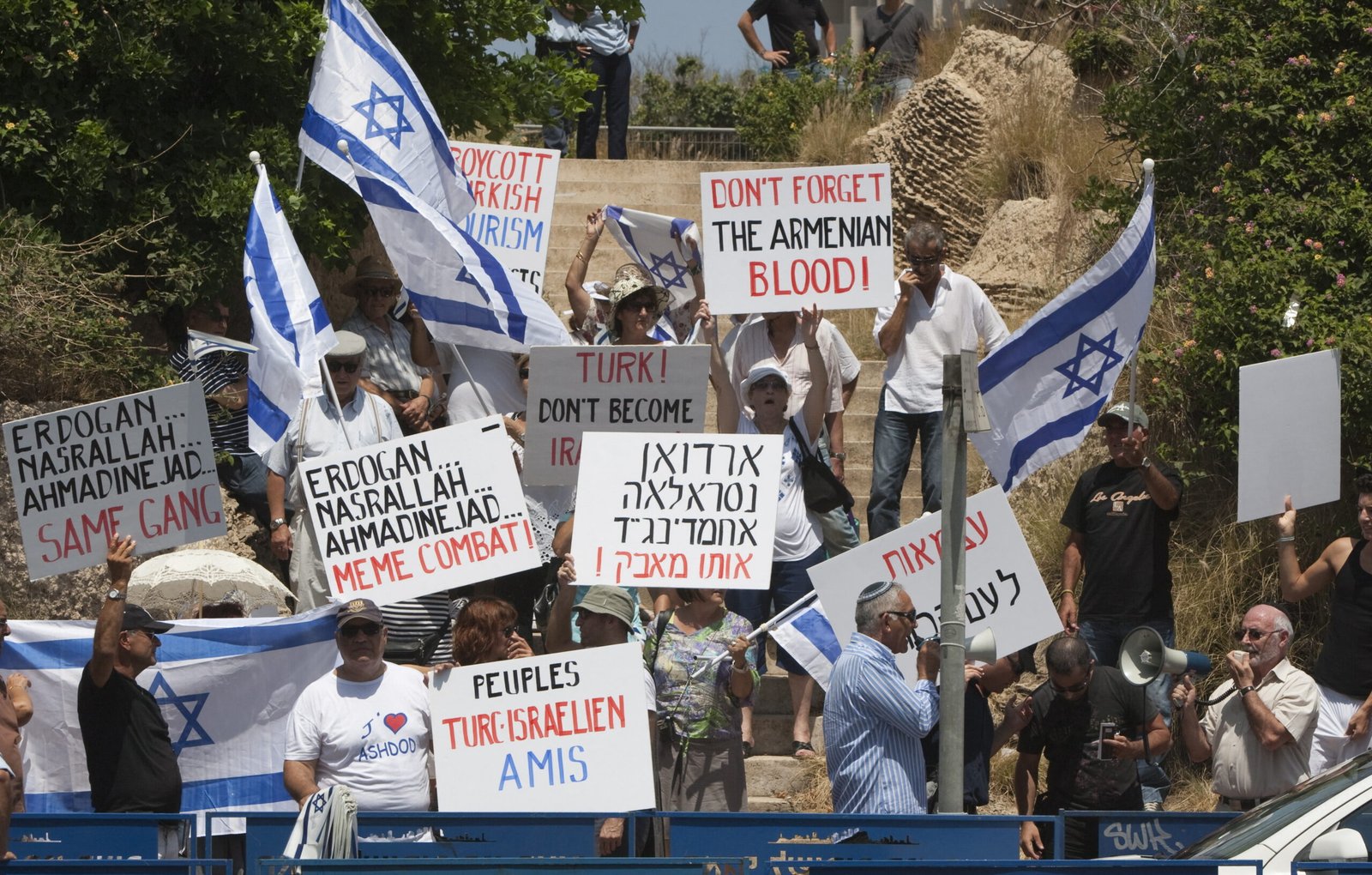
At the same time, Israel’s relations with Turkey nosedived. As Turkey emerges as Israel’s chief critic and competitor in the Middle East, the campaign to inflate Turkish hegemonic aspirations and reframe them as the next existential threat—a “new Iran,” in the eyes of many Israelis— is being aggressively pushed by Israeli leaders and their usual neoconservative allies in Washington, such as the Foundation for Defense of Democracies (FDD). Their playbook is unmistakable: Just like Iran was portrayed, for decades, as the head of a nefarious “Shiite axis,” Turkey is now depicted as the head of a Sunni one—aligned with Hamas, the Muslim Brotherhood, Qatar, and the post-jihadist government in Syria.
Other elements of this narrative include accusing Ankara of exporting Islamism, undermining democracy, weakening the NATO alliance, and oppressing minority groups like the Kurds.
This is the context in which Israel’s recognition of the Armenian genocide needs to be seen. The reactions of the principal regional countries affected are telling. While Turkish President Recep Tayyip Erdogan’s dismissal of the move was expected, Armenia’s own reaction was notably lukewarm. Its recently reelected prime minister, Nikol Pashinyan, who campaigned on a platform of normalization with Turkey, deprioritized the international recognition of the genocide.
Azerbaijan’s Foreign Ministry predictably rejected the move. Meanwhile, the country’s chief rabbi urged the Knesset to rescind the recognition, warning that it could jeopardize the safety of Azerbaijani Jews. In doing so, he unwittingly exposed Baku’s decades-long campaign to showcase its tolerance toward the Jewish community for what it really always was—a ploy to strengthen ties with Israel and the Israel lobby in the U.S.
Even more revealing were the remarks of the former Azerbaijani foreign minister, Towfiq Zulfugarov, whose views often echo the Baku establishment: “I think this is a good reason for us to distance ourselves from Netanyah’s government, given the growing pro-Azerbaijani sympathies among Iran’s political elite.”
That latter claim is dubious—Tehran suspects Baku has facilitated Israeli operations—but his broader point about distancing from Netanyahu is instructive: Israel is becoming a liability for Baku. By launching a war against Iran that it cannot win, Israel has placed Azerbaijan under pressure, as the Iranian drones that hit Azerbaijan shortly after the start of the war highlighted. Now, by escalating tensions with Turkey, Israel forces Azerbaijan into an impossible choice between its strategic partnership with Ankara and its military dependency on Jerusalem.
Predictably, Israel’s move met hostility from Turkey, growing doubts about the future of the relationship in Azerbaijan, and calculated indifference from its intended beneficiary—Armenia.
Israel can’t fall back on moral justification. It cannot claim a “moral duty” to remember the Armenian dead while it armed the very state that just completed the ethnic cleansing of Armenians from Nagorno-Karabakh—and while it faces plausible genocide charges for its own conduct in Gaza.
Subscribe Today
Get daily emails in your inbox
All of this leaves only one plausible explanation: The Netanyahu government is willing to go to extraordinary lengths to antagonize Turkey.
The main audience is not in the region, but in Washington. The endpoint of this campaign is to trigger a U.S. confrontation with Turkey. The same voices that spent decades advocating for regime change in Iraq, Libya, Syria, and Iran are now pivoting to Turkey, all while the Iran file remains unresolved. They seek to drag the United States into yet another endless Middle Eastern conflict, this time with a NATO ally, all to serve Israeli strategic interests.
The United States should resist attempts to be drawn into a confrontation with Turkey. With the Iran War fiasco still not fully resolved, and with fresh memories of failed interventions in Iraq, Afghanistan, and elsewhere in the Middle East, Washington should make it abundantly clear to the Netanyahu government that Israel is free to pursue its foreign policy as it sees fit, but that the U.S. will play no part in any future military adventures in the region.
[ad_2]
Source link
