
[ad_1]
A new executive order claims it is not creating an AI licensing regime. Jeffrey Wernick argues that’s precisely what makes it so dangerous.
Jeffrey Wernick
The most effective systems of control rarely arrive wearing jackboots. They arrive wrapped in reassuring language about innovation, security, and public safety.
In a blistering critique of the Trump administration’s new artificial intelligence executive order, economist and commentator Jeffrey Wernick argues that Washington is quietly constructing something far more consequential than a technology policy: a framework for government-managed access to the most powerful AI systems ever created. Not through outright bans or formal licensing requirements, but through classified thresholds, privileged partnerships, and incentives that make resistance increasingly irrational.
At the center of Wernick’s warning is a troubling reality. The government insists it is not creating an AI licensing regime while simultaneously empowering the National Security Agency to determine—through secret benchmarks—which models qualify as “covered frontier models” and therefore warrant government scrutiny before public release. In Wernick’s view, this transforms the rules of technological development from transparent regulation into something more elusive: invisible power exercised through discretion rather than law.
The result, he argues, is the emergence of a new surveillance-industrial complex, where intelligence agencies, military priorities, and corporate technology giants become increasingly intertwined. Unlike traditional forms of state coercion, this system does not compel compliance at gunpoint. Instead, it restructures the marketplace so thoroughly that cooperation becomes profitable and dissent becomes costly.
Echoing Dwight Eisenhower’s famous warning about the military-industrial complex—and drawing parallels to Edward Snowden’s revelations about modern surveillance—Wernick contends that America is witnessing the formalization of relationships that once operated largely in the shadows. The question is no longer whether government and Big Tech will collaborate, but how much of the future will be shaped behind closed doors before the public ever has a chance to object.
As artificial intelligence becomes the infrastructure through which people communicate, work, learn, and govern, Wernick asks a simple but unsettling question: If the rules are classified, the gatekeepers are unelected, and participation is technically voluntary, how much freedom remains when refusal itself carries a price?
Transcript
They called it promoting advanced artificial intelligence innovation and security. Read past the title. Go to Section Three, paragraph C. Quote: “Nothing in this section shall be construed to authorize the creation of a mandatory governmental licensing, preclearance, or permitting requirement.” Unquote.
Stop there. Sit with it.
When a document swears it is not building a licensing regime, take it at its word that it is not. Then ask why a document that is not building one needed the disclaimer at all. You do not disclaim what you did not do. You disclaim what you did when you would rather it not be called by its name.
So let us name it.
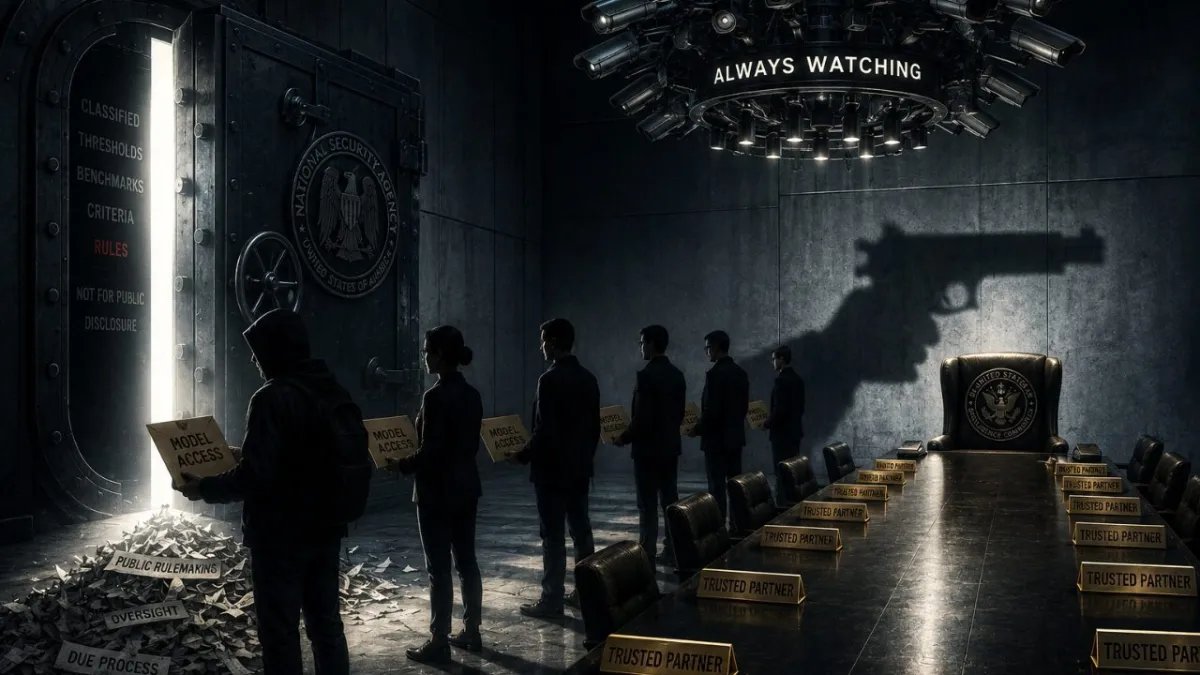
The order creates a category: a covered frontier model. If your model is covered, the government wants in. How do you know if you are covered? You don’t. The threshold is classified. A secret benchmark, run inside the National Security Agency, decides which models count.
Understand what that means: the rule that governs you is a rule you are not allowed to read. You cannot comply with it. You cannot challenge it in court. You can only be told after the fact which side of the line you fell on.
This—this is not a regulation. A regulation is published. You can argue with it. This is discretion, and discretion you cannot see is just power with better manners.
Now ask: Who draws the line? The NSA—an agency whose core craft is breaking into other people’s systems. That agency decides which models in America are powerful enough to matter, and then it gets access.
The text says it plainly: up to 30 days before release, the developer provides the government with the model. The order surrounds that access with confidentiality and intellectual‑property protections. Fine. Grant them every safeguard on the page. The structure does not change. The same agency gets the most capable models in the country in hand before anyone outside the building.
They will call this security. Ask the only question that matters: secure for whom?
Here is the part they wrote most carefully: the government will “collaborate with developers” to select trusted partners who get early access to covered models. Read that slowly. The state helps decide who gets the good technology first.
That is not a market. A market does not have a host. This has a host. This has a guest list. And the government holds the pen.
The order does not say refusal is punished. It does not have to. When the government controls procurement, partnerships, designations, and access, participation acquires a market value. The question is not whether refusal is legal. The question is what refusal costs.
This is how you build a cartel without ever using the word. You do not seize the industry; you pick its winners and let them seize it for you. And every line of it is voluntary. They are proud of that. They say it twice: there is no mandate. There is no gun.
There does not need to be. When you control procurement, you control revenue. When you hand out a “trusted partner” label, you create a market for the label. When the most powerful intelligence agency on earth asks for 30 days with your model, no is a word with a price.
They did not compel you. They made refusal irrational. Understand the difference, because it is the whole design.
A gun is honest. You can see it. You can name the hand that holds it. You can stand in a court and say, I was forced. Compulsion leaves a mark, and a mark can be fought.
This leaves no mark. No gun was pointed. They rearranged the choices until refusal became self‑harm, then let your own interest finish the job. You were not forced. You complied freely, because compliance paid and refusal cost. There is no hand to name. No court hears a case against an incentive. And the consent is not a side effect. The consent is the alibi—because you chose it. They get to say no one made you. Your freedom becomes the proof that nothing was done to you.
That is the most durable power there is: control that the controlled will defend, because they have mistaken the absence of a gun for the presence of a choice.
And notice who stands at the center of it. Not the Commerce Department. Not a civilian regulator. The surveillance agency. The order seats the institution built to intercept, collect, and decrypt at the head of the table, and routes the whole thing through the Department of War, which pays to print it. Civilian technology, hospitals, community banks, local utilities—named right there in the text—all of it on a war footing.
Sixty‑five years ago, a departing president warned the country about exactly this shape. Eisenhower called it the military‑industrial complex: a permanent fusion of the security state and the industry that feeds it, gathering influence no one had voted to grant. He said it from the top, in the open, on his way out the door.
This is the successor. Not steel and missiles, but models and inference. A surveillance‑industrial complex fusing the agency that watches with the technology that will soon mediate everything you read, say, and ask.
And notice who warned us this time. Not a president—a contractor. The man who told you what this apparatus already was did not get a farewell address. He got an indictment and a life in exile. The system that once produced Eisenhower’s warning now produces Snowden’s banishment. That is the measure of how far it has traveled.
What Snowden exposed as a secret program, this order publishes as a partnership. The complex has gone from covert to chartered. They are no longer hiding it. They are signing it.
So go back to the disclaimer—the line that swears this is not a licensing regime. It is not a lie. There is no mandate, no license, no preclearance. On that, the order is honest. That is the part that should worry you.
A mandate can be fought. A license can be challenged in open court. A rule you are permitted to read is a rule you can argue with. This hands you none of that. There is nothing to appeal, because nothing was forced. The threshold stays classified. The list stays curated. The access stays privileged. And everyone who lines up will have done it of their own free will.
A free country writes its rules down and lets you contest them. This order writes the rule in a vault, sends the invitations in private, and calls the result a market. They will not have to compel you. They never planned to.
The only question this order leaves open is: How many of you line up before they ask, “Do you?”
Editor’s Note: At a moment when the once vaunted model of responsible journalism is overwhelmingly the play thing of self-serving billionaires and their corporate scribes, alternatives of integrity are desperately needed, and ScheerPost is one of them. Please support our independent journalism by contributing to our online donation platform, Network for Good, or send a check to our new PO Box. We can’t thank you enough, and promise to keep bringing you this kind of vital news.
You can also make a donation to our PayPal or subscribe to our Patreon.
Please share this story and help us grow our network!
[ad_2]
Source link
