
[ad_1]
‘We didn’t kidnap anyone’, Russia’s then-ambassador to the US, Anatoly Antonov, insisted in 2023. ‘We saved these children’. The ambassador was not simply denying the systematic deportation and forcible transfer of Ukrainian children by Russian occupation forces in Ukraine, a crime for which there is a growing body of evidence from international organisations, researchers, and human rights groups. He was using a well-known playbook – an information campaign seeking to paint the crime as humanitarian rescue.
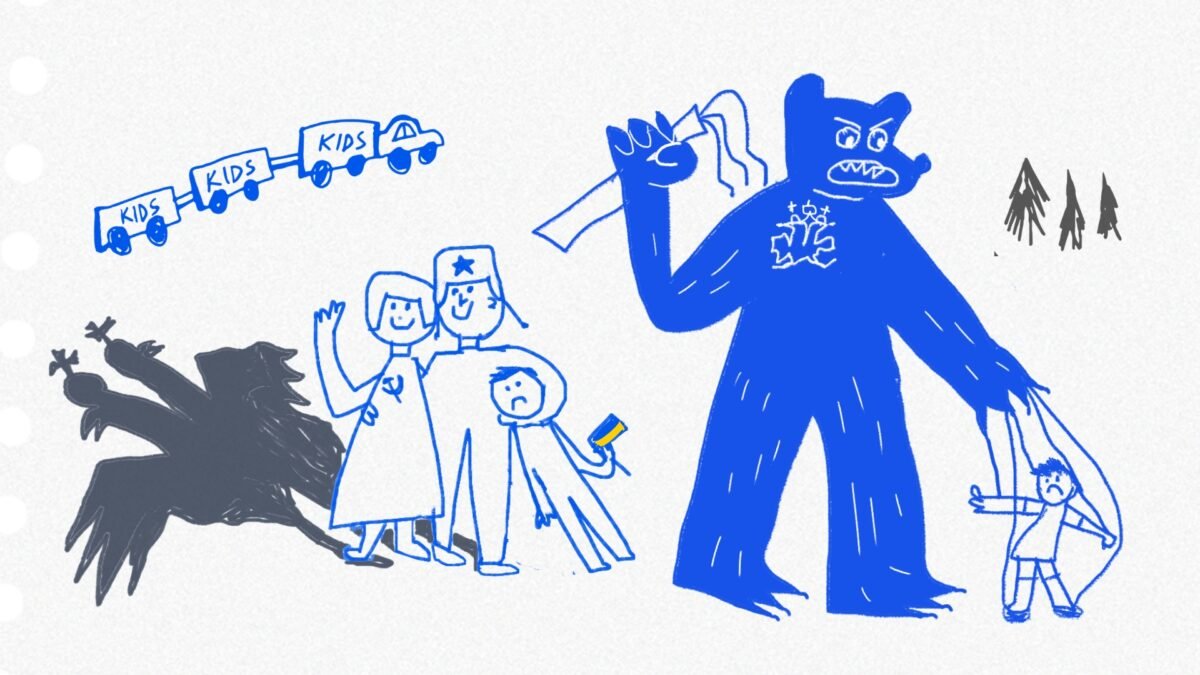
The story of Ukraine’s abducted children is not only about the crime itself. It is also about the parallel campaign to obscure that crime – a sustained effort by the Russian state to manipulate narratives, deny responsibility, and recast deportation as humanitarian action. In Russia’s war against Ukraine, childhoods have been stolen – but so, too, has the truth.
The scale of the problem
The documented forcible transfers of Ukrainian children began with Russia’s occupation of Crimea and parts of eastern Ukraine in 2014. Since the full-scale invasion of 2022, the scale of the problem has expanded dramatically. Estimates say that over 20,000 children have been forcibly deported or transferred from Ukraine to this date.
Under the framework of the Bring Kids Back UA initiative launched by President Volodymyr Zelenskyy, more than 2,100 children have been successfully returned, but many thousands remain separated from their families. More than one million Ukrainian children continue to live in territories under Russian control, where they face constant assimilation pressure, coercion and violations of their rights.
International institutions have recognised the gravity of these acts. The Independent International Commission of Inquiry on Ukraine has concluded that the deportation and forcible transfer of children constitute war crimes and crimes against humanity. The United Nations General Assembly has adopted a resolution condemning the forced separation of families, the imposition of Russian citizenship on children, and the placement of Ukrainian children into Russian foster or adoptive families. And the International Criminal Court (ICC) has issued arrest warrants for Russian President Vladimir Putin and Russia’s Commissioner for Children’s Rights, Maria Lvova-Belova, over the unlawful deportation of Ukrainian children.
But as the evidence has mounted, Russia has responded with a barrage of false narratives aiming to manipulate public opinion and escape responsibility. For example, the Kremlin dismissed the ICC warrants as politically motivated, with Russian state outlets framing the ICC as a tool of Western pressure.
Yet the court’s decision was based on extensive evidence gathered by international investigators. The attempt to discredit the ICC forms part of a broader information manipulation effort to undermine institutions capable of holding the perpetrators accountable.
How the narratives spread
These narratives do not appear in isolation: they follow a recognisable pattern of information manipulation. Claims by Russian officials are first delivered through official channels or press briefings, then amplified by state outlets such as TASS, RIA Novosti, and Russia-1. From there, the narratives spread through pro-Kremlin online networks, Telegram channels, and proxy accounts that tailor the messaging to international audiences.
Different audiences receive different versions of the same story. Domestic Russian audiences hear about heroic evacuations. International audiences hear about humanitarian protection. The aim in both cases is the same – to blur the line between deportation and assistance.
‘Evacuation, not deportation’
One of Russia’s most persistent claims is that Ukrainian children were merely evacuated for their own safety. Russian Foreign Minister Sergey Lavrov and Russian Foreign Ministry spokesperson Maria Zakharova have repeatedly framed the transfers as humanitarian evacuations. Kremlin spokesperson Dmitry Peskov argued Russia ‘saved’ Ukrainian children from the dangers of war. This framing is frequently amplified by state outlets such as TASS, RIA Novosti, and Russia-1 which regularly describe the children as having been ‘rescued’ from dangerous areas.
However, international law draws a clear distinction between temporary evacuation and deportation. Evacuations must be temporary, transparent, and coordinated with the child’s legal guardians and home state. Independent investigators have documented that many Ukrainian children were transported hundreds or even thousands of kilometres from their homes, often without parental consent and with active obstruction of any attempts to return. Investigations have documented networks of facilities across Russia where Ukrainian children have been transferred.
The legal term for such actions is not evacuation. It is deportation.
Another concerning development is the gradual emergence of the issue of abducted children in negotiations on possible prisoner exchanges. International humanitarian law, however, is clear: children are not bargaining chips. But framing children as objects of exchange risks normalising the crime and creating incentives for further abductions.
‘These children are really Russian’
Another recurring narrative seeks to question the very identity of the children involved. Russian officials have claimed that many children taken from occupied territories are ethnically Russian or naturally belong within Russia’s cultural sphere. Such claims are often echoed in commentary on Russian state television and pro-Kremlin outlets.
But identity is not determined by geopolitical claims. Ukrainian children remain Ukrainian citizens, and international law recognises their right to maintain their nationality, identity, culture, and family ties. However, many of the policies accompanying the transfers appear designed precisely to weaken those ties. Russian authorities have introduced measures to fast-track citizenship for Ukrainian children and facilitate their placement in Russian foster or adoptive families.
In camps and educational programmes, children have also been exposed to messaging promoting Russian patriotism while downplaying or rejecting Ukrainian identity. A particularly cynical framing portrays these facilities as benign educational or recreational camps. Russian state outlets have broadcast images of children attending summer camps, participating in activities, and receiving schooling. This is supposed to suggest that the children are safe and well cared for.
But investigations have shown that many such facilities are part of a system designed to integrate Ukrainian children into Russian institutions and narratives. Some children have been placed in programmes emphasising military training or ideological instruction. This raises serious concerns about coercion and indoctrination.
A coordinated international response
Against this backdrop of denial and manipulation, the international response is steadily consolidating. On 11 May, the International Coalition for the Return of Ukrainian Children will convene at ministerial level in Brussels to take stock of progress and agree on practical next steps. The meeting will send a clear signal: political solidarity on this issue is translating into coordinated action. It builds on a Civil Society and Expert Day held in Kyiv on 30 April, which brought together practitioners, researchers, and civil society voices, contributing directly to the Brussels meeting agenda.
While Russia offers fabrication and spectacle, the coalition works with evidence, lived experience, and the testimony of those doing this work on the ground.
Defending truth, and childhood
The ministers meeting in Brussels on 11 May have a specific task that goes beyond political signalling: to treat the Russian information manipulation campaign as a component of the crime, not a sideshow. Kremlin narratives are not mere noise surrounding the deportations – they are the very mechanism by which accountability is deferred and returns of the children are obstructed. Countering them is therefore integral to bringing the children home.
[ad_2]
Source link
