

[ad_1]

“People Mover” monorail, Detroit. Photo: Jeffrey St. Clair.
How did we get here? How can we get out of this mess? From Nixon to Reagan to George W. Bush to Trump, Republican presidents have been getting worse and worse. We can no longer afford to hope that we will be lucky enough to just barely squeak out a narrow victory, election after election. One more victory for the Republicans might mean the end of democracy. We need a political realignment, of the kind that FDR started, or the Congress that Lyndon Johnson used in 1964 to usher in an era of bold government action.
Democrats have been debating the question of electoral strategy for a long time, with the center claiming that not doing what FDR and LBJ did would somehow lead to Democratic dominance, while further on the left, the existence of a set of issues that consistently poll high, such as Medicare for All, seem to show the way forward. Thanks, I think, mainly to the campaign of Zohran Mamdani, affordability has become an issue that both camps can agree on, although they differ in how to achieve that goal.
On the left, the problem of inequality is highlighted, for instance in the Oligarchy tour of Bernie Sanders and AOC, a concept which in turn emerges from the problem of stagnating incomes over the last several decades. Taken together, we have the overriding problem of not enough people earning enough income to afford the high cost of the goods and services needed for a comfortable standard of living.
We can further boil these two concepts of affordability and income down into one larger concept, although the word is not generally used in political discussions: production. Essentially, what is happening is that not enough of certain needed goods and services are being produced, and not enough people are being employed to produce those goods and services. There has been a misallocation of resources over several decades. Whether it is energy, housing, transportation infrastructure, food, education, health, manufactured goods, or a myriad of other goods and services, as far as most Americans are concerned, the wrong things are being produced and the wrong jobs are available.
Infrastructure-led and Manufacturing-Centered Growth
My argument is that this misallocation is an inherent part of a market economy that minimizes government infrastructure building. That doesn’t mean that a market economy is bad — it means that the government has to be a main driver of growth in a market economy, and the main way the government creates economic growth and prosperity is through constantly building and reconstructing national infrastructure. Instead of a permanent war economy, as Seymour Melman called it, we need a permanent infrastructure economy.
During what we might call the long New Deal, from approximately 1933 to 1965, the government drove economic growth by building national infrastructure, most of which we still use today. From the infrastructure projects of the New Deal, to the expansion of the university and research systems after WWII, to the Interstate Highway System and the build-out of suburbia, to the creation of the internet and space communications, the Federal government in coordination with State and local governments created enough wealth and good jobs that prices were generally low, and incomes were generally adequate.
Much of this wealth and income was generated because infrastructure spending led to a thriving manufacturing sector, a trend which we see repeated with the rise of China — not to mention the rise of the previous top powers, Britain and the US. Infrastructure and manufacturing, I am arguing, is the key to economic power and a strong middle class. A virtuous circle emerges, so that a strong manufacturing sector leads to the capability to build a world-class infrastructure, which in turn helps the manufacturing sector by creating demand for its output, which gives manufacturing the surplus to stay on the cutting edge technologically, which then leads to better infrastructure — and the cycle is repeated over and over again.
That is, economic growth has been infrastructure-led, by the government, and manufacturing-centered, in the private sector. But even though infrastructure building helps create the foundation for private sector wealth, the business class is at the least suspicious, and at the most just plain hostile to infrastructure building. Why? Because when there is full employment caused by infrastructure building and a strong manufacturing sector, the collective power of working people, of the working class, is greatly expanded, and the corporate elite lose power. The job market becomes ‘tight’, that is, it is very easy to find a job, and it is easy to quit one job and find another. The result is that it becomes much easier to demand wage and income increases and better conditions at work.
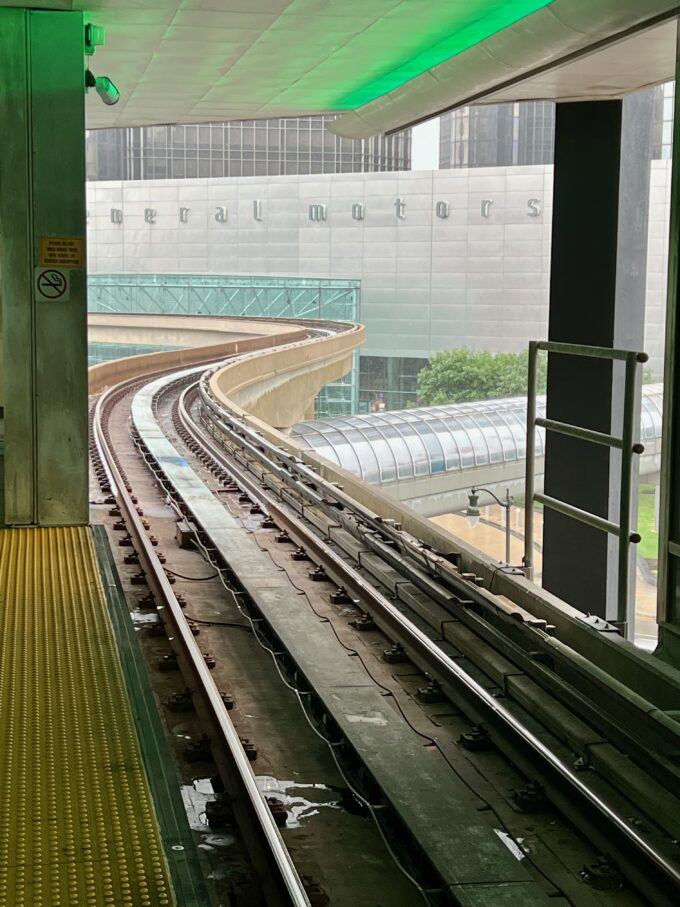
“People Mover” monorail sluicing around GM’s HQ in Detroit. Photo: Jeffrey St. Clair.
A Good Job Market Leads to Working and Middle Class Power
When the job market is tight and employers must go out of their way to attract people to their businesses, unions become stronger, and people who have been discriminated against are able to gain economic power, such as women and people of color.
With full employment comes rising incomes in a period of economic growth, because employers must pass along at least some of the gains of technology that lead to higher profits. Better technology leads to higher quality products and to greater productivity, which means that more goods and services can be produced with the same number of people.
In the era of infrastructure building and manufacturing prowess, which started to tail off in the 1970s, unions remained strong and working people reaped the rewards of productivity increases. But since the mid70s, the richest have taken a greater and greater share of productivity gains, as the government spent less on infrastructure and manufacturing was offshored. The job market became worse for working people, union power declined with the decline of manufacturing, and the negotiating power of the working class declined. The electorate became angrier with every passing decade, and the extreme right has been waiting to fill the political vacuum with their solution — scapegoating the Other, or in the case of the US, directing their ire at immigrants.
Filling the Political Vacuum by Blaming Immigrants
Blaming immigrants is a fake solution for the affordability and income problem: the argument is that if you throw out immigrants — or other ‘Others’ — the job market tightens, because there are less people vying for jobs. In addition, with less people around, the price of at least some goods, like housing, are supposed to go down, or so it is claimed. An infamous tweet from DHS is the ultimate example of this line of thinking. In reality, none of this happens, but the important point is that the extreme right is at least offering a solution. Enough people are receptive to these ideas that the Republicans are competitive in elections nationally.
Since the Democrats, (and progressives in general, I would argue) have abandoned the New Deal agenda of national infrastructure reconstruction, they have no response to these anti-immigrant arguments. Instead, they depend for their success on the Republicans destroying themselves politically by starting wars and recessions, which the Republicans generally excel at, leading to an attempt by the Democrats to ‘return to normalcy’, a phrase invented by Warren Harding — not a good sign. However, since the underlying problem of production has not been solved by the Democrats, the electorate remains angry, and this gives the Republicans another shot at taking power.
In the 1960s, the Democrats moved ideologically from focusing on the New Deal to championing the Cold War. Instead of investing in national infrastructure, every President threw more and more money into the military establishment. As the late Professor Seymour Merman showed, the diversion of manufacturing expertise to military production led to incompetence in civilian production, at the same time that globalization became possible because of communications and shipping advances. Factories were relocated outside the US. The economic engine of an infrastructure-led, manufacturing centered economy broke down, and with it, the ability of Democrats to hold off the appeal of anti-immigrant, and ultimately, racist, misogynist, and anti-LBGT propaganda.
The Neoliberal Ideology Takes Hold
Accompanying these real-world shifts in spending priorities was a shift in ideology to what is called neoliberalism. Neoliberalism has many definitions and has been percolating in several forms for many decades, but for our purposes, it has three main pillars that help to explain its importance in current politics.
First, there is the general idea that, as Reagan put it, ‘government is the problem, not the solution’. None dare speak of the good things government does, and only ‘entrepreneurs’ and titans of business, even fake ones like Donald Trump, can Do Good Things, and create economic growth and wealth. The only legitimate use of the government, as Trump recently said, is for the military and security.
Second, and related to the first, national planning is strictly forbidden, according to the neoliberal worldview. National infrastructure planning is the  very essence of civilization, and has been central to societies for 5,000 years. The economic power of the US was made possible because of it, and China rose in a burst of infrastructure building. But according to the neoliberal philosophy, any kind of planning inevitably leads to Soviet-style central planning, and as the godfather of neoliberal thought, Friedrich Hayek put it, planning is ‘the road to serfdom’. Democrats and liberals, terrified that they will be labeled communist, sprint away from anything that smacks of planning, including infrastructure planning. Even those to the left of the Democratic Party seem to be afraid of the idea.
Third, a pillar of mainstream thought since the 1970s has been the myth that we live in a ‘post-industrial’ society, that manufacturing is a ‘lower’ form of economy, that we have ‘progressed’ to a service economy, particularly a computer-based economy. In fact, the very word ‘tech’ or ‘technology’, which covers dozens of different kinds of essential technologies that are necessary for civilized life, has been narrowed down to only mean computer technology.
These three concepts, government-as-problem, planning-as-serfdom, and manufacturing-as-primitive, combined, lead to the ideological checkmate of any effort to advocate for New Deal-type policies that increase production, incomes, and affordability through national infrastructure planning. Devoid of any ideas to deal with underlying problems, the door is open for Trumpist, and globally, fascist-adjacent right-wing movements. They do want to use the government to oppress and expel enough people that to the survivors will go all the spoils.
National Infrastructure Reconstruction Can Solve the Production Problem
At this point, as I write in 2026, the level of decline in the US is so great that an enormous effort of infrastructure reconstruction and the attendant manufacturing renewal will be required to revive a middle class economy, and thereby regain the trust and support of most Americans. If there are enough resources in the economy that AI companies can spend close to 1 trillion dollars per year on data centers, the military can spend 1 trillion per year, and billionaires can get tax cuts of trillions of dollars, then there are enough resources to pour at least 2 trillion dollars per year into a reconstruction program, permanently.
Such a program, as I have for example laid out in some detail, could create at least 20 million good jobs, and could lower the costs of the goods and services that are making modern life unaffordable. The sheer scale of this agenda is its strength. We could basically eliminate unemployment and underemployment, and lift wages to such an extent that the category of ‘working poor’ would cease to exist. In fact, with moderate income support programs for people who can’t work, we could eliminate poverty. Once you eliminate poverty, crime plummets, and not only does the quality of life thereby increase, but another main pillar of right-wing propaganda is neutralized.
On the other hand, in a political environment in which it is hard to get any money for even the most basic social programs, it might seem delusional to think that trillions could be spent rebuilding the country. But there are millions of people who could be gainfully employed creating the goods and services that people need but can’t afford. The wealth exists, it is just being used for the wrong things.
Of course, the market is supposed to ‘figure out’ what to produce and who will produce it. But clearly the market is failing (notwithstanding various efforts to blame the government for the failures of the market). On the other hand, we don’t want the government to decide the vast majority of goods and services that the economy produces, most of which is better left to the market. Therefore, we need to democratically plan — yes, that word — how to build the infrastructure that is the foundation on which the market rests. Unlike the market, however, there is no ‘automatic’ mechanism for making decisions about infrastructure. Those decisions must be made consciously, by representatives elected by the citizens.
We need to have an expansive definition of what constitutes a national infrastructure. National infrastructure can be defined as the national systems that the government builds and maintains that provide the social and physical foundations on which the rest of the economy depends. In civil engineering, the physical networks generally are defined as composed of energy, transportation, water, and communications/information systems. To this I would add some percentage of housing and the placement of buildings relative to each other, that is, the use of land. On the social side of national infrastructure, we have health, education, and some parts of the financial system.
The Interstate Highway System is the premier example of a national physical infrastructure system, built, maintained and operated by the government (Federal and State). We could build an Interstate Renewable Electricity System, that would consist of a modern, national grid that would use solar and wind farms strategically placed throughout the continent so that there would always be enough wind blowing or sun shining (with some battery backup) to fill the electrical needs of the country. We could have an Interstate High-Speed Rail System, which could run along the Interstate Highways. We could have an Interstate High-Speed Internet System that would not only provide cheap and fast internet, but could also provide public cloud and public AI capabilities.
We could, over a 20 year period, build enough high-quality apartments to house 25% of the population in walkable town and city centers, thereby solving the housing crisis, along with complementary transit systems. We could support and subsidize urban and local regenerative farming, bringing down the price of food. We could require that the manufactured goods necessitated by all of this building be produced by domestic firms, including providing inexpensive financing via an institution like the New Deal Reconstruction Finance Bank, in order to build the new factories, and even encourage new manufacturing firms to be employee-owned and operated.
As for social infrastructure, a Medicare for All program, including a network of government-run hospitals to rebuild the rural health infrastructure as well as government-run clinics nationwide, and an educational expansion of childcare, pre-K, school building upgrades and support for more teachers, trade schools, and free public college, would be a much easier sell if it was part of a package which included the reconstruction of physical infrastructure systems. The argument could be made that we need a healthy workforce for the task of reconstruction, and we will need to have a highly trained and educated workforce in order to build these systems.
Thus, the whole is greater than the sum of the parts. The most important economic consequence of this set of systems is that everyone who wants a good job could get one, and that an era of ecologically and economically sustainable growth would be initiated.
The multiplicity of programs can lead to further benefits flowing from their interactions. For example, a vastly expanded national park system could become successful because a tight labor market would lead to higher wages as well as more vacation time for workers. If there were an inexpensive high-speed rail system that could take vacationers to national parks, the demand for national parks would increase, and the need to hire people to take care of the parks would lead to yet more good jobs.
Trump and his followers can offer none of the benefits of a central focus on creating good jobs by spending on national infrastructure and manufacturing. They occasionally talk about manufacturing, and Trump’s fumbling attempts at tariff policy were designed to make this appeal. But the results have been less than meager. Even the immigration policies have horrified most Americans.
By contrast, a program of reconstructing the country offers, if you will, a patriotic way to spread around the wealth by building the wealth of the nation, without the jingoistic appeals to blood and soil that JD Vance and others are trying to exploit. Giving the working class enough power to increase their standard of living, along with appropriate wealth taxes, is a constructive way to attack the problem of income and wealth inequality.
Another way this program can appeal to most voters is to handle the problem of AI. On the one hand, we see that it is possible to spend hundreds of billions of dollars creating AI infrastructure, so why not spend it on infrastructure that the public needs? On the other hand, either AI will turn out to be a colossal bubble, in which case much of that money will have been wasted and electricity and electronic prices will have gone up for no reason, or AI will have a large negative effect on employment, in which case a program of reconstruction will be able to gainfully employ all the people whose jobs are threatened. In addition, as mentioned, a government that is busy building out infrastructure can build a public AI system that can be directed towards public use.
Finally, the younger generations are still concerned about climate change, even if conventional wisdom is that we shouldn’t talk about it. For all the criticism that the congressional proposal for a Green New Deal attracted, it still elicited an enormous amount of publicity because it seemed to offer a workable solution. The idea should not be buried because Biden’s Inflation Reduction Act had climate change provisions in it; the IRA didn’t show that the Green New Deal was a bad idea, it showed that showering corporations with subsidies and tax breaks, without government direction, is not an effective solution. All of the programs I have proposed can not only create millions of jobs and bring down prices, the cessation of greenhouse gas emissions is the most important long-lasting consequence of the sum of the parts of this agenda.
We cannot afford to ‘return to normalcy’, assuming Trump leaves office and the Democrats have another chance to govern. If we return to normalcy, the conditions that produce the rage of the working and middle classes will not disappear; if anything, without the economic engine of national infrastructure renewal and manufacturing, the economy will become more unequal, more prone to bad job prospects, and more expensive. Reorienting the government, the economy, and workforce to rebuilding the country is the only way to counter and win out against the right-wing forces of bigotry and fascism.
[ad_2]
Source link
