
[ad_1]
Germany threw everything it had behind its campaign for a seat on the UN Security Council, but the campaign failed: The UN General Assembly decided that Germany has no place there.
This year, two rotating seats allocated to the Western European group were up for election. Portugal received 134 votes. Austria received 131. They took the two seats. Germany secured 104 votes, falling 23 short of the required two-thirds majority.
For Berlin, this is not a minor diplomatic setback, but a historic humiliation. Since reunification, Germany has served four times as a non-permanent member of the Security Council, winning the seat every time it ran. Indeed, going back to the 1970s, even West Germany secured the position every time it made a bid.
To those paying attention to Berlin’s recent foreign policy, the outcome was hardly surprising. And for those who take seriously international law, and Israel’s routine violations of it, it was justice.
Let’s name the elephant in the chamber: Germany’s unconditional support for Israel’s war in Gaza. Hamas’s October 7 atrocities were appalling crimes, but Israel’s subsequent campaign, according to international law experts, UN rapporteurs, and the International Court of Justice, could plausibly constitute genocide. Even many critics who shy away from the “g” word can’t deny that Israel is waging a campaign of ethnic cleansing.
Yet Berlin continues to adhere to a twisted logic: that the memory and shame of the Holocaust require unconditional backing for the current Israeli government, even as it starves, bombs, and displaces millions. Even after the UN humiliation, German officials don’t seem to have learned the correct lesson. Foreign Minister Johann Wadephul conceded that “historical responsibility” to Israel cost Germany votes, yet he blames Russia for organizing the opposition and ignores his own nation’s glaring hypocrisy: Berlin arms Ukraine to defend the UN Charter, yet shields Israel as it tears that same charter apart.
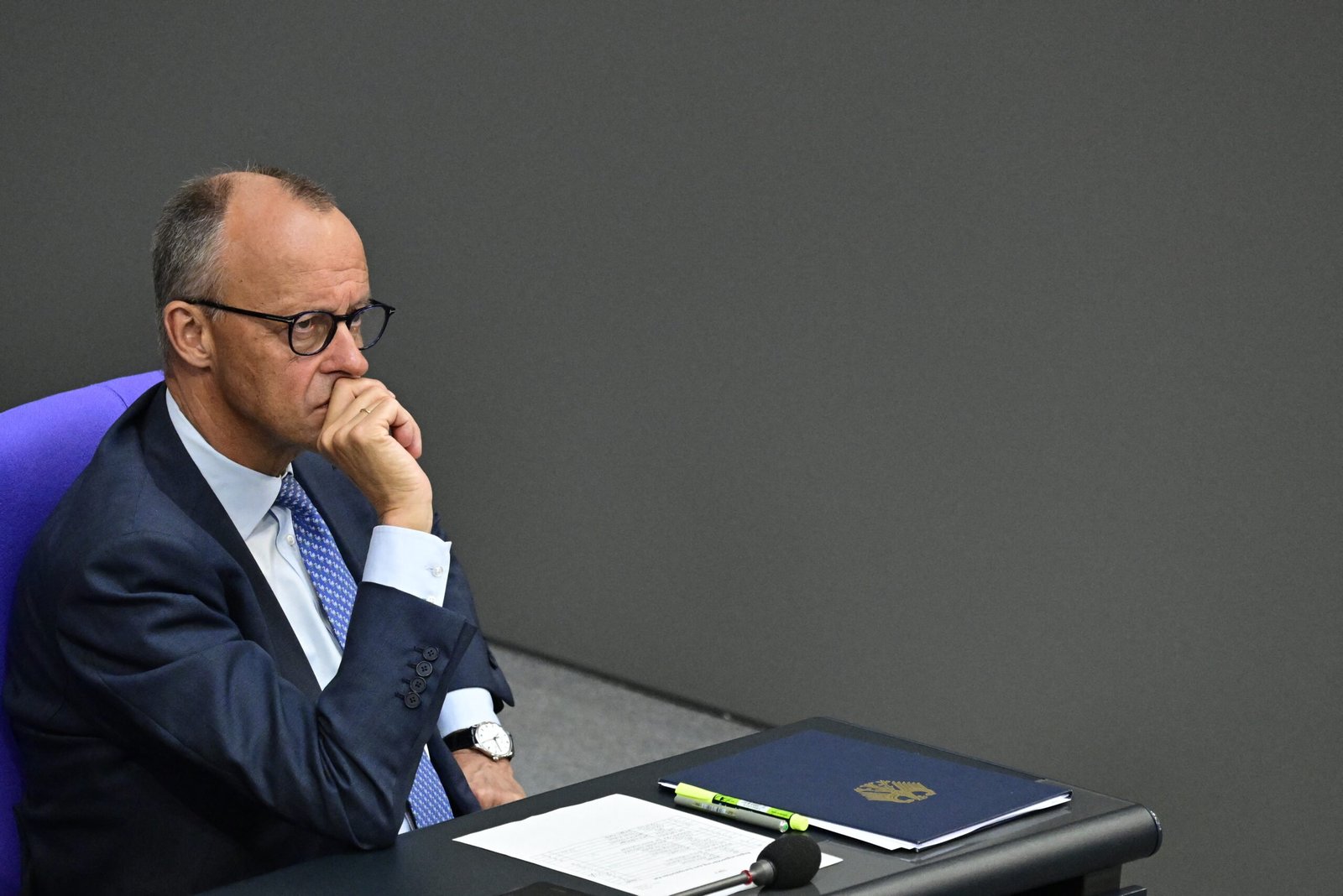
And Wadephul’s boss, Chancellor Friedrich Merz, has been no better. In June 2025, Merz cheered on the American-Israeli war against Iran, claiming that Israel was doing “our dirty job.” This February, when the U.S. and Israel renewed the war against Iran, he bluntly said that “this is not the moment to lecture our allies” on international law. He also confidently predicted that “we are witnessing the final days and weeks” of the Iranian regime.
The current, conservative-led coalition in Berlin, however, is not solely responsible for this failure. The Greens, now safely in opposition, criticize the government for squandering German influence—as if their own stint in power between 2021 and 2025 had nothing to do with it. But Annalena Baerbock, the current president of the UN General Assembly, served as German foreign minister in that period, and her tenure was a masterclass in moralistic posturing divorced from strategic reality.
For all her lecturing about a “feminist foreign policy,” where was Baerbock’s feminism when Israeli bombs flattened Gaza’s maternity wards and, according to UN figures, killed over 10,000 women and children?
Apparently, feminism means arming the side that does the bombing, not protecting the women being bombed. Baerbock’s self-congratulatory virtue-signaling was always more about German moral vanity than about actual justice. As coarchitects of this fiasco, the Greens do not get to lecture others about it now. Their “feminist foreign policy” died in Gaza.
As for Russia’s alleged role in fomenting opposition to Germany because of its support for Ukraine, that is no more than an unconvincing excuse: Portugal and Austria, after all, are both staunch Ukraine supporters too—and they won the Security Council seats.
Gaza does seem to have made the real difference. To be fair, Austria is equally pro-Israel. But what grated most in the case of Germany were its efforts to cloak its policies in moralistic language—as well as the fact that, unlike Austria, it is arguably Europe’s most powerful country, which is why its actions always carry more weight and attract more scrutiny.
But the defeat does not seem to be changing Berlin’s policies. As the EU member states’ ambassadors to the EU have moved, at long last, to debate individual sanctions against extremist Israeli ministers Itamar Ben-Gvir and Bezalel Smotrich, Germany reportedly insisted that even this symbolic measure be further diluted by targeting only the former. According to the Germans, Smotrich should be let off the hook—despite declaring openly that his goal is to “kill the idea of a Palestinian state” by inciting Israelis to illegally settle in the occupied Palestinian West Bank.
And what is that double standard if not a betrayal of the actual lesson of the Holocaust? That catastrophe taught a universal truth: Justice must apply equally to all peoples, or it means nothing. Yet Berlin’s elite has twisted that memory into a license for exceptionalism.
Unsurprisingly, the nationalist Alternative for Germany (AfD) party is capitalizing on the establishment’s missteps. Party leader Tino Chrupalla mocked the recent diplomatic failure, and he even correctly and candidly identified why it happened: “Anyone who arbitrarily formulates double standards in foreign policy won’t be elected to the UN Security Council either—good so!” The AfD, at 29 percent, now convincingly leads in the polls.
To be clear, the AfD’s rise in Germany is overwhelmingly due to domestic issues—the economy, immigration, and a deep distrust of the political establishment. But on foreign policy, the party has managed to outsmart the mainstream by adopting positions that are genuinely popular. The AfD opposed the war with Iran—a conflict that 88 percent of Germans also oppose—while pushing for peaceful relations with Russia and normal trade with China.
On Israel, the mainstream’s blind spot is even more glaring. According to a recent Pew Research poll, 73 percent of Germans hold an unfavorable view of Israel, up 9 percentage points compared to the same period a year ago. The German public is moving away from Israel’s government, and doing so fast. Yet Berlin’s elites are still running in the opposite direction.
With the UN vote, it’s hard to escape the conclusion that Germany has reached a diplomatic nadir. President Donald Trump openly looks down on Merz and treats him with contempt. Moscow shows no interest in dealing with Berlin’s current leaders. Beijing increasingly treats Germany not as a strategic equal, but as a second- or third-tier player.
Even within Europe, Merz appears weak. His personal relationships with key leaders like France’s Emmanuel Macron and Italy’s Giorgia Meloni are evidently strained, as both played a key role in defeating Berlin’s push to seize the frozen Russian assets and use them to aid Ukraine in December 2025 (eventually, the EU agreed to keep helping Ukraine from its own funds, an outcome Berlin opposed).
Subscribe Today
Get daily emails in your inbox
The domestic picture is just as brutal. According to a recent survey, only 11 percent of Germans are satisfied with the Merz coalition’s performance—a catastrophic collapse. Merz’s Christian Democrats are polling at just 21 percent, while his coalition partners from the Social Democratic Party have fallen to 12 percent, historic lows for both.
Many challenges and failures account for these poor ratings and Germany’s diminished standing on the world stage, but one major problem is a political class that confuses moral posturing with strategy, ideology with realism, and self-importance with influence.
Back in 2003, Germany passed its greatest geopolitical test, opposing the Iraq War as a violation of the UN Charter. Today’s Germany has betrayed its commitments to international law, and its UN defeat is the first real price. If it takes losing a Security Council seat for Berlin’s elites to remember what kind of state Germany was and could be again, then maybe the UN just did them—and the world—a favor.
[ad_2]
Source link
