
[ad_1]
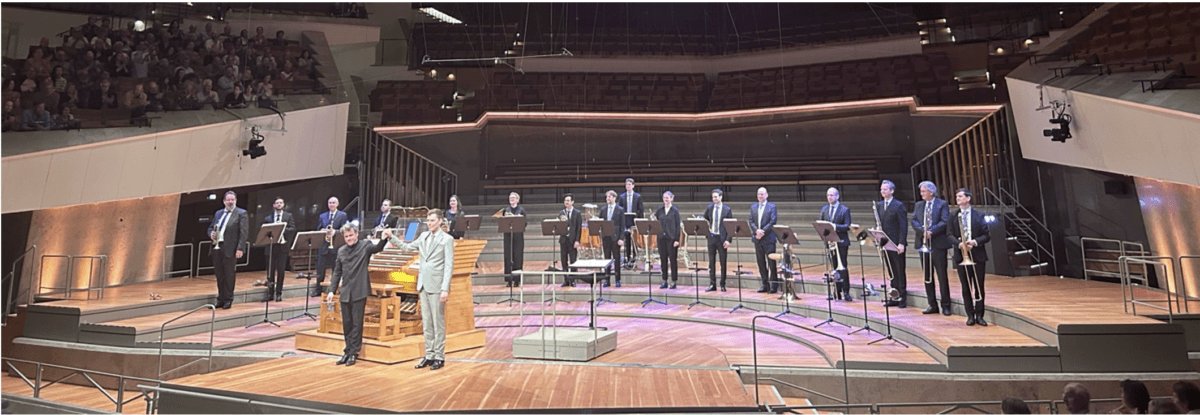
Richard Gowers (front right) with Jakub Hrůša, conductor, and brass players of the Berlin Philharmonic. Photo: David Yearsley.
For centuries, the King of Instruments ruled by Divine Right.
He had come from humble origins, midwifed into the world by an Alexandrian engineer by the name of Ctesibius two centuries before the birth of the King of Kings (aka Jesus Christ). This hydraulis—so called because water pressure was used to stabilize the wind generated by a cylindrical pump—was a modestly sized but ingeniously appointed portable mechanism.
Soon, the boy (the organ, not Jesus) had been adopted all around the Mediterranean World. (The adoption of Jesus’s invention—redemptive God, who is also his own Father, comes to earth in human form—would take place several centuries later.) In a bizarre prelude to later baptism, the Antique organ even hymned the feeding of Christians to lions in the Roman Coliseum. The foundling rose up to become a favorite of Nero, perhaps the most rabid organ nerd there ever has been. Even if the imperial favorite may not have been enthroned as Emperor of Instruments, the organ had become the Instrument of Emperors.
Rome fell and with it the organ. But the ingenious technology continued to be cultivated in Byzantium and was regifted to Western Europe in the 8th century, a millennium after its birth, when the Instrument-Who-Would-Be-King was brought by an embassy from Constantinople to the court of Pepin the Short, Charlemagne’s father.
Over the coming centuries, industrious monks and enterprising secular artisans built up the boy into a giant. Massive instruments rose in the upper stories of mighty cathedrals. With the aid of unseen minions working giant bellows, a single player (also usually invisible to congregants) commanded thousands of pipes, some as far as thirty or forty feet away from a hidden console with its several keyboards for hands and even one for the feet.
The power of the massive sonority that the king produced was not merely regal but godlike, though these attributes were synonymous in the lavish organs that graced royal chapels. Eventually, the invention of the “stop” allowed different rows of pipes to be silenced and then pulled on and combined with each other. Sonic majesty complemented infinite variety. The King was all-powerful—“the instrument of instruments,” as one of the earliest printed books on the organ boasted.
Industrialization and secularization combined to topple this monarchy. On the small island to which the once-great Christianizing power of the British Empire has once again shrunk, church organs are being junked at the rate of 400 a year. The King of Instruments now resembles those residual European royals still going through their monarchic motions—entertaining rather than essential, an oddity rather than omnipotent.
Yet occasionally large rapt crowds assemble for an audience with the King. So it was last Sunday morning in the Philharmonie concert hall in Berlin. Many more than a thousand people flocked to hear and see the young English organist, Richard Gowers, present an hour-long program with fifteen brass players and a timpanist from the Berlin Philharmonic. The timing of the event said everything about the history just outlined, admittedly in egregiously tendentious terms. Little more than a century earlier, the audience, much of it gray-haired, would have been in church on a Sunday morning. Instead, they had come to the modernist temple of Art to be entertained.
The King aimed to please.
The concert began with Richard Strauss’s Festliches Präludium, premiered in 1913 for the dedication of a new organ in Vienna’s famed concert hall, the Musikverein. Five years later, the Austrian Monarchy was swept away by the self-inflicted catastrophe of World War I. Across its nearly 700-year reign, the ruling Habsburg family had been a vital benefactor of organs and organists.
Strauss’s score had originally called not only for brass but also a full battery of wind instruments. In Gowers’s own ingenious arrangement, he charged himself with managing both the original solo part while also assuming those of the missing oboes, clarinets, and bassoons. Bombast was leavened by lyricism, acclamation by contrapuntal verve.
Installed in 1965, two years after the Berlin Philharmonie was opened, the hall’s organ is tucked up against the ceiling of the faceted, pentagonal space. The instrument’s original keyboards, now mostly dormant, are built into its case, but, thanks to the two-edged magic of electricity, a newer console can be wheeled out onto the stage amongst the orchestral musicians. The electric connection to the pipes far above leads to a cognitive disconnection: the organist calls forth music from a distant source as if the player is being ghosted by himself.
Placing the organist front and center is a strategy of self-preservation in this age of screen addiction and obsessive image-making. As with modern human monarchs, the player must be seen. Indeed, the spectacle of four-limbed, gymnastic action enthralls, especially when enacted by someone as fluent and occasionally fiery as Gowers.
A warm, engaging stage presence with reserves of technical prowess, Gowers was impressive, yet always intelligent, daring yet trustworthy, like a virtuosic jet pilot in his on-stage cockpit.
Arrayed in a broad, flattened semicircle behind the organist, the brass players directed the bells of their instruments directly out into the hall, while the pipes called distantly from above. Together and individually, trumpets, horns, trombones, and a tuba—backed by the covering fire of the timpani—were far more brilliant than the organ, further disadvantaged in Sunday’s formation by its lofty position. Much of Gowers’s brilliant orchestration of the Strauss Präludium went missing in action. When heard alone, the Cold War organ sounded like the report from another battle, though the organist appeared spectacularly active in the midst of the fray.
The Strauss was followed by two solo works in which Gowers competed only with himself. He won. In his flawless performance of the magisterial Fantasia in F minor by Mozart, originally composed for a mechanical organ, Gowers proved that musicians can still best machines, even as the AI menace spreads and deepens. J. S. Bach’s Chromatic Fantasy and Fugue for harpsichord, made even more turgid in a version for organ by maximalist Max Reger, summoned dark clouds. Though lightning never struck, Gowers’s poise and intelligence shone below the storm.
With muscular clarity and unfussy expressivity, guest conductor Jakub Hrůša returned to the stage to lead the program’s final work, a compact 20-minute symphony for organ, brass, and timpani by his countryman Miloslav Kabélač. Gowers played the demanding, sometimes showy organ part with panache and precision. Composed before the Iron Curtain came crashing down, three of the four movements ended in bombast, the organ holding out as the brassy masses besieged the palace. An encore began with a furtive pedal solo, as if the beleaguered king were tiptoeing out the back door. But the band stormed the castle and subdued the monarch, forcing him to serve the people rather than rule alone and above.
[ad_2]
Source link
