
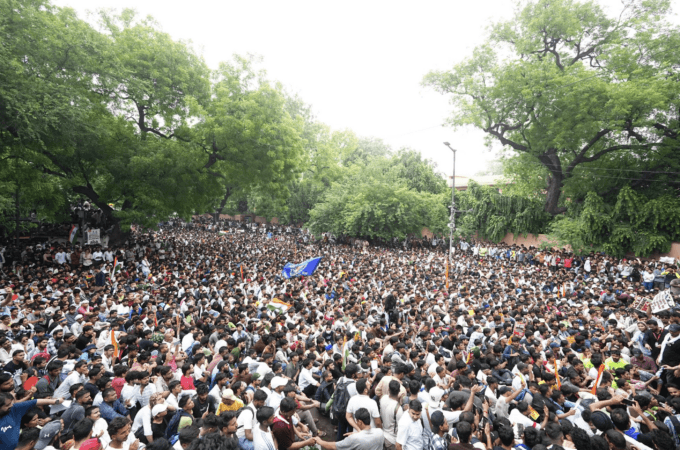
Jantar Mantar protest, photo provided by the author.
Dharmendra Pradhan, the Education Minister of India resigned on July 25! The government finally succumbed to the demands of the Gen Z. The protest that started at Jantar Mantar in New Delhi a month and half ago under the banner of Cockroach Janata Party (CJP), demanding the resignation of Pradhan finally triumphed.
Emergence of Cockroach Janata Party (CJP)
In response to the ‘Cockroach’ remark by the Chief Justice of India Surya Kant on the activists – that drew flak from several quarters – Abhijeet Dipke, an Indian youth who studied in Boston University and lived there started a satirical name: Cockroach Janata Party (CJP). In a few days, it gained 20 million followers on Instagram. A nervous government blocked its Instagram and X handles, though the Instagram handle was unblocked after a short period followed by their X handle. This led to a social media storm in protest against the move. Earlier, the NEET paper leak, the entrance examination for admission to the Bachelor of Medicine and Bachelor of Surgery (MBBS), leading to the cancellation of the exam. At least twelve students died by suicide due to the paper leak, reported Indian Express. CJP claims the number of suicides is twenty one. The CJP demanded the resignation of the Education Minister Dharmendra Pradhan for the paper leak. Almost simultaneously, the fiasco surrounding the CBSE (Secondary Board of Secondary Education) online paper evaluation was also exposed. These systemic failure of the education system has affected millions of students. The government took some kneejerk actions frustrating the youth. Gradually the CJP youth decided to launch a protest at Jantar Mantar in Delhi to press their demands. Dipke arrived in Delhi from Boston and led the protest on June 20. The other leaders of the movement are Saurav Das, a journalist who writes on judiciary, and Ashutosh Ranka.
Sonam Wangchuk sat in an indefinite hunger strike
With the renowned educationist and Magsaysay award winner from Ladakh, Sonam Wangchuk sitting on an indefinite hunger strike supporting the youth’s demands at Jantar Mantar, the protest gained momentum. Thousands of youths joined in and protested in a peaceful manner. After about ten and eleven days of fast, as the message of deteriorating health of Wangchuk spread across, several activist, opposition leaders, celebrities started supporting the protest and reaching out to Wangchuk urging him to end fast. Wangchuk was firm in his conviction. “I will end my fast only if Dharmendra Pradhan resigns”. With government turning a deaf ear to the protest, the CJP announced ‘Sansad Chalo’ (March to the Parliament) on July 20 inviting youths from across the country.
The protest leaders including Wangchuk, Dipke and others constantly appealed the youth to remain peaceful and non-violent throughout the protest. Owing to these appeals, the protest remained remarkably peaceful despite rising numbers of youth, children, mothers, fathers and elderly people pouring in each passing day barring probably a few exceptions.
On July 19, the police forcibly and quite unceremoniously took Wangchuk to a hospital, which was aimed at weakening the planned rally to the Parliament. At this juncture, CJP scaled up its pitch demanding the resignation of Prime Minister Narendra Modi. This incident flared up the situation and hundreds of thousands of youths from different parts of the country came to join the march on July 20 when the monsoon session of Parliament began.
It was only on July 19, the government offered to talk to the protesters based on the intelligence report that crowd was surging in Jantar Mantar.
March to the Parliament
On July 20, when more than hundred thousand students and youths marched to the Parliament under the banner of Cockroach Janta Party (CJP) demanding the minister’s resignation, the police unleashed unprecedented violence on unarmed youth. Layers of barricades were erected on roads heading towards the Parliament to prevent the youth. Youth broke the barricades and moved ahead. Several opposition party leaders joined in. The protesters were ruthlessly beaten with sticks, and teargas was used on them. Some protesters suffered skull fracture with blood pouring out from their injuries. Children protesters as young as ten – fifteen years were beaten and seen crying. In some cases, the clothes of female protesters were torn. There were allegations of molestation. In one case, a tear gas canister was fired directly at a youth causing him lose consciousness on the spot. Worse, pellet guns were used against the peaceful protesters, reportedly for the first time by the police in recent past, according to a report by The Hindu. While the youth were seen running hither and thither to escape the assault, some youths stood firm – braving the batons of the police personnel – a scene that is reminiscent of the freedom struggle against the British in colonial India. While the NDA government led by the Bharatiya Janata Party (BJP) thought that unleashing violence against the protesters would dampen the spirit of the youth, the strategy backfired. The youth movement spread to at least 34 cities – including Mumbai, Chennai, Kolkata, Hyderabad, Patna, Bhubaneswar, Ahmedabad, Bangalore, Chandigarh and Nagpur, among others (as on 23 July 2026) making it a national movement.
The police alleged that some of its personnel were injured in the attacks by the protesters on July 20. In some places, the youth were seen pelting stones, while in another, police were seen doing the same. Dipke had earlier warned that a vehicle full of stones was parked at Jantar Mantar before the march to Parliament. Therefore, an independent investigation should be conducted to establish the facts.
Gandhian method of Satyagraha – nonviolent resistance
When the protest began, no one was sure of its effectiveness. People doubted the non-violent character of the protest as government kept ignoring it. The government was probably of the impression, as Yogendra Yadav, a political activist, sarcastically summarized, “that India’s Gen Z is too sophisticated, habituated to living in air-conditioned environment. They cannot sit outdoors for a long-time bearing Delhi’s heat and humidity. The struggle would fizzle out in some days!” Several opposition leaders cautioned Wangchuk that Modi government is too stubborn to care for his sacrifice. Some even compared the continued non-response of the government with the Britishers in pre-independent era, who at least responded to the hunger strikes of Mahatma Gandhi and other leaders then. Some students of the All India Students Association (AISA), a left leaning students union, Neha Bora, Aameen Amitoj, Manish Kumar and others also sat on a hunger strike at Janatar Mantar in a separate place with similar demands. Wangchuk, Neha and others continued fast despite advice from well-wishers. People got emotional at the sacrifice of Wangchuk, Neha and others youth staging a dharna (sit-in protest) in adverse conditions for the sake of the future of all children and youth of the country. The masses realized that it was time they shed their fear and join the protesters who were risking their lives.
There were as many as 152 examination paper leaks in the last decade, claims Rahul Gandhi, the leader of opposition, that affected 7.5 million youth and their families. Hopeless over their future, the youth were getting increasingly restless.
People in general are already fed up with rising authoritarianism and insensitivity of the NDA government at the Center and NDA/BJP-ruled states. Bulldozing of people’s houses at slightest provocation, putting people behind the bar for doing democratic protests – criminalizing dissent, widespread allegations of corruption, bringing anti-farmer policies to benefit their corporate friends, allegations of electoral manipulation including vote theft with the alleged complicity of the Election Commission, mass disenfranchisement of the citizens under SIR (Special Intensive Review of electoral rolls), putting opposition leaders behind the bars using investigating agencies, engineering mass defections from opposition ranks, spreading communal hatred to cover its failures and so on. The protest was an opportunity to vent their frustration.
Lawyers’ associations, farmers’ associations and many other have extended support to the movement. Bollywood stars like Salman Khan, Shabana Azmi, Prakash Raj and others have also extended support.
The way people stopped fearing the government, started joining and supporting the protest in Delhi, and starting peaceful protests across the country proved the efficacy of the Gandhian method of Satyaghara!
It may be noted that in Nepal, Sri Lanka and Bangladesh, the Gen Z movement and people’s resistance took a violent turn within a matter of days. In India, however, this did not happen. The government was ready to crack down at any moment at a slightest instance of violence by the protesters,. The youth, however, frustrated this attempt due to their entrenched Gandhian values.
Opposition parties united behind the students
As the July 20, when the march to Parliament was ruthlessly dealt with by the police making hue and cry across the country, the opposition party leaders created ruckus inside and outside the Parliament condemning the government. Leader of Opposition Rahul Gandhi and Congress party did a sit-in protest near the Prime Minister’s residence.
Role of media and judiciary
Initially the Godi media (a term used by critics to describe media outlets perceived as being close to the government) – mostly the TV channels, did not cover the protest initially. When they covered, they branded the protesters as ‘anti-nationals’ having international connections instead of reporting the facts. This is what these channels do in every genuine protest. Their agenda is to protect and defend the government and blame any form of dissent. Some of them are also spreading fake narratives and spew hate. It’s only the independent journalists through their YouTube channels who are doing a good job by doing factual reporting. Independent newspapers like The Hindu and Indian Express and some others continue to cover the protest in a professional way.
At the protest site the youth chanted “Godi media” to the reporters from these so-called Godi TV channels. Unfortunately, on the day of march to Parliament, a reporter from TimesNow TV channel was allegedly manhandled by the protesters, which has been condemned by the CJP and all concerned.
In recent years, the credibility of the higher judiciary has taken a severe beating. Even common people now can observe courts’ apathy towards people’s issues and human rights violations. As a plea on the police excesses on the unarmed youth during the march to Parliament reached the Supreme Court seeking urgent listing, the Chief Justice of India Surya Kant said, “Do not waste our time” and declined to entertain it. However, after severe criticism, the CJI has clarified that he was misunderstood and said that the court is available 24 hours a day.
Government bowed, Wangchuk ended fast
As the protest spread like wildfire across the country after the July 20 mayhem drawing international attention, and mounting pressure from the opposition and general public, the government bowed. The government however used a “carrot and stick” method to engage with the protesters. On the one hand it was talking to the protesters, on the other the police were taking different measures to stifle the protest. Ministers J P Nadda and Jitendra Singh met Wangchuk in the hospital and persuaded him to end his fast, which he did after 26 days. The CJP leadership led by Saurav Das and Ashutosh Ranka have had two rounds of talks with the ministers putting forward their demands: the resignation of the Education Minister; compensation to the families of the children who died by suicide due to the paper leak; and the withdrawal of FIRs on the protesting youth. The latter two demands were accepted by the government. For the first demand, the ministers sought time.
What happens to the movement now?
The youth led ‘Gandhian struggle’ awakened the whole nation! Minister resigned. It was an instance of direct democracy where the government had to succumb to its electors. All demands of the protesters were accepted leading to CJP announcing an end to the protest. Is it actually an end to the youth protest? For now, yes. However, this is one battle won – in education sector. This victory is likely to open protests in other sectors of governance which are in disarray.
