
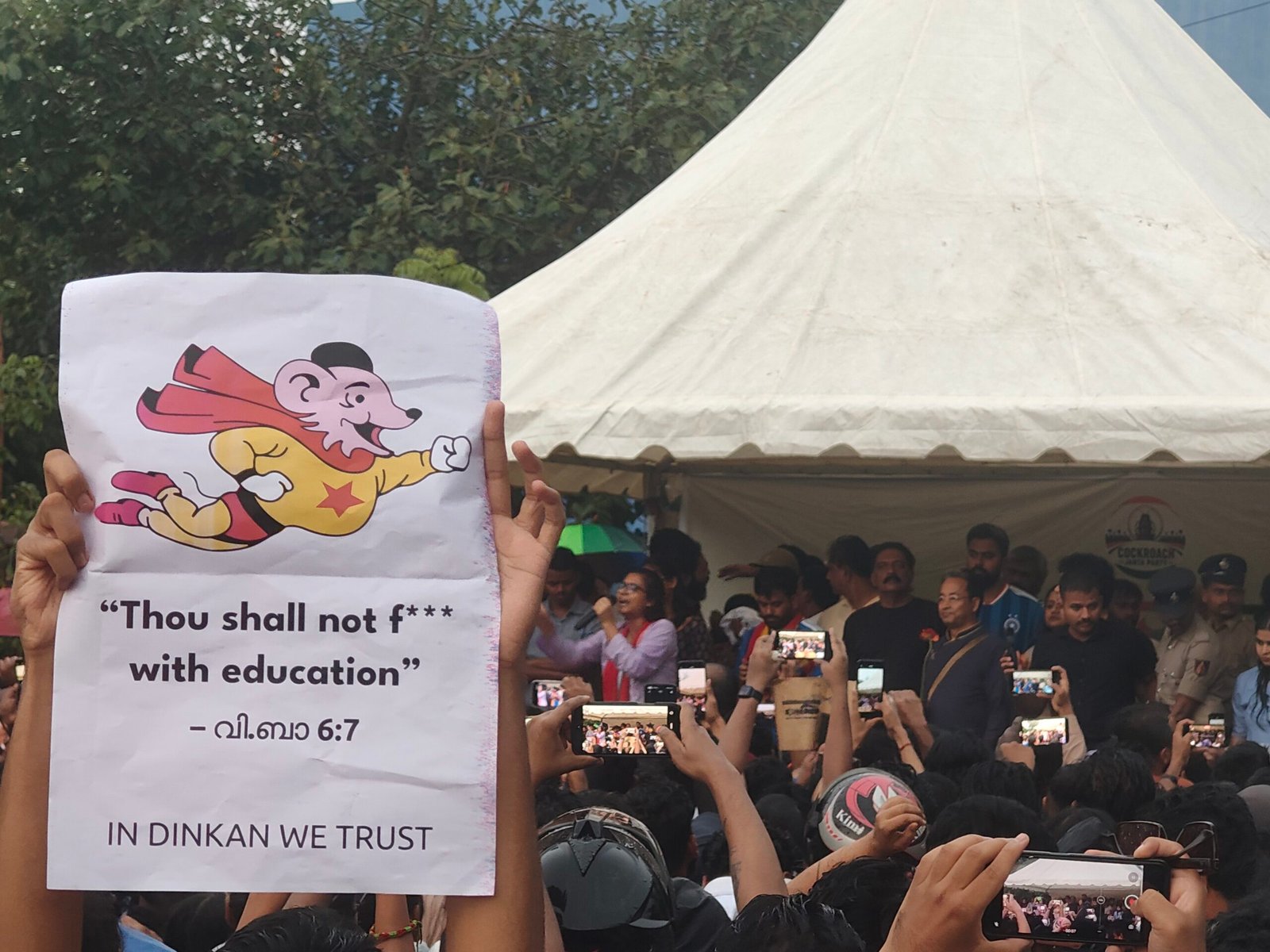
Photograph Source: Subin Siby – CC0
“What if all the cockroaches come together?”
Marx and Engels issued the historic call: “Workers of the world, unite! You have nothing to lose but your chains!” Today, that summons returns with renewed urgency and takes a new form: Young people of the world unite and resist. Youth today possess the courage, imagination, anger, and numbers to change the course of history. They have grown up in societies paralyzed by cynicism, loneliness, desperation, and hatred, conditions that isolate people from one another and teach them to regard cruelty as inevitable. Yet even amid this desolation, a radical possibility remains: the recovery of solidarity as a passion for justice and love as a public and collective force. This militant love begins with the recognition that our lives are profoundly interconnected, that freedom cannot be reduced to individual escape, and that none of us can be secure while others are rendered vulnerable and disposable. It creates bonds strong enough to break through isolation, connect private suffering to public responsibility, and transform compassion into organized resistance. As James Baldwin and Malcolm X understood in different ways, learning to live requires learning to love, not as sentimentality or a retreat into private life, but as a refusal of hatred, racism, and the machinery of disposability.
Militant love takes the side of justice. It finds expression in solidarity, shared struggle, and the willingness to assume responsibility for lives beyond our immediate experience. It transforms loneliness into connection, despair into collective courage, and anger into a disciplined struggle for a world in which no human being is considered expendable. With catastrophe no longer on the horizon but at their doorstep, young people must build a worldwide movement of resistance that neither propaganda nor repression can silence. It is time to bring to a halt the machinery of death sustained by governments and their military-industrial-academic institutions, all stained by the suffering of children, women, the elderly, and those condemned as disposable.
But solidarity becomes a radical force only when moral conviction takes the form of organized struggle. Student-led protests in India have demonstrated how culture can become both a pedagogical weapon and a vehicle of collective resistance. After Chief Justice of India Surya Kant contemptuously referred to unemployed young people as “cockroaches,” Abhijeet Dipke answered with a provocative challenge on Instagram: “What if all cockroaches come together?” The question spread rapidly, transforming an insult meant to humiliate into a rallying cry of defiance. Confronting the corrupt and increasingly authoritarian Modi government, students, unemployed young people, and their supporters used memes, satire, and Instagram reels to expose corruption, puncture the mythology of power, and mobilize mass protest. Met with tear gas, police violence, and detention, they refused to abandon the streets. Their resistance revealed that domination is sustained through more than force. It also depends on images, narratives, and a manufactured common sense that teaches people what to fear, accept, and obey. By turning culture against power, the protesters entered the very terrain where identities are formed, anger finds a language, and private suffering becomes public outrage and collective action.
The youth-led Cockroach Janta Party converted this defiance into a rapidly expanding movement. With more than 20 million followers on Instagram, it built an alternative public sphere beyond the government’s propaganda machine.Young people turned digital ridicule into political solidarity and carried it from the screen into the streets. Images of police repression widened public outrage, while the movement’s growing power forced the resignation of India’s education minister and placed educational reform and public accountability on the national agenda. As Arundhati Roy notes, “the student protesters who have swarmed Delhi are showing us a different future for India.”
What began as an insult became a symbol. What began as a meme became a movement. What began online became a material force capable of making an authoritarian government retreat. This was more than a new style of protest. It was a restructuring of politics from below, one that seized the cultural technologies of domination and turned them against the systems of power that produce censorship and dispossession. It showed that culture is not an ornament to politics; it is one of the decisive sites where power is challenged, solidarity is created, and collective agency is born.
The lesson extends far beyond India. It must not be lost on young people in the United States or elsewhere, especially as the genocidal assault on Gaza is accompanied by an accelerating campaign of state and settler violence in the occupied West Bank. The catastrophe in Palestine is not confined to Gaza. It is part of a broader colonial project of dispossession, forced displacement, territorial theft, and the destruction of Palestinian life, a logic of domination increasingly visible across the globe. It is also a warning of what awaits the rest of the world as emerging fascist states answer economic crisis with racist paranoia, militarism, and fantasies of purification. This violence involves more than the crushing of dissent. A gangster form of neoliberal capitalism is merging with colonial violence and authoritarian rule, producing a criminogenic order in which law serves power, cruelty becomes policy, and entire populations are abandoned to injury, exile, and death. Azeezah Kanji is right to insist:
We speak often of the “Palestine exception”: the extreme repression of Palestinian and Palestine solidarity speech and activism. We ought also to speak of the Palestine example: understanding Palestine not simply as an exception, but as an emblem of the colonial modern condition.
The assault on the village of Tell, southwest of Nablus, gives concrete meaning to this “Palestine example”: colonial power operating through the combined forces of the military, the state, and armed settlers to dispossess a people and destroy the conditions necessary for collective life. Following a deadly confrontation involving Palestinians, armed settlers, and Israeli forces, the Israeli government imposed collective punishment. Four Palestinians were killed, dozens were detained, homes were raided, and military operations spread across neighboring communities. Prime Minister Benjamin Netanyahu ordered a wider military campaign, while members of his far-right government demanded further settlement expansion and the depopulation of Palestinian villages. UN Special Rapporteur Francesca Albanese described the combined army-settler attacks as pogroms against defenseless civilians.
Tell is not an isolated incident. Since October 2023, Israeli forces and settlers have killed more than 1,000 Palestinians in the occupied West Bank, including roughly 200 children. Thousands have been injured, and more than 10,000 have been displaced by military operations, demolitions, settler attacks, and restrictions on access to their land. Entire Bedouin and rural communities have been driven from their homes, while settlement construction and the seizure of Palestinian territory have proceeded at an unprecedented pace. The violence of armed settler mobs cannot be separated from the government that protects, arms, and politically enables them. Nor can it be separated from Israel’s widening military assaults across the region, including Lebanon. These are not disconnected eruptions of violence but expressions of a larger politics of colonial expansion, collective punishment, and permanent war.
What is unfolding across Gaza and the West Bank is a crime against humanity made possible by weapons, diplomatic protection, media indifference, and the shameful complicity of powerful Western governments, especially the United States. Universities invest in and collaborate with the institutions that sustain the war machine. Corporate media turn mass suffering into background noise. Political leaders empty the language of human rights of all meaning by applying it selectively. Under these conditions, silence is not neutrality. It is a form of collaboration, and the normalization of genocide becomes a rehearsal for further crimes.
The young people of India have shown what becomes possible when a generation refuses the future imposed upon it.They are not alone. The resistance emerging among young people across the world offers a language for confronting this global regime of violence. Although sparked by specific grievances, these revolts are rooted in widening inequality, unemployment, economic insecurity, corruption, censorship, and the shameless nepotism of political elites.
What is often missed in the mainstream press is that young protesters are revolting against a global form of gangster capitalism that has denied them a meaningful place in the present and robbed them of a future. Commenting on the Cockroach uprising, Vijay Prashad identifies the deeper economic forces driving this revolt:
The young protesters are not in revolt because they possess shorter attention spans or a special cultural aversion to authority. They are in revolt because capitalism cannot integrate them into dignified economic life. They have been told to study, acquire degrees, learn new skills, remain competitive, and become ‘entrepreneurs.’ Their families have borrowed money, sold land, postponed medical treatment, and reduced household consumption to pay for education and coaching. At the end of this punishing journey, many discover that the promised job does not exist. Others find only temporary contracts, unpaid internships, platform work, or jobs whose wages bear no relation to their qualifications.
This crisis is not confined to India. In Bangladesh, student protests brought an end to Sheikh Hasina’s fifteen-year rule. In Nepal, resistance to corruption and digital censorship forced the prime minister’s resignation. In Madagascar,protests that began over water and power cuts grew into demands for “a complete overhaul of the political system” and drove President Andry Rajoelina from the country. In Kenya, a decentralized youth movement compelled the government to withdraw a punishing finance bill and continues to challenge state power and shape the country’s politics.
Largely leaderless and digitally connected, these movements have transformed social media into a counter-public sphere and translated online networks into political power in the streets. Different in their histories, demands, and results, they share a crucial lesson: when young people refuse silence, organize across differences, and connect their courage to a broader public outrage, governments can be forced to retreat and seemingly immovable structures of power can begin to crack.
The challenge now is to turn these scattered revolts into a common struggle. Young people everywhere must transform these lessons into an international movement capable of bringing millions into the streets and interrupting the institutions that make mass violence possible. They must organize peaceful demonstrations across borders, build student-worker alliances, occupy public spaces, radicalize the social imagination, and expose the systems of propaganda that sustain it. They must demand an immediate end to the slaughter, an arms embargo, international sanctions, and freedom and justice for the Palestinian people. Moral outrage must become organized power.
Such a movement must be joined by educators, artists, cultural workers, trade unionists, journalists, faith communities, and public intellectuals. Resistance cannot remain fragmented by national borders or confined to isolated campuses and cities. Demonstrations must become global, coordinated, sustained, and impossible for governments to ignore. Boycotts, divestment campaigns, labor actions, teach-ins, and mass civil disobedience must converge into a broad democratic front capable of imposing a political cost on complicity. The capitalist and reactionary nationalist institutions that sustain oppression must be confronted wherever they operate: in government ministries, corporations, universities, media systems, financial networks, and the arms industry.
The Indian youth movement thus offers a lesson that is both cultural and political. Images, algorithms, digital platforms, and political spectacles are expressions of power, but they can also be seized as instruments of resistance. Cultural critique must move beyond exposing how consent is manufactured and desire is organized. The cultural realm can be reclaimed from below and transformed into a public pedagogy of resistance, collective courage, and radical democratic possibility. But digital resistance reaches its limit unless it enters the streets, builds durable organizations, joins workers and communities, and converts visibility into lasting political power.
The power of young people lies not in youth alone, but in their capacity to awaken the rest of society from the paralysis of cynicism, fear, and manufactured helplessness. They can expose the lie that nothing can change, connect struggles that power works to keep apart, and give global solidarity an organized and material form. Yet youthful rebellion cannot be sustained by the rush of collective energy and the explosive reach of digital culture alone. As Vijay Prashad rightly warns, “spontaneity and digital reach alone cannot overcome entrenched power.” If the Cockroach movement is to become a lasting political force, it must link examination reform to what Prashad calls “broader struggles for employment, public education, labour rights, and economic redistribution.” The question, then, is no longer whether young people possess the power to ignite change, but whether people across generations will join them in building a movement capable of sustaining it.
The burden of resistance does not rest solely with the young. Their movements provide a map, not an alibi for the inaction of others. They have revealed the language, imagination, courage, and forms of struggle required of everyone who refuses a future organized around genocide, colonialism, and permanent war. Gaza is being destroyed. The West Bank is being emptied village by village. The politics of genocidal violence is spreading across the globe. The time for isolated gestures and ceremonial outrage has passed. What is needed now is a worldwide uprising of conscience transformed into disciplined, sustained, nonviolent mass resistance. Young people of the world must unite with workers, educators, artists, and all those who refuse a world ruled by cruelty, dispossession, and war. They must organize to shut down the institutions that feed the war machine, making complicity impossible and solidarity unavoidable. At stake is whether the future will belong to the merchants of death or to those with the courage to stop them. Neutrality is no longer an option. Resistance is an imperative.

