
Photo by Taylor Rooney
One of the glaring inconsistencies of American life is that the culture prides itself on “individual freedom,” but insists on blind participation in collective ritual. The inculcation of the conformist impulse begins early with the daily recitation of the “pledge of allegiance” in classrooms, and in a display of national arrested development, it continues with an almost identical exercise before every sports event, where the national anthem plays with expectation that everyone in the audience will dutifully rise from their seats, remove their hats, and show great reverence for…what exactly? The flag, as prevalent bumper stickers and t-shirts declare, “In America, we stand for the flag”? The song itself, a largely tuneless paean to war? Military veterans? When former NFL quarterback Colin Kaepernick took a knee during the National Anthem to protest racial profiling and police brutality, he was widely accused of “disrespecting the troops.” Or all of the above in a country that has no real sense of shared culture or history?
It is doubtful that the most pious of patriots can coherently explain, but they will get quite angry with those who refuse to participate. Much of America functions as an inverse execution of psychoanalyst Erik Erikson’s concept of “negative identity.” While Erikson coined the term to describe malcontents who define themselves in perpetual opposition to social mores, in America it is typical to identify in opposition to those who counter the mainstream; who conflict with social mores. So, you don’t who you are, but you know you aren’t the guy who doesn’t stand for the anthem. You don’t know what it means to be “white,” but you know you aren’t Black. You don’t know what “American values” really constitute, but you know they are not the same values as the people we are bombing. To paraphrase the “Star Spangled Banner,” the bombs are always bursting in air…somewhere.
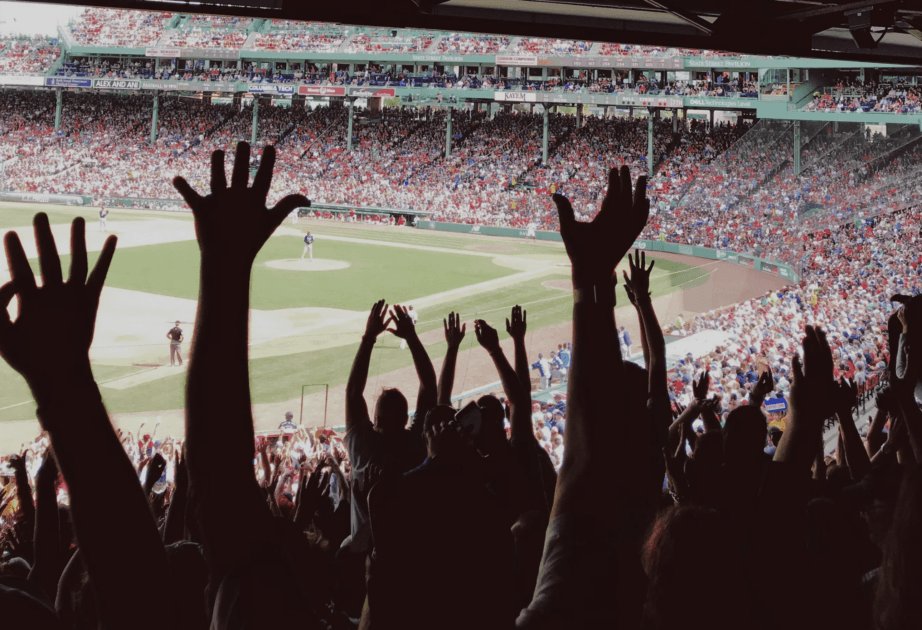
I recently considered the oddity of American ritual when attending a Chicago White Sox game with my father and uncle. My dad, who was drafted into the Vietnam War, was in his seat when a voice over the sound system instructed all attendees to “please rise for the National Anthem.” He later told me that he remained seated, preferring to eat his hot dog in relative comfort. My uncle and I were in the concession stand concourses. He was looking for Italian sausage, while I was trying to find a beer vendor that sold Leinenkugel’s Summer Shandy. Distracting me from my search for my beverage, preferably on draft, was something that resembled a scene from a science fiction movie in which the activation of some devious device places everyone into a catatonic state. In the concession area, almost everyone stopped moving, paused their business transactions, and fell silent to turn toward the field. Most held their ballcaps over their chests. My eloquent reaction was to mutter, under my breath, “what the fuck?” I continued walking, my own hat still squarely on my head, as did my uncle, also wearing headgear. A few of the pious gave us dirty looks. I wondered if anyone would confront us, perhaps even with an insult or threat. The blood and hatred in the American air can always explode into violence. In a country with 500 million civilian-owned guns, and concealed carry liberties, including in the reliably “blue” Illinois, the explosion often becomes literal, inside a victim’s stomach, chest, or cranial cavity.
Perhaps, too hypnotized by the patriotic spectacle, no one chastised my uncle or me. He found his encased meat of choice, and I did locate the summer shandy on draft for a plunderous $15.
Less than two weeks later, controversy, violence, and characteristic Americans idiocy did ensue at a Chicago baseball game, only it was on the north side in the storied, pastoral Wrigley Field. A cell phone video went viral, at least in the Chicagoland area, of a twentysomething man remaining seated during the National Anthem, while an elderly man behind him, wearing a Cubs jersey customized to feature his own surname across the shoulders, barked at him, “Stand up! Stand up!” When the young guy failed to respond, the angry old man smacked him across the back of the head. With a look of shock on his face, the young man slowly rose to his feet. Still not satisfied, the patriot, who just committed an assault in front of hundreds of witnesses, none of whom did a thing to respond, continued to shout toward the back of his victim’s head.
The assailant was later identified as Robert Chavez. In an interview with “Inside Edition,” Chavez explained that security did intend to remove him from the stadium, but his victim actually talked them out of it. Not only did he cooperate with the slap and convince security to let the slapper enjoy the game, he also bought Chavez a beer. The Chicago Cubs organization declined to punish Chavez, and the local media treated the story with a tone of amusement.
In his interview, Chavez confessed to the crime with a degree of remorse, saying, “Even though I fought in Vietnam and I had buddies killed, you know, I mean, we fight for the rights of the people, and that’s one of his rights.”
It leaves one punch-drunk to contemplate how over 51 years after the Fall of Saigon, there are still Americans, combat veterans no less, who believe that the Bill of Rights was somehow at stake in the jungles and villages of Vietnam. Perhaps, it is a coping mechanism for Chavez, along with the many Vietnam Vets who I see walking around grocery stores in sweatshirts and baseball caps advertising their service, to believe that their “buddies were killed” and that they themselves killed people to preserve the American “way of life” against an existential threat; to protect the right of a young man, five decades later, to sit or stand during the National Anthem. My father doesn’t believe that absurdity nor do most of the veterans, like Tim O’Brien, Robert Kovic, Larry Heinemann, and Lynda Van Devanter, who wrote the great literature of the war. But it is sufficiently widespread that every Memorial Day, Veteran’s Day, and Fourth of July includes celebrations of those fought not only in Vietnam, but also Afghanistan and Iraq, whether it was the Gulf War or the post-9/11 “weapons of mass destruction” monstrosity, as defenders of “American freedom.”
Rare is acknowledgement of the three million Vietnamese who the US annihilated or the millions who remained to suffer the defects and diseases that result from agent orange poisoning. It is uncommon to hear discussion of the American soldiers, like my father, who have had a lifetime of health issues related to exposure to the same chemical weaponry. There is hardly a passing thought for the Afghans and Iraqis, numbering in the hundreds of thousands, who died in American wars. Like their medical cousins in Vietnam, thousands of civilians in those countries also deal with an assortment of maladies, some of them life-threatening, from the environmental toxicity that lingers after days and days and days of bullets, bombs, military pollution, and burn pits.
The end of the war is hardly the end of the torture and torment – not for the civilians of the countries that our military leaves choking in the dust or for the women and children who have to tiptoe around the traumatized, maladjusted, on-edge man in their home. Stacy Bannerman, a heroic leader of the campaign for military spouses and children, has dedicated much of her life to spotlighting the dark corners of violence that few Americans, especially those in positions of legal, political, or military leadership, are willing to explore. She has testified in front of Congress that households with a combat veteran are three to five times likelier to experience domestic violence. Her research has also uncovered that the United States Army even has an “acceptable rate of domestic violence,” meaning a rate that they find manageable from a public relations and personnel management standpoint; a rate that does not require or motivate an official response.
The war machine that is central to American power must silence consideration of the lives that it crushes into the dirt. As Bruce Springsteen sings in “Last to Die,”
We don’t measure the blood we’ve drawn anymore
We just stack the bodies outside the door…
Essential to the stacking is a religious reverence for America itself, turning on the dogma that American wars – no matter how many revelations emerge regarding real reasons and specious justifications – are about “freedom.” It is not so much a historical argument or political analysis, but theological doctrine. The young man who Robert Chavez slapped, whether he remained seated as a protest or as an expression of laziness, was a heretic. Heretics deserve punishment.
Sociologist Robert Bellah wrote in 1967 that the “theme” of American life is a “continuous one in civil religion.” “From the earliest years of the republic is a collection of beliefs, symbols, and rituals with respect to sacred things and institutionalized in a collectivity,” Bellah asserted as part of his explanation that there is “no other word” but “religion” to describe how most Americans (I would add, white Americans), from the powerful to the one-out-of-one-hundred-million voter, views their society.
Bellah was not entirely opposed to civil religion, as he believed that it could promote social cohesion, civic virtue, and public service, but he did write that the Vietnam War, the Watergate scandal, and the daily injustices that the Civil Rights Movement had brought to the forefront, drained and discarded much of the substance of the American religion, leaving only a “broken and empty shell.”
The broken and empty shell provokes a massive investment of time and energy – manpower, political resources, and cultural pressure – to make it appear solid, robust, and expansive. White Americans, along with certain immigrant groups attempting to assimilate according to the most obnoxious model of mainstream behavior, love their flags, anthems, patriotic clothing, and declarations of American superiority. Anyone who has lived abroad or travelled to an educated, developed country can attest that the constant displays of national pride in the US, which obviously mask deep feelings of insecurity, are odd and novel. One is unlikely to hear an Italian declare that Italy is the “greatest country in the history of the world.” It is difficult to imagine a Japanese politician announcing, as Kamala Harris did about her own national identity, that “the greatest privilege on Earth is being Japanese.”
I recall one of my first conversations with a Croatian immigrant in college. She told me that when she arrived in the United States, she was “frightened” by all the flags flying from every government building, many businesses, and countless private homes. It reminded her of when the Croatian War of Independence broke out during the 1990s, the only time she saw such widespread and garish exhibitions of patriotism in a European country.
Of course, when she arrived in the US, the country was at war with two countries, Afghanistan and Iraq, under the umbrella policy of the “war on terror,” which would eventually lead to the bombing of eight additional countries, and the deployment of special forces on missions in several African nations. Even the least seasoned political observer can make a safe bet that, irrespective of the president, political party in power, or domestic circumstances, the US is bombing some foreign city. Unless the bombing campaign qualifies as a “war,” as is the current policy toward Iran, the “death from above” method of international relations is not even subject to debate. In the first year of his second term in office, Donald Trump has authorized the bombings of seven countries: Iraq, Iraq, Nigeria, Somalia, Syria, Venezuela, and Yemen. What percentage of Americans could name these countries? What percentage of journalists, for that matter?
Most Americans don’t know who their government is bombing, or why, but they will stand for the National Anthem at the nearest sporting event. Surveys show that Generation Z is less patriotic than their forebears, with 56 percent of them telling national pollsters that they are “proud to be American” (Generation X and Baby Boomers score higher). Well over half is still a strong showing for Gen Z, and the number could easily rise when the ghastly Donald Trump is no longer in office. I was recently surprised at a Fourth of July party to see the large number of recent college graduates wearing patriotic-themed clothing. A few of them asked my wife and me why we weren’t wearing “red, white and blue.”
On the same day, I saw footage of Barack Obama explain that, even though George Washington owned slaves, it “does not negate his greatness.” Such a baffling statement is similar to declaring that Charles Manson was a good musician. The whole murderous cult thing doesn’t “negate his greatness.”
Arguing that keeping human beings as property isn’t a profound enough failure to condemn a leader makes as much sense as young people displaying national pride or smacking young people who refuse to display national pride in a country that is currently rounding up minorities, encaging them in abusive and filthy conditions, and killing those who protest in the streets. For those not under the hypnosis of devotional zeal, it is challenging to have pride in a country that allows thousands of people to die each year for lack of health care coverage, while many more suffer financial ruin due to “medical debt.” One of our national hymns is “America the Beautiful,” and yet with each passing day, more of our natural beauty faces destruction at the hands of corporate machinery and relaxed pollution standards, destroying wildlife habitats, threatening livable ecology, and allowing the degradation of natural treasures from the Alaskan wild to the Indiana Dunes.
But just as it would be improper to walk into a prayer meeting with questions about epistemology, one doesn’t poke at a civil religion. In reviewing the career of Robert Bellah, historian Ray Haberski concludes that the deep moral transformation that genuine leaders, like Martin Luther King, hoped to achieve is unlikely. Instead, periods of reform will merely smooth the rough edges to renew the faith. “The United States [is] is too big to fail,” Haberski writes.
His Great Recession lingo is appropriate. The US is one giant bubble, waiting to pop. The instinct to smack a young guy who sits during the anthem is a milder version of the imperative that a masked agent of the state feels when shooting a protestor: Anything to keep the thin surface intact.
Conformity and violence? As American as baseball and apple pie.
