
[ad_1]
With another break-the-siege flotilla now en route, Eman Abu Zayed, a writer in Gaza, says that hope — despite its weight — keeps finding its way across the sea again and again.

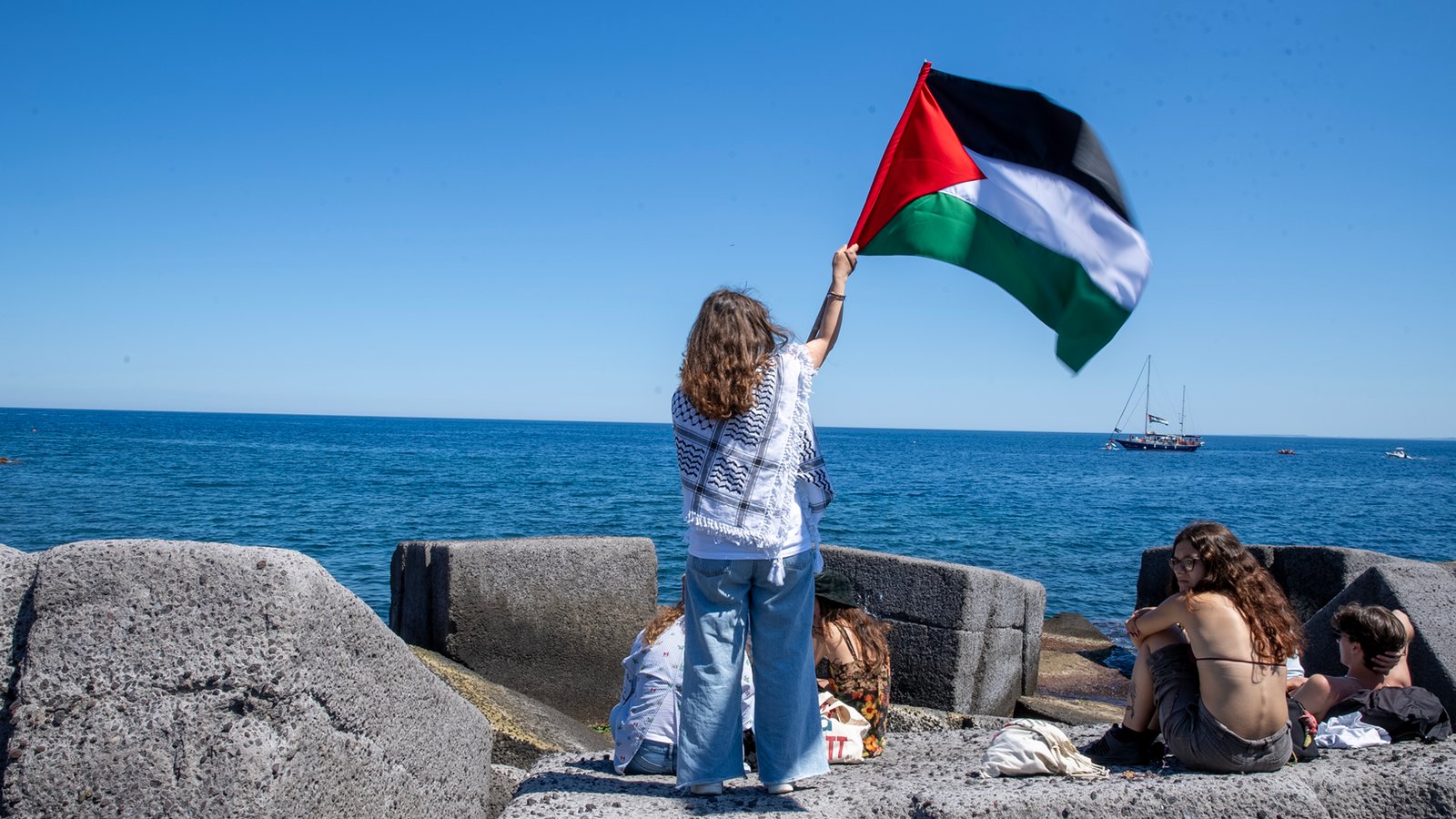
A woman in Catania, Sicily, holds the flag of Palestine on June 1, 2025, before the Freedom Flotilla’s Madleen departs on its voyage to Gaza. (Tan Safi / Freedom Flotilla )
By Eman Abu Zayed
Z Network
 When word of an upcoming maritime flotilla coming from countries thousands of kilometers away first began circulating, Palestinians were in the heart of this war, in one of its harshest moments, with famine silently tearing through Gaza — heavier even than the shelling itself.
Despite my awareness of the Israeli occupation’s brutality and severity, and my knowledge that it does not really distinguish much between one nationality and another, there was something that made me hold on to a small hope: that the flotilla would be allowed to pass.
That those ships carrying aid, medicine and teams of doctors whose only purpose was to save what could be saved, would actually reach us.
The first attempts to send a humanitarian maritime flotilla during the genocide emerged in the spring of 2024, when an international civil coalition announced it was sending ships loaded with aid toward Gaza in an attempt to break Israel’s naval blockade — or, at least, to draw attention to the deepening humanitarian catastrophe.
The route was never easy. From the very beginning, these efforts faced all manner of obstruction from the Israeli and U.S. governments and their allies. Some ships were stopped before arrival and participants encountered various forms of pressure and restrictions.
Still, the idea could not be stopped. What began as a single attempt turned into continuous repetition. Each time the flotilla was blocked, it did not return the same — it became larger and more diverse: doctors, journalists, writers and activists from different countries deciding to undertake this journey despite fully understanding the risks.
The idea did not disappear after the first failed attempt; it kept repeating and expanding, as if its persistence was stronger than the ability of Israel to stop it. Each time, the initiative was revived again in the face of a reality that was becoming more complex and harsher.
In 2025, another flotilla came, the Global Sumud Flotilla. Larger and more organized than the previous one, it carried both a humanitarian and a political message, determined to break the blockade and open a maritime corridor for aid.
This effort faced a harsh response; it was intercepted at sea, participants were stopped and detained and force was used against them, despite all of them being part of a purely civilian mission without any military element.
This treatment was not an isolated incident; it was part of an ongoing policy aimed at enforcing the blockade and preventing any attempt to challenge it, regardless of the identity or background of those involved. The diversity of nationalities and the clearly humanitarian nature of the initiative did not change the firmness of the response.
The flotilla, however, did not remain confined to the sea. As it was intercepted, its echoes spread to different cities around the world, where protests and solidarity actions were held rejecting the blockade and demanding the flotilla be allowed to continue its journey.

March and rally in Sydney, Australia for Sumud flotilla members who tried to break the blockade of Gaza. (Cathy Vogan)
I, like many others, received photos and videos of demonstrations in Italy and elsewhere, as the flotilla turned into a global point of convergence that placed the blockade itself at the center of international debate.
Still, the interception continued, and so did the blockade — the existing policies allowed no exception.
Yet what the Global Sumud Flotilla left behind could be measured not only by its immediate outcome, but also by the scale of reaction it generated and the questions it reopened about the legitimacy and continuation of the blockade under growing international pressure.
A number of participants in the 2025 flotilla gave public testimonies upon their release, describing harsh detention conditions and treatment they characterized as abusive and humiliating.
Some said they were restrained for long hours, denied sufficient access to medication and food, and subjected to psychologically punishing conditions and degrading procedures.
Journalists and European activists who took part in one of these journeys stated that they were subjected to prolonged restraint and confiscation of personal belongings, simply for attempting to reach Gaza by sea, despite the declared humanitarian nature of the mission.
In other testimonies, activists spoke about being denied communication for periods of time and being transferred between jails before being deported to their home countries.
Meanwhile, Israeli authorities asserted that all procedures were carried out in accordance with the law and that the objective was to prevent entry into restricted waters.
These conflicting narratives between activists and Israeli authorities added a new dimension to the debate. The discussion was no longer limited to the interception of ships at sea but extended to the treatment of those on board and how it reflects broader Israeli policy.
For me, as a woman from Gaza, the scene has remained present in my mind. It carried a mixture of exhaustion, astonishment and hope at the same time.
Exhaustion from the continuation of blockade conditions, from the limited humanitarian corridors and from a reality that continues to impose constraints on people’s lives despite months of war, ongoing scarcity and irregular entry of aid through border crossings.
At the same time, there is an undeniable sense of astonishment at the persistence of those at sea. After two rounds of interception and detention, they return again in larger, more organized flotillas, as if each previous attempt did not defeat the idea but deepened it.
This persistence, to me, creates a deep sense that the cause is still alive in distant places, and that there are those who consider it a moral responsibility that cannot be abandoned despite pressure or humiliation.
This persistence has, in many moments, become a small but real source of hope — that the world has not completely closed in, and that there are still those trying to reach us despite all obstacles.
At the same time, reality here remains harsh. Our pain is reduced to a simple yet heavy question: How can the distance between our need and their support be only a border crossing or a small strip of sea, yet life remains suspended in a state of prolonged suffering?

Tunisians gathered in Sidi Bou Said near Tunis on Sept. 7, 2025, to welcome the Global Sumud Flotilla, including Greta Thunberg. (Brahim Guedich/Wikimedia Commons/ CC BY 4.0)
Still, this encounter between those trying to arrive and those waiting under blockade forms a complex human space that tells us all at least one thing: This cause is still capable of moving people and reshaping the meaning of solidarity, even in the most difficult moments.
The diversity of participants in these initiatives is evident. They included doctors who left their workplaces, journalists who left their professional duties, as well as writers, volunteers, and students — all gathered within a single framework, driven by a shared sense of human responsibility.
Among them was my Italian friend who was on board the flotilla and is a journalist like me. Throughout her time there, she would send me messages full of hope and encouragement despite the difficult conditions she was experiencing.
Her presence on the flotilla was not just a passing participation, but an extension of a human purpose that brings together people from distant places, meeting around a single idea and a shared desire for support and survival.
In the end, what is happening at sea does not appear to be an isolated event or a passing moment, but rather a continuous chain of attempts that repeat themselves despite all obstacles.
Each flotilla that reaches the point of interception leaves behind an impact that continues beyond the moment it is stopped and reopens the same question about the blockade and its limits.
With another flotilla now en route, it is clear that the idea continues to be reshaped with each new experience.
For me, there remains in this tactic a meaning that cannot be ignored: a sense that there are still those trying to reach us, that the cause has not been closed, and that hope — despite its weight — continues to find its way across the sea again and again.
Eman Abu Zayed is a writer and journalist from Gaza who believes in the power of words to change reality.
This article is from Z Network.
Views expressed in this article and may or may not reflect those of Consortium News.
[ad_2]
Source link
