
[ad_1]
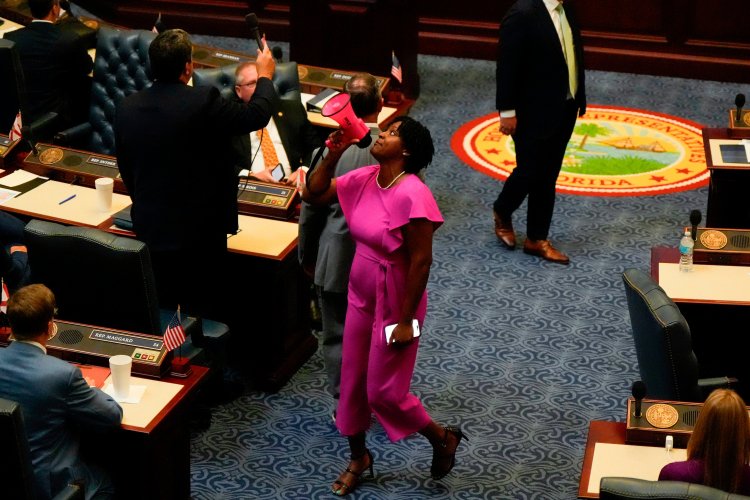
Far-left State Rep. Angie Nixon handed the progressive movement a surprise win against deep-pocketed Alex Vindman in Florida’s Democratic Senate primary Tuesday night.
With nearly all precincts reporting, Nixon had handily defeated Vindman, a retired Army lieutenant colonel and a top witness in President Trump’s 2019 impeachment, by 12 points, 56% to 44%.
Nixon’s victory over Vindman despite his name recognition and being vastly overspent in Florida’s Democratic Senate primary came as surprise precisely because of where it happened.
Progressives or those aligned with the democratic socialist movement have racked up primary victories elsewhere this cycle, but almost all of them came in blue or purple states.
Florida is neither. The once swing state has turned red over the last several years, which is exactly why Republicans are already treating Nixon’s win as a gift: a weak candidate that gives them the advantage of tying Democrats across the ballot to the party’s left flank heading into November.
Vindman had amassed a $16 million war chest for the campaign while Nixon raised a paltry $974,000 by comparison.
Shortly after the race was called, Trump celebrated Vindman’s defeat.
“SleazeBag Vindman loses tonight to a Radical Left Lunatic. How cool is that???” the president wrote on Truth Social.
Nixon and Vindman were vying for a chance to unseat Florida GOP Sen. Ashley Moody, whom Republican Gov. Ron DeSantis appointed to the seat vacated when Sen. Marco Rubio became Trump’s secretary of state.
Nixon joined the Democratic Socialists of America during the course of her primary bid – though the group stopped short of endorsing her – and drew backing from progressives including Democratic Reps. Maxwell Frost of Florida, Ilhan Omar of Minnesota, Rashida Tlaib of Michigan and Ayanna Pressley of Massachusetts.
She and Vindman were competing for a chance to challenge Moody and serve the last two years of Rubio’s term, which ends in 2028. Whoever wins the November election will still need to run again in 2028 if they want to serve the full six-year term.
Moody, a former Florida attorney general, fended off three longshot challengers for the GOP nod. She easily won her Republican primary Tuesday.
Vindman received endorsements from key Democrats like Sens. Mark Kelly of Arizona, Jack Reed of Rhode Island, and Tammy Duckworth of Illinois, as well as Florida state Senate Democratic Leader Lori Berman. Nixon, who was first elected to the Florida state House in 2020, never got the chance to make her case against him directly – Vindman skipped debating her during the campaign and increasingly distanced himself from the party’s left flank as the race wore on.
Vindman also leaned into his history of standing up to Trump during his first impeachment, by fashioning himself as an anti-MAGA attack dog. Vindman, who was serving on Trump’s National Security Council at the time, testified before Congress in late 2019 that the president had pressed Ukrainian President Volodymyr Zelensky to investigate former President Biden.
Trump has defended himself, calling his communication with Zelensky a “perfect” call, and the Senate ultimately acquitted him. Nixon, for her part, argued Democrats haven’t been forceful enough in their own messaging, hammering cost-of-living pressures on health care, housing, and food assistance.
Vindman was expected to clinch the Democratic nomination, with many polls predicting a Moody-Vindman match-up.
Despite Tuesday’s primary drama, Moody remains the clear favorite heading into November. The last time Florida elected a Democrat to the Senate was in 2012 when former Sen. Bill Nelson won his third term. The nonpartisan election handicapper Cook Political Report rates Moody’s seat as “solid Republican.”
A University of North Florida poll of likely voters taken in July had Moody leading Nixon 50% to 42% in a head-to-head matchup, while a separate survey from Associated Industries of Florida conducted in early June showed Moody up 7 points over Vindman, with her support rated as “harder” than his.
Donalds faces Jolly to succeed DeSantis as governor
Florida delivered a far more predictable outcome in the gubernatorial primary, as GOP Rep. Byron Donalds and Democrat David Jolly won their respective races to compete for the state’s open governorship.
The primary results confirmed a long-expected clash to determine who will lead Florida after eight years under term-limited Gov. Ron DeSantis. Donalds and Jolly emerged from crowded primary fields – Donalds beat out ten other Republican candidates, while Jolly separated himself from his Democratic rivals through stronger fundraising and polling.
Donalds enters the general election as the heavy favorite, buoyed by both institutional backing and a significant financial edge. His win positions him to succeed DeSantis, and he ran with President Donald Trump’s endorsement after serving as a frequent Trump surrogate and appearing on the shortlist for vice president in 2024. On the fundraising front, Donalds has raised nearly $10.2 million through his political committee and campaign account over the past three months – more than ten times the roughly $1 million Jolly has brought in since entering the race in late April.
Jolly, notably, is a former Republican making his second act as a Democrat. The Tampa-area congressman, who served in the House from 2014 to 2017, left the GOP largely over his opposition to Trump before launching his gubernatorial bid. In 2018, he departed the Republican Party altogether to become a no-party-affiliation voter, and he has since built a following among Democratic activists partly through his work as a political commentator on MS NOW (formerly MSNBC). His campaign has focused on lowering housing and insurance costs, boosting public education funding, and pursuing new gun-safety measures.
Despite Donalds’ financial and structural advantages, recent polling suggests the race may not be a runaway. A University of North Florida survey last month showed Donalds leading Jolly 46% to 41%, a 5-point margin notably smaller than the wide victories Republicans have typically posted in recent Florida statewide elections.
Closing that gap would require Democrats to consolidate behind Jolly, win over a large share of independents, and potentially peel off some Republican crossover voters – a tall order in a state where Republicans now hold a voter-registration edge of more than 1.2 million, but not, pollsters say, an impossible one.
A new Hart Research Associates poll released Tuesday night shows a razor-thin lead for Jolly, 46% to Donalds’ 45%, which Democratic operatives attribute to Donalds’ “polarizing image” and “underwater ratings” with independents.
Republican registrations favor Donalds, Moody
Still, Republicans start with a built-in structural edge statewide: GOP-registered voters outnumber Democrats in Florida by roughly 1.5 million.
Moody, who secured Trump’s endorsement early enough to avoid a serious primary challenge of her own, has kept a notably low profile since – holding few solo public events and giving relatively few media interviews, a pattern that has frustrated some GOP county chairs and operatives and left voters with limited information about where she stands on key issues. Most of what she has said publicly has been aimed at attacking progressives, a line of attack Nixon’s win is likely to sharpen.
The Nixon-Moody match-up is one of several in a Senate midterm map where Democrats have almost no room for error nationally. To retake the majority in November, the party would need to defend every seat it currently holds and flip four Republican-held seats elsewhere, making Florida one of several long-shot pickups the party has been eyeing to win control.
Florida’s electorate complicates that math further. The state is home to a large population of Latino voters, many of whom or whose families fled left-wing dictatorships in countries like Cuba and Venezuela and remain wary of anything that reads as similar ideology taking hold in American politics. It’s a dynamic that could cut against Nixon’s DSA ties in November.
Florida incumbent Democrats prevail
Nixon’s Senate upset wasn’t the only test of the party’s progressive-versus-establishment fault line on the ballot Tuesday.
In two of South Florida’s most closely watched House primaries, sitting Democratic incumbents beat back DSA-aligned challengers to hold their seats in newly redrawn districts.
Rep. Jared Moskowitz won the Democratic primary in Florida’s redrawn 25th Congressional District, turning back a challenge from Oliver Larkin, a former union organizer backed by the Democratic Socialists of America. Moskowitz had been drawn out of his old 23rd District by the state’s GOP-controlled redistricting process and will now face former Boca Raton Mayor Scott Singer in a district Republicans made significantly more competitive this cycle.
Rep. Debbie Wasserman Schultz, the state’s longest-serving Democrat in Congress and a former Democratic National Committee chair, also won her primary Tuesday – but in a different district than the one she currently represents.
After Republicans dismantled her Broward County seat in redistricting, Wasserman Schultz opted to run in the newly configured 20th District, a Democratic stronghold that has been represented by black lawmakers for more than three decades. She won roughly 48% of the vote in a crowded field that included former Rep. Sheila Cherfilus-McCormick – who resigned from the same seat in April amid allegations she stole millions of dollars in COVID-19 relief funds, which she denies — along with progressive Elijah Manley and musician-turned-activist Luther “Uncle Luke” Campbell.
Wasserman Schultz’s decision to run in a historically Black district drew criticism from some activists worried about the loss of black representation in Congress.
Trump-backed Florida Rep. Cory Mills ousted
While Trump reveled in Vindman’s defeat, he was mum on another loss of a Republica candidate he had endorsed. In Florida’s 7th Congressional District, GOP Rep. Cory Mills, who is embroiled in ethics scandals, lost his primary despite having been endorsed by President Trump.
Mills was defeated by Ryan Elijah, a former local television news anchor. He has faced a multi-pronged House Ethics Committee investigation into allegations of domestic violence, stolen valor, and campaign finance violations, along with a separate Justice Department inquiry into his finances, but has denied wrongdoing.
Trump backed Mills in February, but as the allegations mounted, the president left him out of a fresh round of endorsements for Florida incumbents that he posted in the days before the primary. DeSantis also said he did not support Mills, and Florida Reps. Anna Paulina Luna and Mike Haridopolos both endorsed Elijah over the incumbent. With more than 80% of the expected vote counted, Elijah had roughly 46% to Mills’ 34%.
With Elijah now the nominee, the Cook Political Report rates the seat as “likely” to stay in Republican hands, easing one point of vulnerability Republicans had been watching heading into the fall.
Alaska primary tees up key Senate race
Alaska’s Senate race is set: Republican Sen. Dan Sullivan and Democrat Mary Peltola emerged from Tuesday’s primary and will meet in November for one of the cycle’s most closely watched contests.
With nearly all precincts reporting, Peltola was edging Sullivan 48% to 42.8%.
The state uses an all-party primary in which all candidates – 16 in this case – appear together on one ballot, with the top four finishers moving on regardless of party. Sullivan and Peltola secured two of those four spots; the identities of the remaining two general-election candidates were still unsettled.
Complicating that picture is a second candidate who also goes by the name Daniel Sullivan Jr., whom critics have accused of running specifically to sow confusion among voters and muddy the outcome. As of early Wednesday morning, Sullivan Jr. had secured 2.4% of the vote.
The race is pivotal in the broader battle for Senate control. Sullivan is seeking a third term in a state Trump carried by more than 13 points in 2024, and he has built a substantial financial cushion to defend it – over $11 million raised, with north of $7 million still on hand as of late July.
Peltola, who held Alaska’s lone House seat from 2022 until 2025, is betting that a pitch focused on defending the fishing and energy industries can win over enough crossover voters to flip the seat blue. Her fundraising has actually outpaced Sullivan’s, topping $18 million with roughly $4.6 million remaining in the bank.
Even though Alaska is simultaneously hosting its first genuinely wide-open governor’s race in a generation, it’s the Senate contest drawing the lion’s share of outside money – ad tracker AdImpact puts total spending on the race at more than $56 million so far.
Alaska’s open race for governor favored two Democrats leading a crowded field that includes 12 Republicans. With more than 94% of votes reported, former Sitka state Rep. Jonathan Kreiss-Tomkins leads with 21.7%, followed by Anchorage state Sen. Tom Begich at 20%, Anchorage businesswoman and Republican Bernadette Wilson with 10%, and former Anchorage Mayor Dave Bronson with 8.4%.
Mixed bag for Trump endorsements in Wyoming
Wyoming Republicans delivered a split verdict on President Trump’s endorsements Tuesday, backing his pick in the state’s Senate race while rejecting his choice for governor.
Rep. Harriet Hageman, who carries Trump’s endorsement, won her primary to succeed retiring GOP Sen. Cynthia Lummis, positioning her as the likely victor against former Democratic state Rep. James Byrd in November. Wyoming hasn’t elected a Democrat to the U.S. Senate since 1962.
Trump had backed Hageman in her Senate bid, and she significantly outraised her nearest Republican competitor, Sam Mead, drawing about $2.4 million to his roughly one-tenth of that sum.
The victory mirrors Hageman’s 2022 breakthrough, when Trump’s backing helped her unseat then-Rep. Liz Cheney – a vocal Trump critic who had voted to impeach him in 2021, sat on the House committee probing the January 6 Capitol attack, and repeatedly condemned the riot publicly.
“I know Harriet well, and she is a TOTAL WINNER!” Trump wrote of this year’s race. “Harriet has ALWAYS delivered for Wyoming, and will continue to do so in the United States Senate.”
The governor’s race told a different story. State Sen. Eric Barlow, a Gillette rancher and former House speaker, won the GOP nomination for governor, a result that made him the overwhelming favorite to become the state’s next chief executive. With 57% of the vote counted, Barlow led with 44.4% of the vote, well ahead of Trump-endorsed Megan Degenfelder’s 29.9% and Wyoming GOP-endorsed Brent Bien’s 24.2%.
Money and organization appear to have mattered more than the presidential endorsement in the governor’s race. Barlow outraised his rivals in what became Wyoming’s most expensive gubernatorial primary in recent history, collecting roughly $1.54 million in contributions and carried-over funds, about $380,000 more than Degenfelder. Notably, the overwhelming majority of Barlow’s fundraising came from individual donors rather than PACs or loans – 74% of his total dollars and 96% of his individual contributions. Degenfelder, by contrast, leaned more heavily on political action committees for her financial backing.
Barlow, born in Gillette and raised on his family’s ranch, previously served as a Marine and worked as a large-animal veterinarian before entering the state legislature in 2013 and later chairing key Senate committees. He now advances to face Democrat Kenneth Casner, who ran unopposed for his party’s nomination, along with Constitution Party nominee Rebecca Bextel, in the November general election to succeed term-limited Gov. Mark Gordon.
Susan Crabtree is RealClearPolitics’ national political correspondent.
[ad_2]
Source link
