
[ad_1]
When a driverless car makes a mistake, everyone pays attention.
A robotaxi stops awkwardly in traffic. A Waymo gets confused near a construction zone. A child runs into the street and is struck. A fleet of empty autonomous cars circles a residential neighborhood. A self-driving vehicle passes a stopped school bus. The incident becomes a headline, then a symbol, then a warning: See? The robots are dangerous. But this is exactly where skepticism is needed. What if, despite the headlines, driverless cars actually make fewer mistakes, and less deadly mistakes, than human drivers?
Human driving is not a gold standard but more of a mass-casualty system we have normalized. The National Highway Traffic Safety Administration (NHTSA) reported 39,254 traffic deaths in the United States in 2024, with a fatality rate of 1.19 deaths per 100 million vehicle miles traveled. Its early estimate for 2025 was 36,640 deaths, still a staggering number. Distracted driving alone killed 3,208 people and injured an estimated 315,167 in 2024. 1, 2
Those numbers are so large that they are hard to fathom. A human driver drifts across the centerline, runs a red light, texts through an intersection, falls asleep, or drives home drunk—tragic but familiar. A robotaxi makes a mistake, and it becomes a referendum on the future of the technology.
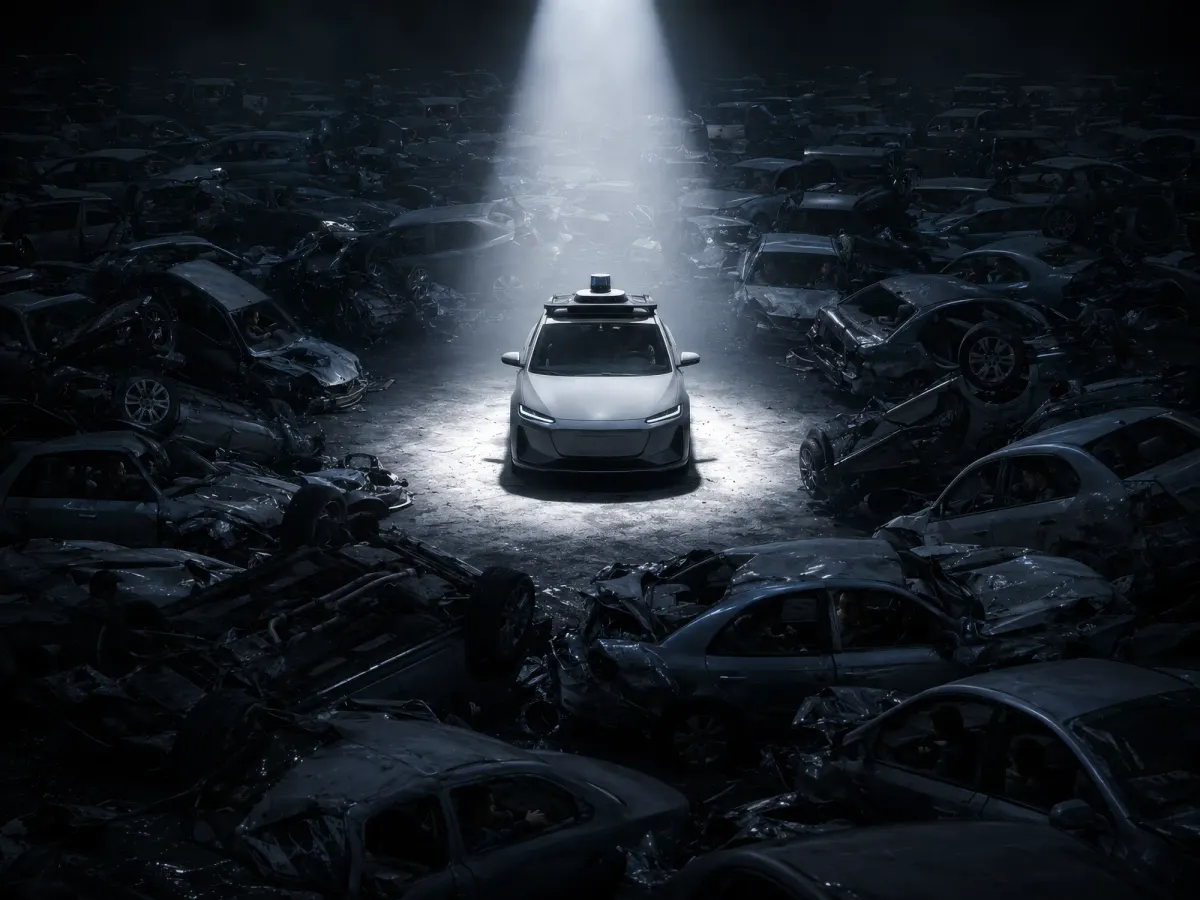
So, the question isn’t really whether driverless cars are perfect, but whether they are safer than us. The human driver is the control group.
The Failures
In January 2026, a Waymo vehicle struck a child near a school in Southern California. According to reporting on the NHTSA investigation, the child ran into the street from behind a parked vehicle, and the Waymo braked from about 17 mph to under 6 mph before impact. The child reportedly suffered minor injuries. Waymo has said its simulation suggested a human driver would likely have hit the child at a higher speed, but federal investigators opened a preliminary evaluation to examine the event and related safety questions.3
Human driving is not a gold standard but more of a mass-casualty system we have normalized.
This is the kind of incident that frightens people the most. Children near schools are exactly the kind of vulnerable road users any autonomous system must handle with extreme caution. But it is also exactly the kind of incident that must be compared honestly. Children sometimes dart into roads from behind obstructions. Human drivers often do not see them in time. If an autonomous vehicle slows dramatically before impact, and if a human driver would likely have hit at greater speed, the incident is a test of whether the technology is reducing harm in the real world more so than a simple indictment of the failure of the technology to prevent the accident.
Waymo has also faced serious scrutiny for passing stopped school buses. Reuters reported in 2026 that U.S. auto safety regulators were investigating Waymo after its robotaxis passed stopped school buses in Austin and Atlanta. The company reportedly identified a software problem that could cause vehicles to slow or stop, then proceed when school-bus stop arms were deployed. Waymo issued a voluntary recall to address the issue, though Austin officials later reported additional incidents after the earlier software update.4
Stopped school buses are among the clearest cases where the law deliberately prioritizes child safety over traffic flow. If autonomous vehicles fail there, the software needs correction, regulators need data, and deployment conditions may need to be tightened. But again, the key question is comparative and corrective: how often does this occur, how quickly is it fixed, and how does the rate compare with human drivers, who illegally pass stopped school buses by the thousands?
There have been other embarrassing failures. In 2026, Waymo recalled 3,871 vehicles after reports that some entered closed freeway construction zones; 13 incidents were described, though no crashes or injuries. In Atlanta, residents complained that riderless Waymos were repeatedly circling a Buckhead neighborhood cul-de-sac, apparently using it as a holding area while waiting for ride requests.5, 6
The human driver is the control group.
These incidents show that autonomous vehicles have distinctive failure modes. They may not get drunk, but they can misinterpret school-bus rules, construction zones, or fleet-routing logic. Second, they show why transparent reporting and regulators are necessary. Third, they show something critics often ignore: software problems can be corrected across an entire fleet. A human driver who passes a school bus may or may not learn. A software update, properly validated, can change the behavior of thousands of vehicles at once.
That is a central feature of this technology: the errors are real, but they are also data that can correct the mistake.
What “Self-driving” Actually Means
The debate is often confused because “self-driving” is used casually to describe very different systems. The standard classification comes from SAE International and is used by regulators such as NHTSA. It defines six levels of driving automation, from Level 0 to Level 5.7
Level 0 means no driving automation. The human does all the driving, though the car may provide warnings or momentary assistance.
Level 1 means driver assistance. The system may help with steering or speed, but not both as a sustained automated driving task. Adaptive cruise control is a common example.
Level 2 means partial driving automation. The system may control steering and speed at the same time, but the human driver must continuously supervise and remain responsible. Tesla’s Autopilot and Full Self-Driving Supervised fall into this broad category, despite the marketing confusion created by names such as “Full Self-Driving.”
Level 3 means conditional driving automation. The vehicle can perform the driving task under certain conditions, but the human must be ready to take over when the system requests it. This is one of the most psychologically difficult levels because it expects a human to stop paying active attention, but then suddenly resume control when something unusual happens.
Level 4 means high driving automation. The vehicle can perform the entire driving task within a defined operational design domain—for example, certain cities, roads, speeds, and weather conditions—without needing a human driver. Waymo robotaxis are the leading real-world example.
Level 5 means full driving automation everywhere a human could drive. This is the science-fiction version: any road, any weather, any condition. No deployed consumer system has reached Level 5.
This distinction is essential. A crash involving a Tesla driver using a Level 2 driver-assistance system is not the same category of evidence as a crash involving a Level 4 Waymo robotaxi with no driver. In Level 2, the human is still part of the safety system. In Level 4, the automated system is the driver within its operating domain. NHTSA’s crash-reporting framework reflects this distinction by separating automated driving systems from Level 2 advanced driver-assistance systems.8
Collapsing these systems into one category—as is often done in mainstream media discourse—is not unlike judging commercial aviation by including toy drones, hang gliders, and fighter jets in your assessment. It creates more heat than light!
Google, Waymo, and Tesla
Waymo began as the Google Self-Driving Car Project in 2009. The project logged autonomous miles, developed custom sensors and software, and eventually became Waymo in 2016 as part of Alphabet, Google’s parent company. Waymo’s own timeline notes that the Google project began in 2009, completed a fully autonomous ride on public roads in 2015, and became Waymo in 2016.9
The long history is significant because the public often treats driverless cars as a sudden, recent tech fad. They are not. They are the product of more than a decade of engineering, mapping, simulation, sensor development, regulatory fights, and road testing. Waymo’s current system is not just “a car without a driver.” It is a fleet-based, heavily mapped, geofenced autonomous driving service built on a long development history.
Tesla is pursuing a different path. Rather than relying on the same type of lidar-heavy, geofenced robotaxi model, Tesla has emphasized camera-based systems and scale through consumer vehicles. In June 2025, Tesla launched a limited robotaxi service in Austin, Texas, with select users and safety monitors in the passenger seat. Tesla’s ambitions are enormous, but its safety evidence should be evaluated separately from Waymo’s. Tesla’s Level 2 supervised systems and emerging robotaxi program should not be treated as if they have already proven what Waymo has begun to demonstrate over tens of millions of fully driverless miles.10
If an article criticizes “self-driving cars” using Tesla Autopilot incidents, then uses that criticism to restrict Waymo robotaxis, it is mixing categories. The same is true when news reporting slams Tesla after a Waymo drives aimlessly in a loop. A skeptic should reject that kind of sloppy reasoning.
The Safety Studies
For many years, the strongest argument against driverless cars was simple: we did not yet have enough real-world driverless miles to know whether they were safer. That objection was reasonable. It is becoming less so.
The strongest safety evidence currently comes from Waymo’s Level 4 robotaxi service. A 2024 paper in Traffic Injury Prevention analyzed 7.14 million Waymo rider-only miles in Phoenix, San Francisco, and Los Angeles. It found that Waymo’s any-injury-reported crash rate was 0.6 per million miles, compared with 2.80 per million miles for the human benchmark—an estimated 80 percent reduction. Police-reported crash rates were also lower: 2.1 per million miles for Waymo versus 4.68 for the human benchmark.11
A human weakness (in the context of driving) is often permanent, while a software weakness is often solvable through more research.
A larger 2025 analysis examined 56.7 million Waymo rider-only miles through January 2025. It found statistically significant reductions in any-injury-reported crashes, airbag-deployment crashes, and suspected-serious-injury-or-worse crashes. In vehicle-to-vehicle intersection crashes, the study found a 96 percent reduction in any-injury-reported events and a 91 percent reduction in airbag-deployment events. The authors reported no statistically significant safety disbenefit in any of the 11 crash-type groups examined.12
That is not proof that all autonomous vehicles are safer everywhere, but it does show that one mature Level 4 system, operating in defined environments, is performing much better than comparable human drivers on important crash measures.
Insurance evidence points in the same direction. A Swiss Re and Waymo analysis compared Waymo’s fully autonomous driving with human-driven liability claims. Across 25.3 million fully autonomous miles, Waymo vehicles had an 88 percent reduction in property-damage claims and a 92 percent reduction in bodily-injury claims compared with human-driver baselines. The benchmark was based on Swiss Re data from more than 500,000 claims and more than 200 billion miles of exposure.13
This is rather important because insurance companies are not paid to be impressed by technology. They are paid to price risk. If autonomous vehicles generate fewer crashes and fewer injury claims, the economic consequences will be enormous.
Fully independent research is somewhat more mixed, but still promising. A 2024 Nature Communications matched case-control study compared 2,100 crashes involving vehicles equipped with advanced driving systems or advanced driver-assistance systems with 35,113 human-driven vehicle crashes. The study found that vehicles with advanced systems generally had lower accident risk than human-driven vehicles in most comparable scenarios. But it also found specific weaknesses: advanced systems showed higher accident odds in dawn/dusk conditions and in turning scenarios.14
That finding should not be hidden. The evidence shows that autonomous vehicles have different strengths and weaknesses from humans. They do not get drunk, tired, or distracted, but they may struggle in edge cases involving lighting, unusual road geometry, construction, emergency scenes, or unpredictable pedestrians.
A serious policy would ask: where are they safer, where are they weaker, and how do we improve the weak spots?
Driving at Dawn and Dusk
The dawn/dusk problem is a good example of how technological systems improve. A human weakness (in the context of driving) is often permanent, while a software weakness is often solvable through more research.
Why? Humans have biological limits. We suffer glare, fatigue, alcohol impairment, distraction, anger, overconfidence, and boredom. We may improve with training, but the human nervous system is not updated over the air. A fleet of autonomous vehicles can be. If dawn and dusk are difficult because of sensor contrast, glare, shadows, or object classification, engineers can gather data, retrain models, improve sensor fusion, adjust operating limits, and deploy software updates. Every failure, near miss, and edge case can be used to improve the system for all vehicles.15
This is why early mishaps should not be treated as permanent indictments. The Wright brothers did not prove aviation unsafe because early airplanes crashed. Early elevators, trains, automobiles, and medical devices all had failure modes that later engineering reduced. The rational question is whether the technology has a path to becoming better than the status quo, and the answer is that driverless cars do.
Human Monitoring
One popular political compromise is to require a human safety operator inside autonomous vehicles. This sounds cautious, but often it is disingenuous.
Humans are not good at supervising automation that works most of the time but may suddenly fail. This is a well-known human-factors problem. When automation handles a task reliably for long periods, human vigilance declines. People become bored, distracted, or mentally detached. Then, when the system suddenly needs help, the human may not understand the situation quickly enough to intervene safely.
That is one reason Level 3 automation is conceptually dangerous: it asks the person to be out of the loop until the very moment the system cannot handle the situation. A 2015 analysis in Science Robotics and related human-factors research have warned that expecting humans to monitor increasingly capable automated systems can be unsafe because it leaves humans responsible for rare, sudden, high-stakes interventions after long periods of inactivity.16
If the human is actually driving, then the autonomous vehicle has effectively been banned.
Google learned this lesson early. In 2013, before Waymo was spun out as an Alphabet company, Google developed a semi-autonomous highway system called AutoPilot. Employees testing it were told to keep their eyes on the road, and Google reportedly used cameras inside the cars to check whether they complied. But the system worked well enough that some testers became too comfortable; after one employee fell asleep while the car was traveling about 55 mph, Google shut down the project and turned away from driver-assistance toward fully autonomous driving. The lesson was exactly the opposite of what some politicians now propose. If the vehicle is doing nearly all the driving, the human becomes less attentive, not more.17
Early Google testing data also showed why relying on occasional human rescue is not a long-term solution. In Google’s 2015 California disengagement report, there were 69 events over 424,331 autonomous miles in which safe operation required the human driver to take over; Google’s simulator estimated that 13 of those would have resulted in contact with another object if the driver had not intervened. But those events were also fed back into the software-development process, and improved the entire fleet.18
So, when politicians say every autonomous car or truck should contain a human driver, the question is: doing what? If the human is actually driving, then the autonomous vehicle has effectively been banned. If the human is merely monitoring, then the law may be creating a false sense of safety. The person may be bored, inattentive, and unprepared precisely because the machine is doing nearly all the work.
Why Anecdotes Dominate the Debate
Daniel Kahneman, who won the Nobel Prize in Economic Sciences for integrating psychological research into economics, spent much of his career studying judgment under uncertainty. With Amos Tversky, he helped develop the idea of the availability heuristic: people judge the frequency or importance of events partly by how easily examples come to mind. Vivid events feel common. Dramatic events feel representative. Familiar statistical carnage fades into the background.19, 20
Kahneman discussed examples such as fear during periods of suicide bombings on buses in Israel. The events were rare in statistical terms, but the images were so vivid and emotionally available that people changed their behavior around them.21
Driverless cars trigger the same psychology. A human-caused crash is ordinary. A robot-caused crash is memorable. An autonomous vehicle hitting a child, even at low speed, becomes an emblem of technological danger. A human driver killing someone while drunk becomes one more tragic entry in a familiar category.
Journalists have incentives to amplify the availability bias. “Human driver rear-ends car” is not a story. “Robotaxi hits child” is. That does not, of course, mean that journalists should ignore robotaxi incidents. Rather, it means responsible reporting should include denominators: miles driven, crash rates, injury severity, comparison with human benchmarks, road type, time of day, weather, and whether the failure has been corrected. Anecdotes don’t accurately represent risk.
The New Luddites
The original Luddites were skilled textile workers in early nineteenth-century Britain who destroyed machinery they believed threatened their livelihoods. They were not simply ignorant enemies of technology—they were responding to real economic disruption, wage pressure, and loss of control over their trades.22 The modern advancements in automation are similar. Self-driving vehicles will threaten jobs. Taxi drivers, truck drivers, delivery drivers, and ride-share drivers are real people. They have families, mortgages, and skills tied to a labor market that may change faster than they can.
Some politicians respond with, I submit, misguided policy. For example, New York State Sen. Luis Sepúlveda’s “Take the Wheel Act” would require a driver to be present in all for-hire motor vehicles, physically seated behind the wheel and engaged in driving. The bill’s justification explicitly says it is intended to “preserve livelihoods,” protect taxi and for-hire drivers, and prevent self-driving cars from delivering a “fatal blow” to the industry.23 And that is the key admission: The law is not just about safety of autonomous vehicles but more so about artificially protecting jobs.
Sen. Josh Hawley has made a similar argument nationally. In 2025, Business Insider reported that Hawley wanted to ban autonomous vehicles and that draft legislation would require human safety operators in autonomous vehicles on public roads. Hawley connected the issue directly to workers such as truck drivers, taxi drivers, Uber drivers, and unionized transportation workers.24
California has seen the same fight over autonomous trucks. Assembly Bill 316 would have required human drivers onboard autonomous trucks over 10,000 pounds. Gov. Gavin Newsom vetoed the bill in 2023, saying it would ban driverless testing and operation of heavy-duty autonomous vehicles and that existing regulatory authorities were sufficient. Unions supported the bill as a way to protect truck-driving jobs.25
The Teamsters have also backed Nevada legislation requiring human safety operators in commercial vehicles over 26,000 pounds, explicitly describing the effort as a way to protect good middle-class jobs.26
There is nothing wrong with caring about workers. But there is something wrong with calling a job-protection law a safety law if the evidence shows the machine may be safer than the mandated human. If the law requires a driverless car to have a driver, it has not regulated driverless cars. It has, effectively, banned them.
The Consumer and Taxpayer Side of the Ledger
Labor unions often speak as if the only moral issue is protecting workers whose jobs are threatened. But consumers and taxpayers matter too.
Driving labor is expensive. The American Transportation Research Institute reported that in 2024 the average marginal cost of trucking was about $2.26 per mile, while driver wages alone were about 79.8 cents per mile. Driver benefits added roughly another 19.7 cents per mile. Together, wages and benefits approached $1.00 per mile, making driver compensation one of the largest components of trucking cost.27 That cost is not absorbed by corporations—it is passed through supply chains into the price of food, clothing, appliances, building materials, and nearly everything else moved by truck.
Analyses of autonomous trucking have estimated large potential savings. A McKinsey analysis summarized by NAIOP estimated that full autonomy could reduce trucking operating costs by about 45 percent, with possible savings of $85 billion to $125 billion annually.28
Even if those estimates prove too optimistic, the direction is obvious. Removing or reducing driver labor in long-haul trucking would reduce freight costs. Lower freight costs would reduce consumer prices, especially for goods that move long distances. This matters most to ordinary consumers, including lower-income households for whom transportation and goods prices consume a larger share of income.
Insurance is another consumer benefit. If autonomous vehicles reduce crashes, they should eventually reduce liability costs and insurance premiums. While today’s autonomous vehicles may be expensive to repair because of sensors, cameras, and specialized parts, over time, fewer crashes and fewer injury claims should reduce the risk component of insurance pricing.
A government that depends on human error, speeding, and traffic violations for revenue has a perverse incentive.
This is not speculation in the abstract. The Swiss Re-Waymo study found large reductions in property-damage and bodily-injury claims for Waymo compared with human-driver baselines. KPMG has estimated that widespread vehicle automation could sharply reduce accident frequency and auto-insurance loss costs over time, even as the insurance industry changes because liability may shift from individual drivers toward manufacturers, fleet operators, and software providers.29, 30
For the average family, the implications are enormous. Auto insurance is a major household expense. Recent consumer insurance estimates put average full-coverage auto insurance at several thousand dollars per year in the United States, though prices vary widely by state, driver, vehicle, and coverage. A future with fewer crashes, fewer injuries, and lower liability losses should eventually mean lower consumer costs, even if the transition is uneven.31
This is the part labor-protection politics often omits. Protecting driving jobs by law does not come free. Consumers pay through higher freight costs, higher ride costs, higher insurance costs, and higher taxes for crash response, congestion, policing, and road trauma.
There is one form of public “loss” that may actually reveal the upside of driverless cars: fewer traffic tickets. The Mineta Transportation Institute estimates that traffic violations generate about $6 billion annually for states and municipalities, and that widespread autonomous-vehicle use could sharply reduce those revenues because AVs are designed to obey speed limits, traffic signals, following-distance rules, and other laws. That may create a budget problem for some jurisdictions, but it is a strange objection to safer roads. A government that depends on human error, speeding, and traffic violations for revenue has a perverse incentive. The public should not preserve dangerous driving because municipalities have grown accustomed to taxing it!32
Help Workers, Don’t Preserve Danger
The humane response to automation is transition support. Truck drivers, taxi drivers, and ride-share drivers did not create the economic forces threatening their jobs. Many have worked hard for decades. Some are older. Some have limited formal education. Some live in regions where alternative jobs are not easy to find. A decent society should not casually tell them to “learn to code.” The solution is wage insurance, retraining, relocation support, retirement bridges for older workers, transition funds, and new employment pathways in fleet maintenance, remote assistance, logistics, vehicle cleaning, charging infrastructure, mapping, dispatch, and safety operations. If autonomous vehicles save consumers, insurers, and logistics firms billions of dollars, then part of those gains can be used to help workers adjust.
That is very different from forcing every autonomous truck or taxi to carry an unnecessary human driver forever. That policy preserves a job title by preserving inefficiency. If the vehicle is safer without the human, it may also preserve danger. The moral line, I submit, is clear: help workers directly; do not protect jobs by banning safer technology.
The Future
The current debate is mostly about mixed traffic: autonomous vehicles sharing roads with human drivers, cyclists, pedestrians, delivery trucks, emergency vehicles, and confused tourists. That is the hardest world for driverless systems because human behavior is unpredictable. The future may look very different.
If most or all vehicles become autonomous, the road system becomes a network rather than a contest among individual drivers. Vehicles could communicate with each other and with infrastructure, coordinate merging, spacing, routing, speed, and intersection timing. Reviews of connected and automated vehicles have found that vehicle-to-vehicle and vehicle-to-infrastructure communication can improve traffic flow, routing, congestion management, and energy efficiency, though the benefits depend heavily on deployment and governance.33
The driverless-car debate is a test of whether we can think statistically about safety, honestly about economics, and humanely about labor disruption.
This could reduce not only crashes but wasted time. Traffic jams are not just annoying. They waste fuel, increase emissions, delay deliveries, raise freight costs, and reduce productivity. Coordinated autonomous vehicles could smooth traffic waves, reduce stop-and-go driving, improve routing, and reduce costly delays.
The climate benefits are plausible but not automatic. Autonomous vehicles could reduce emissions through smoother driving, optimized routing, platooning, and better energy management. Truck platooning studies have found fuel or emissions reductions that can range from a few percent to double-digit savings, depending on spacing and position in the platoon. But autonomous vehicles could also increase total miles traveled if they make travel cheaper and easier. The climate outcome will depend on whether the fleet is electric, shared, efficiently routed, and integrated with public transportation rather than simply adding more empty vehicle miles. The National Academies has warned that the environmental effects of vehicle automation could be positive or negative depending on deployment.34, 35
There are also implications for crime and policing. In a mature autonomous system, high-speed police chases could become rarer because vehicles could be designed to refuse reckless commands, obey speed constraints, or coordinate with law enforcement under clear legal protocols. Stolen-car getaways could become harder if vehicles require authenticated users and cannot be easily commandeered. Highway patrol might eventually spend less time on speeding, drunk driving, reckless driving, and crash response, though resources would likely shift toward cybersecurity, traffic-system oversight, privacy protection, and emergency management.
This future raises civil-liberties questions. A vehicle that can refuse to flee police might also be a vehicle that can be tracked or controlled. Those concerns deserve attention, and are important reasons to build legal safeguards into the system.
Regulation
A skeptical policy would, naturally, reject extremes. It would reject Silicon Valley hype. Companies have incentives to exaggerate safety, understate failures, and deploy quickly. Regulators should demand data, not slogans. But it would also reject political panic: fear of a new technology is not evidence, just as a viral clip isn’t a crash-rate study or a union press release isn’t a safety analysis.
RAND warned years ago that proving autonomous vehicle safety by road testing alone is statistically difficult because fatal crashes are rare events per mile. Fully autonomous vehicles might need hundreds of millions or even billions of miles to demonstrate safety with conventional statistical confidence, meaning regulators need adaptive approaches rather than waiting for impossible certainty.36
That means we need transparent reporting of miles driven, crashes, injuries, disengagements where relevant, operating domains, weather conditions, road types, software versions, and corrective actions. We need independent audits, first-responder protocols, cybersecurity standards, liability rules, and public data sufficient for outside researchers to evaluate safety claims.
NHTSA’s Standing General Order is a step in this direction because it requires identified manufacturers and operators to report certain crashes involving automated driving systems and Level 2 driver-assistance systems.37
Good regulation asks: where is the system safe enough to operate, under what conditions, and with what monitoring? Bad regulation says: even if the machine is safer, put a human behind the wheel forever.
Driverless cars are not yet a universal solution. Waymo’s data do not prove that every company, every vehicle, every city, and every road is ready for full autonomy. Tesla’s robotaxi ambitions should be evaluated on Tesla’s evidence, not Waymo’s. Dawn and dusk remain technical challenges. School-bus violations and construction-zone errors require serious correction. Regulators must insist on transparency.
But the evidence is now strong enough that critics must answer the nuanced, and much harder question: safer than whom?
If autonomous vehicles are currently safer in some domains but not others, permit them in the domains where they are safer and restrict them where they are not. That is the rational approach.
The driverless-car debate is a test of whether we can think statistically about safety, honestly about economics, and humanely about labor disruption. We can help workers without preserving dangerous work. We can regulate technology without banning it. We can investigate robotaxi failures without pretending human drivers are safe.
[ad_2]
Source link
