
[ad_1]
The social, political, and economic factors that lead people to believe in non-existent beings
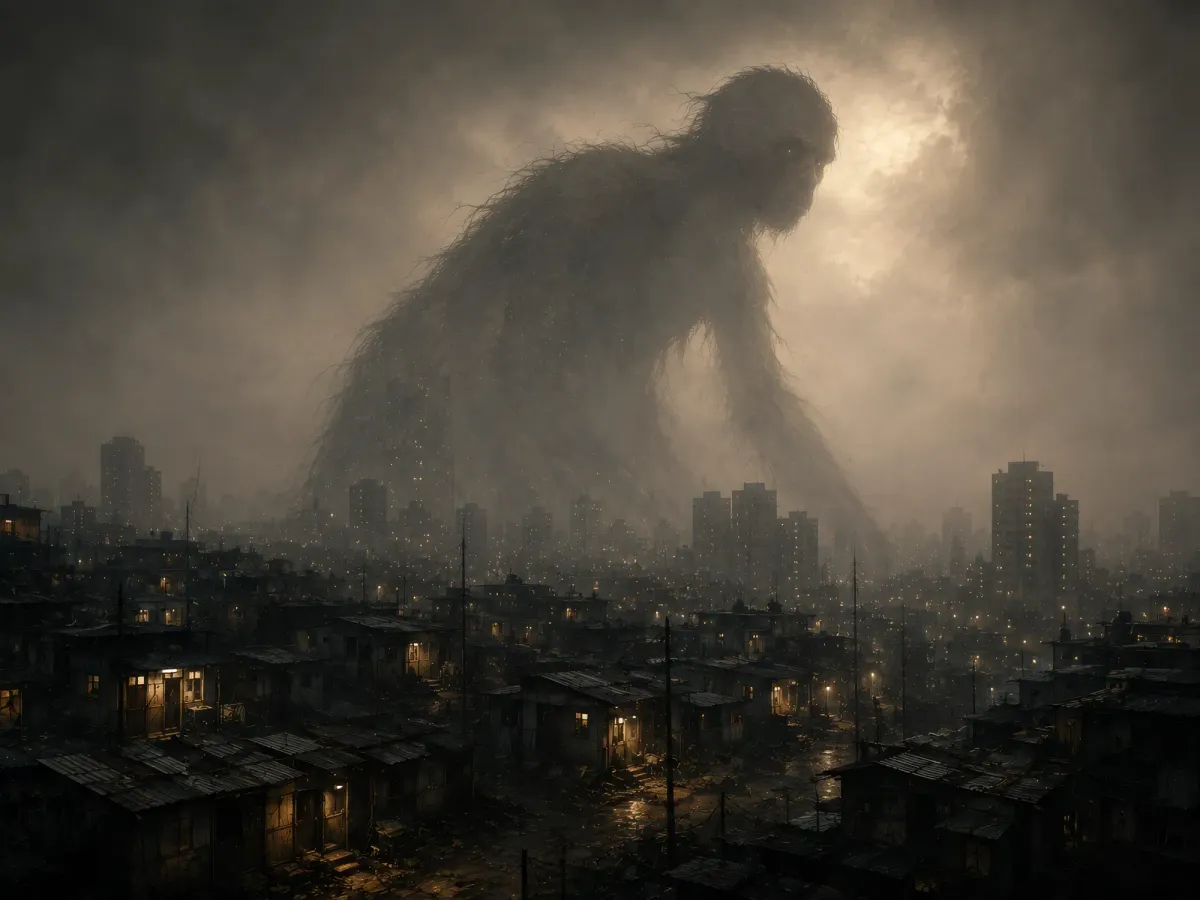
Humans love patterns. Trying to find patterns even where they don’t exist is our way of making sense of the world. Place a million parallel lines before a human observer and they shall immediately know it if one of them is askew. Likewise, that random act of violence must be a conspiracy, those two presidents must have some ontological connection to each other to explain so many coincidences (Lincoln and Kennedy), and that random array of bushes and shrubs must be a human.
Pareidolia is the phenomenon of noticing familiar shapes, patterns, and especially human faces where they don’t exist, the result of a busy human brain trying to make sense of an often-chaotic world, and especially in the case of seeing faces, to recognize signs of friendship or enmity in the external world. Bushes, shrubs, or even car headlights—these are all things we are indifferent to. But a fellow human? Their presence could save a life, or end it. Pareidolia is fascinating as it emerges from an evolutionary instinct that comes to us part and parcel of being social creatures. Our eyes see what the mind wants them to, and what it wants, or fears, is often another human being.
Pareidolia also has a higher chance of occurring when individuals are isolated, and thus under high amounts of stress.
Pareidolia also has a higher chance of occurring when individuals are isolated, and thus under high amounts of stress. Deprivation, whether of food, or oxygen, or even shelter, can exacerbate symptoms, as we are forced to look around more for external support, or to fear that which we cannot see. Interestingly, pareidolia is affected by cultural contexts. If one sees a monkey-like creature for example, whether it is naked or clothed, whether it can speak or not, whether it is malevolent or benevolent, is decided by the social-cultural environment in which the brain has been conditioned.
Another aspect to keep in mind is that instances of pareidolia are self-reinforcing. Once a creature gets spotted, the reports of its sighting get implanted in the minds of other observers, who may thus end up seeing the creature themselves, even if they didn’t believe in the initial reporting and dismissed it as a hoax. The mere implantation of an idea is incredibly impactful upon an impressionable, desperate, and lonesome individual, and has led to multiple cases of mass hysteria, or more technically, Mass Psychogenic Illness (MPI). Pareidolia is one of the most fascinating cases of our minds misconstruing things because we always see creatures that are almost human enough, but lie right in the uncanny valley of uncomfortable recognition. Isolated from society, we wish to see figures similar to ours, but something always feels awry.
This is why stories of the Yeti and Abominable Snowman, more commonly known in the west as Bigfoot, are so prevalent. The first sightings of these creatures always occur at the interstice of nature and civilization, as humans encroach more and more into Mother Earth’s domain, and in that case of isolation, imagine themselves to be not the only human-like thing around. In the case of Bigfoot, loggers in Northern California spotted a large ape-like creature in 1958 near a construction site, and to them it appeared similar to “man-in-the-wild” creatures sighted earlier in the 19th century. The Yeti has no single defining sighting, for it finds its origin in the mythos of glacier beings, or in the Gods of the Hunt in the pre-Buddhist Bön religion, which later got carried over to the Buddhist religion followed by the locals of the frigid, lonely high-altitude regions of Tibet, Nepal, and Bhutan. It is noteworthy that Yetis are spotted by mountaineers and explorers who are almost invariably either hungry, thirsty, lost, alone, or oxygen deprived.
We always see creatures that are almost human enough, but lie right in the uncanny valley of uncomfortable recognition.
Reinhold Messner, arguably the greatest mountaineer of all time (he summited Mt. Everest twice), is best known for attempting high altitude climbs in the Death Zone (above 8000 meters) without the use of supplementary oxygen. Famously, when he claimed to have seen a Yeti in 1986, or at least a creature that had hitherto remained undiscovered, many believed that oxygen deprivation had finally got to him, and had made him see things that didn’t exist. After 12 years of investigation Reinhold (with a clearer mind!) finally closed the case himself when he concluded that he had seen a bear.
Monkey-Man
This brings us to the 2001 “Monkey-Man” case of Delhi, which is particularly fascinating not only that it took place in an environment where humans existed in close proximity to monkeys—thus being close to actual human-like entities, unlike in California or Tibet—but also in close proximity to other humans. If isolation and deprivation add to the pareidolia process, and in combination with other factors, lead to cases of MPIs, what we observe in the Monkey-Man case isn’t a geographical or an environmental isolation, but one of a socioeconomic origin.
A majority of the sightings were reported by people from low-income households—people affected by shortages of food, electricity, and water. Not only this, but many victims were slum dwellers, whose very housings were not only cramped, but technically illegal. These factors played a huge role in deciding who Monkey-Man appeared to. Additionally, in an environment where monkeys are ubiquitous, and humans had to negotiate with them by feeding them, threatening them with violence, or simply ignoring them; in a system where Monkey deities had a powerful hold over the imagination, it is no wonder that the instances of a few actual monkey attacks played the role on the popular imagination that they did.
Poverty, heat, and darkness came together as sources of stress to cause the outbreak.
I recently sat down with sociologist and skeptic Benjamin Radford, who has nearly three decades of experience investigating unexplained mysteries, paranormal activities, and mass hysteria cases, as we revisited the Monkey-Man case more than two decades later. The following contains extracts from the interview interjected with my commentary:
The Monkey-Man Interview with Banjamin Radford
Singh: What fascinates me about this case is… were people seeing a creature with monkey-like features because they already saw actual monkeys around them?
Radford: It certainly makes sense that the embodiment, the characterization of the Monkey Man would be informed by the culture, right? The public image of it was informed by sensationalized media reporting. It happened in New Delhi, India. What might a figure that scares people and then is able to leap big distances look like? A monkey, right?
There are monkeys everywhere. You have Hanuman, you’ve got monkeys around, you have all these cultural aspects to it. So, it makes sense. If it wasn’t the “Monkey-Man,” would it be the “Elephant Man”? No! Elephants are big, bulky, and they don’t jump, right? So, if you’re living in New Delhi at the time, and you’re trying to imagine what this barely visible attacker that sort of leaps out of from nowhere and is never actually caught, might look like, the obvious answer would be, it might look like a monkey. The sightings were always ambiguous, (in) low light, where the human eye fills in the details.
It seems that in this case, pareidolia worked in tandem with logical reasoning to shape the Monkey-Man’s image. The victims saw the figure they did as that would be the only explanation for the abilities it displayed. Most of these attributes might have been assigned by the victims retroactively, as they would be questioned about the Monkey-Man by the authorities. Close proximity with monkeys provided the basis for a gap in logical explanation that the victims’ minds worked to eliminate.
Singh: Most of the people who saw these were men, the primary breadwinners of families which were in the lower income spectrum of society.
Radford: So, you have the city, it’s a poor city, you have rolling blackouts, right? You have sweltering heat. People are sleeping on rooftops because they don’t have any air conditioning. The context is important here. So, you’re right. The Monkey-Man was not reported by Bollywood stars. The Monkey-Man was not reported by well-to-do people.
This was an attacker or a predator that was seen to be stalking the working man, the working class, everyday people. And because of that, that’s who you would expect to have reported seeing it, right? That’s who’s interacting with or feeling threatened by it.
Different types of stress played a big role in the cases of hysteria that were observed in the Monkey-Man incidents. According to a study conducted by Satish K. Verma and D.K. Srivastava, published in the Indian Journal of Medical Sciences in 2003, most of the attacks happened in the early hours of the morning, between 12:00 a.m. and 6:00 a.m., when visibility was low. Only two out of 18 people had a family income of more than 50,000 rupees ($550) per annum. The majority of the cases had male victims, most of whom had to sleep outside houses in terraces due to a combination of the factors of excessive heat and limited space in the houses. It can also be assumed that as the primary breadwinners in a majority of the cases, the males of the household faced an additional financial pressure. Thus, poverty, heat, and darkness came together as sources of stress to cause the outbreak.
What is haunting about the Monkey-Man incident is the loneliness that the victims felt. Many of these victims, faced with the figure of the Monkey-Man, instead of fleeing, tried to grab it. Initially, I had hypothesised that the desire to grab Monkey-Man stemmed from the profound isolation that had defined the lives of the victims, i.e., to attempt to grab Monkey-Man was to attempt to make contact with it—contact with a human-like figure in an attempt to alleviate isolation. I had thought similarly of the injuries that some victims had inflicted upon themselves.
My theory, influenced by an article titled “The Monkeyman of Delhi” by reporter Aman Sethi, published in The Guernica in 2012, had been that the injuries had almost been a form of stress-relief for the victims, some of whom had injured themselves in their sleep. Radford describes the case perhaps more realistically:
Radford: (There were) people who were hoaxing and pranking. Now, the motivations for that are interesting. One of them is attention. Keep in mind that if you’re going to make up a Monkey-Man attack and going to say that you hurt your back or your elbow or your leg or you broke your foot, it’s more interesting and brave to say, “I fought. I tried to grab it,” right? “I was going to grab it and hold it down and tie it up and call the authorities,” because it makes them the hero of the story. You don’t want to say, “Yeah, something scared me and I ran and I hit the door and fell down the stairs.” You’re not the hero of that story then—you’re an idiot. There’s a motivation for people to build themselves up and say, “I was the hero. I tried to capture this evil, scary thing. And I didn’t get it, but boy, I was injured in the process.” So, I think that’s part of what was going on.
On the strange injuries caused by blunt objects, marked by unusual lacerations, with scratch marks also being found on the dorsal aspect of the forearm, while given the orientation of the two bodies with the Monkey-Man being grabbed by the victims, they should have been found on the ventral aspect:
Radford: It’s more likely, in my opinion, that people who faked their injuries were doing so for attention or sympathy or for notoriety. You’re being interviewed on the TV news that night, or whatever else, or you’re quoted in the newspaper. So, I think, most people who saw the Monkey-Man were perfectly normal. I think the motivation was attention and sympathy and, being part of a national story—an international story. So, if you’re a day labourer, you work in a factory, you sell, you know, trinkets on the sidewalk, whatever it is you do. Or you work in the fields and all of a sudden there’s this national story that everyone’s talking about. And you’re like, “Hey, I was, I’m part of this story.”
So, I don’t think most of them were relieving stress. This actually gets into other injuries that have no clear origin. There are people who say that aliens abducted them, they took them up in a spaceship, and they did experiments on them. So, they would have like an injury, or a scar somewhere, and they’d say, “I don’t know why I got this.” In our everyday lives, people can hurt themselves. Without noticing it, you step on something, you brush against something, you get a little wound, just something small. It could happen at night if you’re sleepwalking, in bed, whatever else. And so, it’s not uncommon for people to have small, unnoticed injuries that they later attribute to something extraordinary, such as an alien or a phantom attacker or Monkey-Man.
Fittingly enough, the conclusions the victims made about the injuries converge with what this report began with; the tendency for humans to find patterns where chaos exists. The Monkey-Man’s nocturnality coupled with the stress of daily life for these people led to them believing that injuries which might have occurred accidentally, were in fact deliberately caused by an external and malevolent source. The motivations for the encounters with Monkey-Man are, as Radford describes, still due to societal neglect and isolation, just not in the manner I had earlier conceived.
The Monkey-Man case highlights intractable human isolation, even while being contained within a crowded, concrete jungle.
The conscious need for attention, to be the hero of a story, to be the centre of attention is not only more probable than the unconscious, it is almost a masochistic desire to touch Monkey-Man and cause injuries to the self; perhaps it is an even sharper manifestation of the socioeconomic conditions and isolation implicit here. Hundreds of people, neglected by the society around them, suffering in the horrible summer heat of Delhi, living in “jhuggi-jhopris” at a constant threat of getting demolished, and working despite perjury being an actual condition of life, saw the Monkey-Man incident as an opportunity to finally be heard, to be part of something bigger than the misery of their lives.
The Monkey-Man case highlights intractable human isolation, even while being contained within a crowded, concrete jungle—paradoxically, an isolation that emerges from being trapped within such an environment. The cases of the manifestation of the Monkey-Man are not to be romanticized, instead they should be studied as what they are—consequences of the failure of a society to provide safety nets for the people belonging to its lowest strata; the yearning of an isolated, neglected section of the populace to feel some sort of comfort in social interaction.
Conclusion
I had initially planned on getting interviews from people who had actually seen Monkey-Man. Though overly optimistic, I still set out one dusty evening to Krishna Nagar in East Delhi, which had been the location for a many of the reports. I’m not sure what conception I had had in my mind regarding the neighbourhood, but I was quite surprised by it. Shops lined the streets, there were parks full of trees and other green areas. It looked like any other neighbourhood in Delhi! I couldn’t even find many monkeys near the crowded roads.
Further, to my disappointment, not only did I not find any people with first-hand accounts of the case, but I did not find anyone who had even heard of Monkey-Man. The case was almost a quarter of a century old. With time, it seems people have moved on. MPI cases often fade as such. As Benjamin Radford recounted about his investigation of the Chupacabra in Puerto Rico:
Radford: I go into a store in San Juan, the capital, and there’s all these t-shirts. And I asked this guy behind the counter, I was like, “Hey, do you have anything with the Chupacabra?” And I realized this kid’s like 20, and was like two when the chupacabra was a thing.
I now understand, having spoken to Mr. Radford, that the fact that people don’t even remember Monkey-Man is welcome evidence of the argument I’ve been making throughout this essay, namely that it is evidence of the isolation that tormented the victims having been greatly allayed.
Krishna Nagar, along with East Delhi as a whole, has seen significant economic development since 2001. People don’t remember Monkey-Man because their reality isn’t the same as it was. Socioeconomic isolation isn’t nearly as rampant, people now feel that there are more people around them, and there are no monkeys around in Krishna Nagar anymore—real or imaginary.
[ad_2]
Source link
