
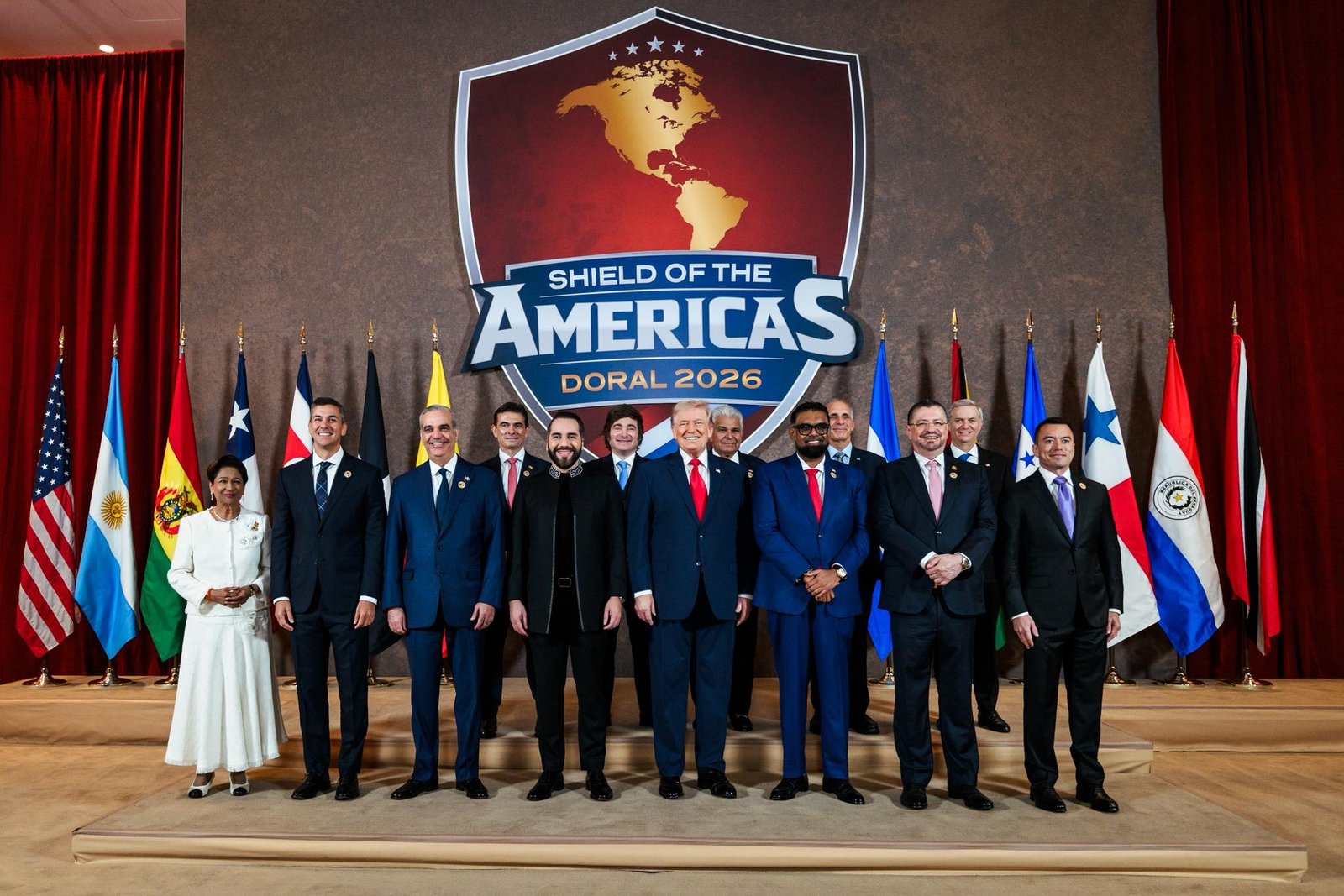
President Donald J. Trump poses for a Family Photo with world leaders at the Shield of the Americas summit at Trump National Doral, Saturday, March 7, 2026, in Miami, Florida. (Official White House Photo by Daniel Torok)
In less than two years, Donald Trump has disarmed the Congress and put the Constitution on life support. The separation of powers has been breached, and checks and balances have been compromised. One of Trump’s most serious victims is arms control and disarmament, a tragedy the mainstream media have virtually ignored.
Trump’s initial proposal last week to allow the sale of nuclear reactors to Saudi Arabia could spark a round of nuclear proliferation that threatens the global community. Trump’s proposal provided a path for Saudi Arabia to eventually make its own nuclear fuel and allowed the Saudis to avoid nuclear inspections that more than 140 nations have accepted. Such a scenario would threaten the Non-Proliferation Treaty that was signed in 1969 and could create an additional nuclear power for the first time in 20 years, when North Korea initially tested nuclear weapons.
One of the major reasons for having only nine nuclear states is the role of the NPT as well as the monitoring activities of the United States and the international arms control community. The fact that there are so few nuclear powers is a testament to the success of the Non-Proliferation Treaty that was negotiated in the 1960s due to Soviet fears of Germany gaining access to nuclear weapons.
Less than 24 hours after the deal with Saudi Arabia was announced, Trump shifted gears and created a new condition—the Saudis would have to establish diplomatic relations with Israel before the sale of nuclear reactors could take place. Secretary of Energy Chris Wright had already signed the agreement with the Saudi energy secretary before Trump’s new condition was announced. The sudden reversal on Trump’s part suggests that the pro-Israeli lobby, led by Steve Wytkoff and Jared Kushner, anticipated Israeli anger at losing its nuclear monopoly in the Middle East and the Persian Gulf.
This would be sufficient for Trump to reverse himself, as he does so often on sensitive issues in his current debilitated state, and place himself in a stronger position for meeting with Israeli Prime Minister Benjamin Netanyahu who arrived in Washington this week. It is also possible that a Trump advisor pointed out the absurdity of opening up the nuclear energy option for Saudi Arabia at the same time that the Trump administration was trying to stop the nuclear ambitions of the Islamic Revolutionary Guard Corps.
The mere suggestion of a nuclear arrangement with Saudi Arabia is the latest nail to be affixed to the coffin of arms control and disarmament. We lost the New START Treaty earlier this year, which was a tragedy for the national security interests of the United States as well as the entire global community. New START was the last remaining pact limiting the strategic nuclear arsenals of the United States and Russia, capping each country at 1,550 deployed strategic warheads.
The expiration of the treaty as well as the unprincipled nuclear flirtation with Saudi Arabia creates a dangerous international environment that could foster nuclear proliferation. Such non-nuclear states as Japan, South Korea, Turkey, and Poland could decide to seek their own nuclear weapons. Even the German government is debating the possible need for a nuclear weapons component.
Clearly, nuclear weapons have returned to the international chessboard with a vengeance as the three greatest nuclear weapons states—the United States, Russia, and China—are devoting vast resources to strengthen and modernize their nuclear inventories. There is no need for modernizing nuclear weapons, which have no utilitarian purpose outside the realm of nuclear suicide.
A nuclear race, moreover, would be taking place despite the vast overkill capabilities that the United States, Russia, and China already possess.
With the exception of George W. Bush and Donald Trump, who followed the advice of John Bolton to abrogate arms control agreements, every president over the past 80 years has recognized the value of reducing nuclear arms. President John F. Kennedy was courageous in taking on the Pentagon and the Department of Defense in pursuing the Partial Test Ban Treaty; President Richard Nixon pursued SALT and the ABM Treaty; even Ronald Reagan appreciated the value of arms control and promoted the INF Treaty that destroyed an entire class of missile systems. Barack Obama did his thesis at Columbia University on arms control, and considered New START one of his greatest accomplishments.
In view of the difficulty and complexity of disarmament negotiations, I cannot imagine the Trump administration being capable of dealing with arms control challenges. We already know from Trump’s handling of our European allies and NATO that the diplomacy of international negotiations is beyond his capabilities. The fact that sensitive matters dealing with Russia and Ukraine as well as with Israel and Palestine are in the hands of two incompetent real estate billionaires—Wytkoff and Kushner—is dispositive.
The failures of Secretary of State and National Security Advisor Marco Rubio have neutralized the important roles of the Department of State and the National Security Council in dealing with sensitive international issues. Trump and his advisors created the Board of Peace for Gaza, which has not produced stability for the Palestinians. The diplomacy that has accompanied five months of warfare with Iran has been a disaster. An independent intelligence community is particularly needed for negotiating difficult arms control agreements, but that community has already been politicized. These are truly tragic times.
