
[ad_1]
For months, polling and prediction markets have forecast that Democrats will retake the House, but that Republicans will retain control of the Senate. However, recently, the prediction markets have moved toward the Senate being a toss-up. The latest RCP Senate Map lists eight toss up states and three in the Leans category. These 11 states are where the battle for the Senate will be decided.
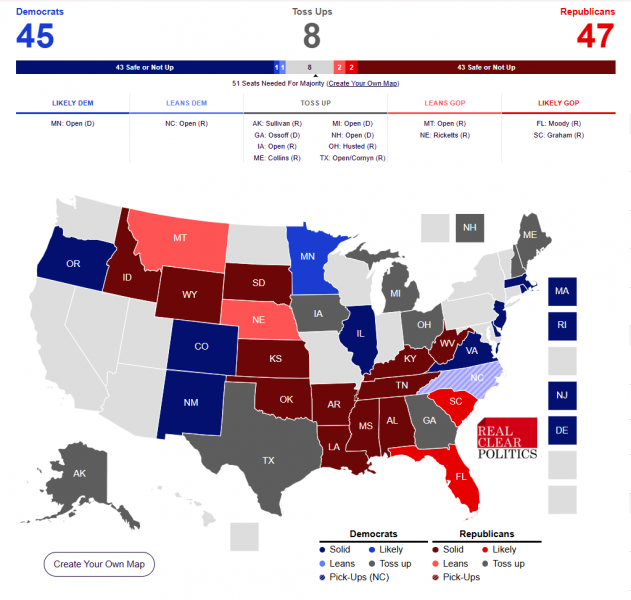
RealClearPolitics
Polling in Michigan is still in flux because of a hotly contested primary that will likely result in a runoff. All we have right now are a couple of hypothetical matchups, which do show a toss-up. However, according to Morning Consult, Trump is underwater by 9 points in Michigan. The prediction markets strongly forecast that the polling will swing toward the eventual Democratic nominee.
If the prediction markets are right, the Democrats would win 49 seats, with the only toss-up being Ohio. That is a special election to fill JD Vance’s unexpired term. Vance won the seat in 2022 by 6 points. The RCP polling shows Republican Sen. Jon Husted with a small lead, within the margin of error. The prediction markets are giving the likely Democratic challenger, former Sen. Sherrod Brown, a 7-point advantage.
Even if the Democrats were to win all of four of these seats, that would leave a 50-50 Senate, and Vance, as vice president, would cast the tiebreaker in party-line votes, as Kamala Harris did during the Biden administration. So, for the Democrats to win control of the Senate, they would have to win all four of these and pick up one other seat where the Republican is currently favored. Here are the possibilities:
Alaska
In Alaska, Sen. Dan Sullivan is running for his third term. The traditional wisdom has been that since Trump won by double digits and Sullivan has the incumbent advantage, this is a safe seat for Republicans. However, the Democratic challenger is Mary Peltola, who was elected to the House in 2022 but lost the seat in a close election to a Republican in 2024. Since Alaska only has one House seat, those elections were statewide.
The only publicly available polling in the state has been done by Data for Progress, which leans Democratic. Its two surveys this year show the race as a toss-up. However, in March, the prediction markets began to break hard in Peltola’s favor. Polymarket currently shows her as a 68% favorite. Keep in mind that Alaska has ranked-choice voting, which tends to favor more moderate candidates – presumably Peltola in this instance.
Iowa
Because of Joni Ernst’s retirement, this is an open seat. Like Alaska, most politicos consider it to be a safe Republican seat. However, some recent polling has shown the Democrats have a chance, and prediction markets agree: the odds have narrowed from the 80/20 range to under 60/40. Both parties have primaries in early June. The leader in the Democratic primary is an intriguing candidate who is a Paralympic gold medalist who is running on a populist platform.
Nebraska and Montana
Both these states should be safe Republican strongholds, but in each, the Republican candidate will face a credible independent candidate. In Nebraska, Dan Osborn will make his second bid as an independent populist after losing to Deb Fisher in 2024 by only 7 points. There will probably not be a Democratic candidate in the race.
Montana could be even more interesting. There is not much data to go on in this race because the last-minute withdrawal of the incumbent senator, Steve Daines, appeared to be done to engineer a succession by a close political ally. But this is often a politically unpopular maneuver and may be especially so in independent-minded Montana.
It may also be a boon to the nascent campaign of independent Seth Bondar. He is a West Point graduate, former Green Beret, Rhodes Scholar, and president of the University of Montana. He should not be taken lightly. (This is a link to a long-form interview he did with Michael Smerconish.)
Texas
We cannot leave the subject of Senate control without mentioning the Democrats’ Holy Grail: the quest to win a U.S. Senate seat in Texas. That quest has been repeatedly dashed for the last four decades. But could it be different this time?
The polling seems to indicate so. The RCP Average shows Talarico slightly ahead of both Cornyn and Paxton. However, a University of Texas poll released this week showed Talarico leading Paxton by 8 points and Cornyn by 7 points. One word of caution about this poll: It surveyed registered voters, not likely voters. Because turnout patterns differ between parties, registered-voter samples can sometimes lean more Democratic than likely-voter models do. This could be especially true in this election because of the apparent rift between Talarico and black voters.
The prediction markets are certainly hedging the earlier bets. The likelihood of Talarico winning has gone from 20% to 45%.
I think you can see from all of this why the prediction markets are calling the control of the Senate a toss-up. Neither party has a clear path. Democrats must run the table on the seats currently rated as toss-ups and at least one other seat where Republicans are favored.
On the other hand, President Trump’s approval rating has become a millstone around the necks of down-ballot Republicans. He has suffered a catastrophic loss of support among the two most important swing-voter groups – independents and Latinos. And his approval on the inflation – that great presidential support killer – is now a negative 39%. Unless Trump can turn around his numbers or down-ballot Republicans can somehow distinguish themselves, the 50% on the prediction marketing betting on Democratic control might just be right.
[ad_2]
Source link
