
[ad_1]
The bilateral guardrails erected in Beijing last week may buy time, but they do not fix global governance institutions drifting toward a rupture that historically has preceded systemic collapse, writes Tatiana Carayannis.
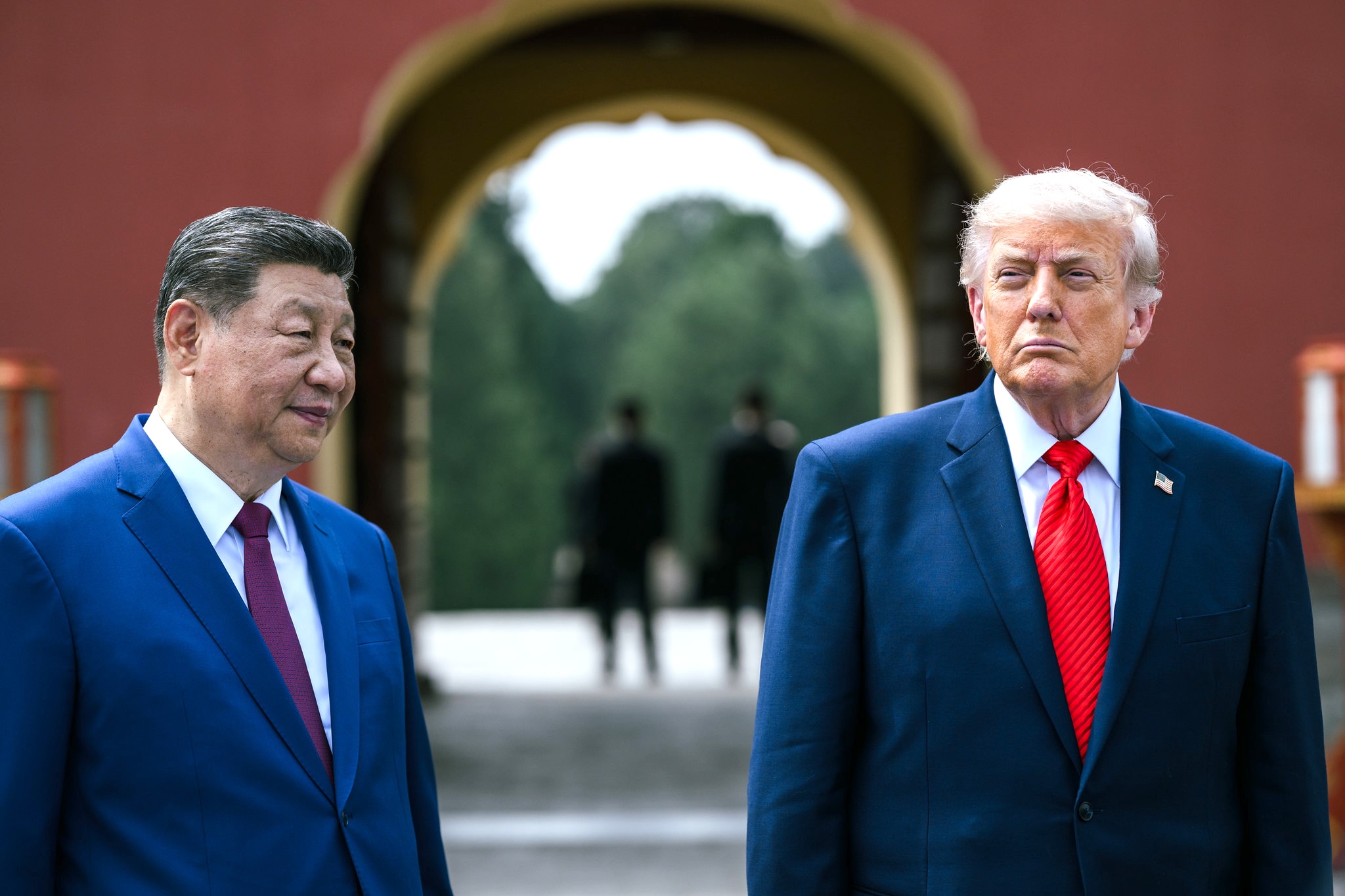
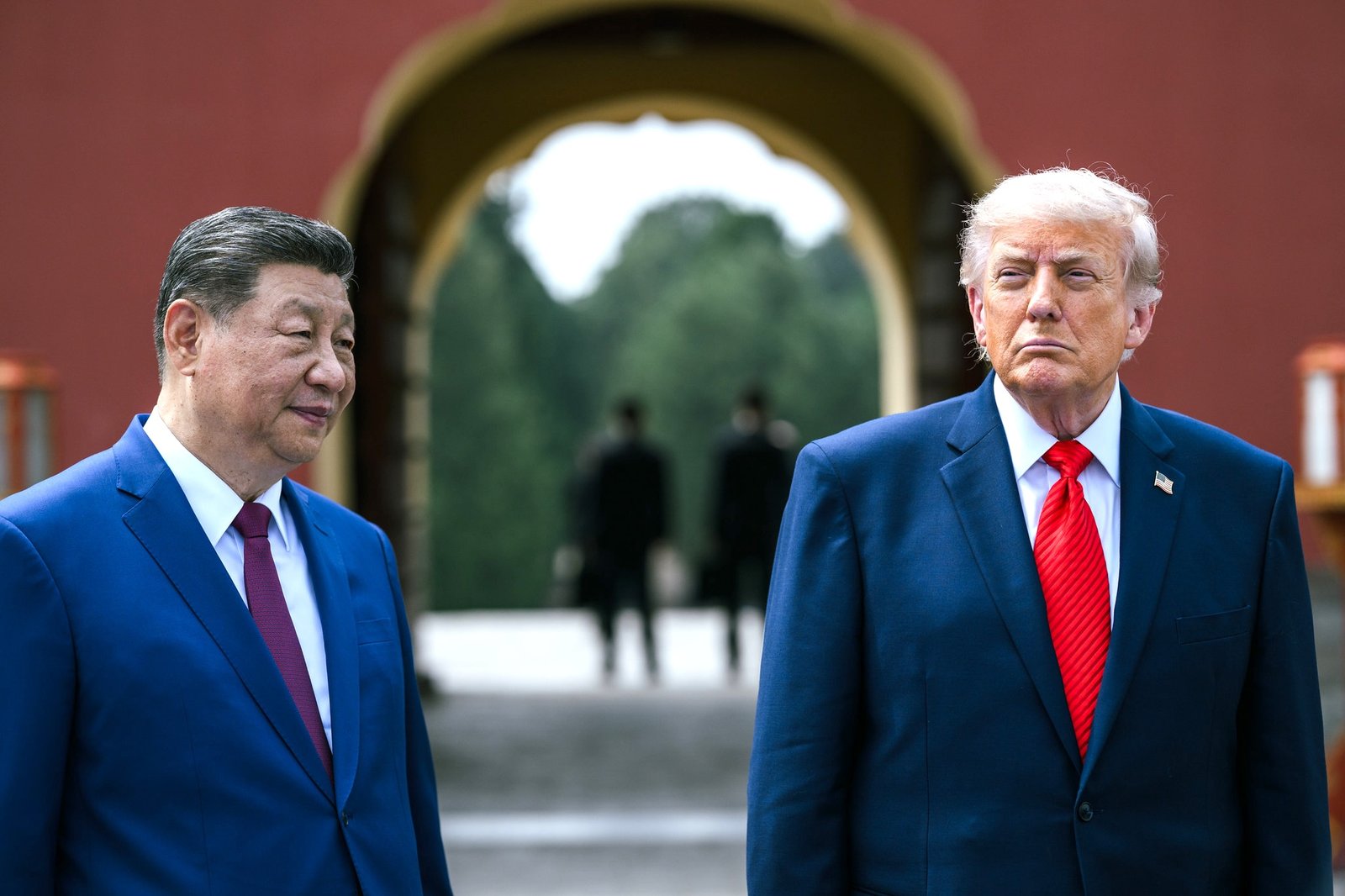
President Xi Jinping and U.S. President Donald Trump touring the ground of the Temple of Heaven on May 14 in Beijing. (White House/ Daniel Torok)
By Tatiana Carayannis
 The recent two-day Beijing summit between Presidents Donald Trump and Xi Jinping has come and gone. There was pageantry: Military honors, flag-waving children, flowers and toasts. Both governments declared success. The relationship has been stabilized, which is not nothing, but the deeper question about the future of our global governance architecture remains unanswered.
Our global governance institutions are not simply under strain but drifting toward a rupture that historically has preceded systemic collapse. The bilateral guardrails erected in Beijing last week may buy time, but they do not fix the structure.
The appropriate time frame is 1814. When the Congress of Vienna assembled after the Napoleonic wars, it produced not a world government but a shared practice: The Concert of Europe, in which the powers whose rivalry was most dangerous met regularly to manage crises before they became crises. For nearly a century it worked. And then it floated apart, until the gap between what it could do and what the world required became unbridgeable. That gap became catastrophically visible in 1914.
The founders of the United Nations understood this history. Meeting in San Francisco in 1945, they returned to the Vienna logic — keep the great powers inside the tent with a universal wrapper. The result was a system with a deep foundational contradiction: The U.N. Charter affirms the sovereign equality of all member states while creating a Security Council in which five states hold permanent vetoes. The postwar order was sustained not through justice but through predictability — the reasonable expectation that disputes would be settled through institutions rather than unconstrained force.
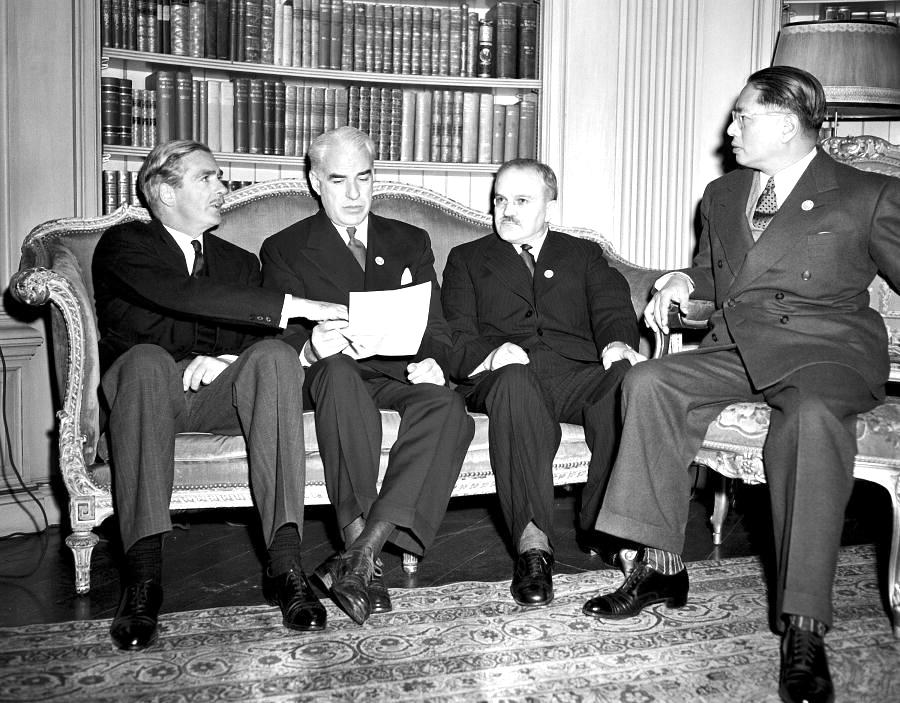
An informal meeting in the Fairmont Hotel in San Francisco during the 1945 signing of the U.N. Charter. From left: U.K.’s Anthony Eden, U.S.’ E.R. Stettinius Jr., Soviet Union’s V.M. Molotov and China’s T. V. Soong. (U.N. Photo/Eastman)
That predictability is now in free fall. United States strikes on Iran were conducted without Security Council authorization. Russia’s veto has blocked every resolution on Ukraine. The U.S. and China have blocked resolutions on Gaza. None of these countries violated the Charter. All acted exactly as the system permits. That is precisely the problem.
Formal amendment of the UN Charter is nearly impossible — the veto applies to its own abolition. But political scientists have identified four other ways institutions change, and all four are visible today.
Layering adds new bodies on top of old structures without replacing them: The 2024 U,N. Pact for the Future stacks new declarations and processes onto a foundation whose underlying architecture is untouched.
Conversion redirects current forms toward new purposes: The Uniting for Peace resolution, invoked after Russia’s invasion of Ukraine, converted the General Assembly from a deliberative body into an emergency mechanism.
Displacement gradually supplants old institutions with new ones: China’s construction of the Shanghai Cooperation Organization, BRICS+ and the New Development Bank follow this logic, building parallel architecture that reflects a different distribution of power.
And then there is drift — the most insidious of all. Drift is what happens when the rules stay the same but the world that they were written for has changed so much that practice diverges from text, without anyone formally altering a word.
The U.N. is on a recognizable version of that trajectory: Its working methods, its relationship with regional organizations and the relative weight of its members are all changing through accumulated practice. The workarounds — conversion, layering, small initiatives like the requirement that the General Assembly convene whenever a veto is cast — are real. But they cannot accumulate fast enough to keep pace with the rate of drift. The Beijing summit with Trump and Xi produced guardrails, yet it produced no new architecture.
Remaining Governance Gaps
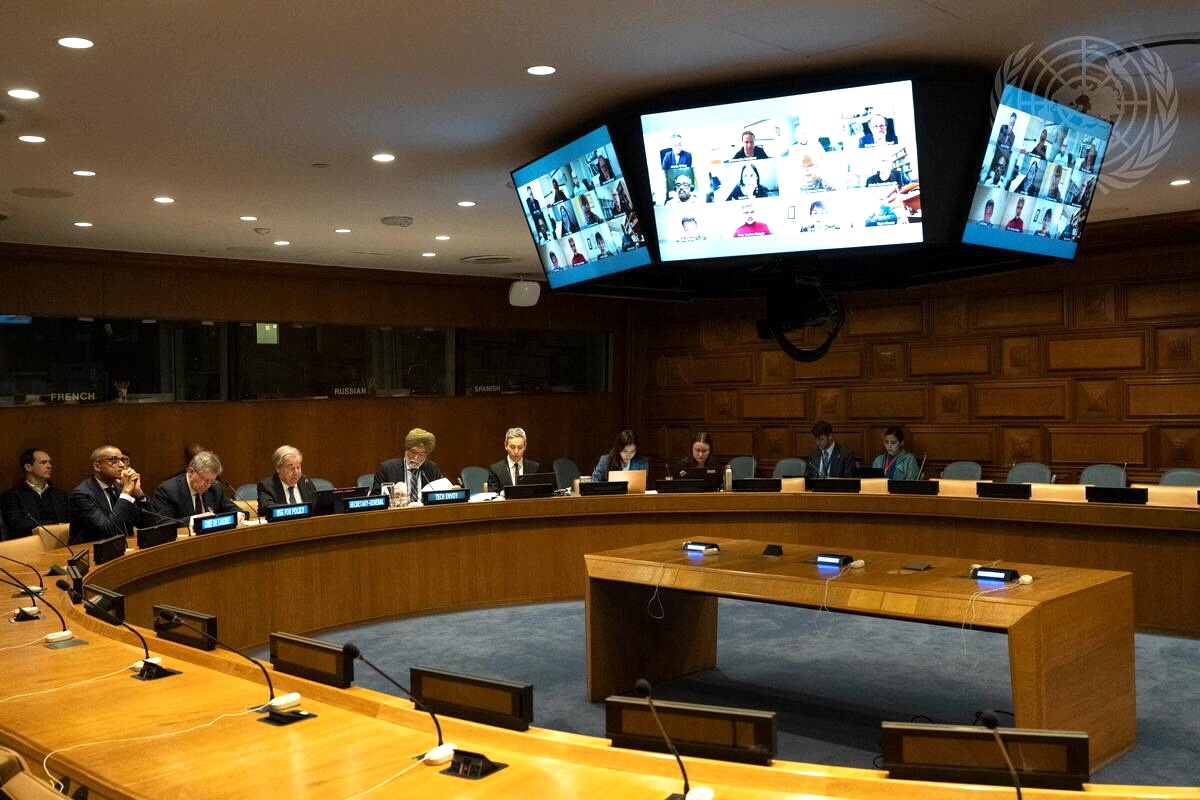
U.N. Secretary-General António Guterres, third from left at table, addressing the
first meeting, which was virtual, of the Independent International Scientific Panel on AI, on March 3. (UN Photo/Evan Schneider)
The most consequential gap is artificial intelligence (AI). Both China and the U.S. are perched at the frontier of AI development, and the governance frameworks being assembled — through the U.N. Secretary-General’s High-Level Advisory Body, the AI Safety Summit process and a patchwork of national regulatory initiatives — have not produced a meaningful forum for genuine U.S.-China engagement.
The risk is not incompatible frameworks but no common framework at all, leaving the most consequential technology in human history effectively ungoverned at the global level.
The same goes for autonomous weapons, climate, pandemic preparedness and many other urgent matters humankind must contend with for survival. These are not technical problems with technical solutions. They are collective-action problems and addressing them requires the kind of cross-national research and dialogue that great-power friction is currently making harder. The scholarly infrastructure for building shared frameworks is pressured by visa restrictions, funding cuts and the logic of decoupling.
Governance Innovation Pipeline
The norm of responsibility to protect was developed by an independent international commission with a university-based research secretariat before it entered the U.N. system.
The science of the Intergovernmental Panel on Climate Change was decades in the making before it became the foundation for the Paris process.
What Tom Weiss, a scholar on the U.N., and I have termed the “Third U.N.” — the ecology of scholars, think tanks and research NGOs that interacts with intergovernmental machinery at key junctures — is the pipeline through which governance innovation flows. The ideas that the incoming U.N. secretary-general will reach for in his or her first year are already being developed in research bodies and policy networks.
We need a formal commitment to protecting and expanding social science research collaboration between American and Chinese scholars. Not in sensitive technical domains but on collective-action problems. These are precisely the fields where shared conceptual frameworks, joint research agendas and genuine intellectual exchange are prerequisites for the governance innovation that the world urgently needs.
Even during the apartheid era in South Africa, academic exchanges were largely protected from the broader sanctions regime on the recognition that intellectual isolation compounds political pathology rather than cures it.
The U.S. and China, whose rivalry is geopolitical rather than moral, can certainly sustain that principle now. That requires visa policies that do not treat social scientists as security threats and a commitment that research ties will not be sacrificed to trade tensions when they rise again.
Small and middle-size states have repeatedly created the forums and dialogues that larger powers were too constrained by rivalry to host themselves. That role is arguably more important than at any point since the Cold War.
The Vienna League-U.N. sequence carries a sobering lesson. Each order emerged from the wreckage of the previous one’s failure. Each eventually strayed out of alignment with the world it was meant to govern. The question this moment poses is whether we can generate the political will for transformation without entailing a catastrophe of the same magnitude as 1918 or 1945.
Beijing stabilized a relationship. Predictability between the two dominant powers is itself a form of global public good but is only as useful as what it builds. The summit cannot fix the architecture. But if dialogue is protected, research is funded and ideas are allowed to travel, it just might.
[ad_2]
Source link
