
[ad_1]
In one of the scariest moments in modern history, we're doing our best at ScheerPost to pierce the fog of lies that conceal it but we need some help to pay our writers and staff. Please consider a tax-deductible donation.
Michelle Ellner for CodePink
The recent deportation of Alex Saab from Caracas to the U.S. on May 18, 2026, has generated shock, confusion, anger, and intense debate across sectors of the international solidarity movement and many Venezuelans themselves.
Alex Saab, a Colombian businessman who became closely associated with the Venezuelan government during the years of heavy U.S. sanctions, is seen by many Venezuelans as someone who helped the country bypass sanctions, obtain fuel and food, open financial channels, and resist economic collapse under blockade conditions.
The U.S. accuses Saab of corruption and money laundering connected to Venezuelan state contracts, but for many people in Venezuela and across the international left, Saab came to represent something larger than an individual businessman: the broader struggle over sanctions, sovereignty, and Venezuela’s ability to survive under extraordinary economic and geopolitical pressure.
The Venezuelan revolution did not survive the last decade of US economic warfare without contradictions. It survived through improvisation, exhaustion, loyalty, fear, sanctions, migration, stubbornness, and an almost unbearable national fatigue that few outside the country truly understand.
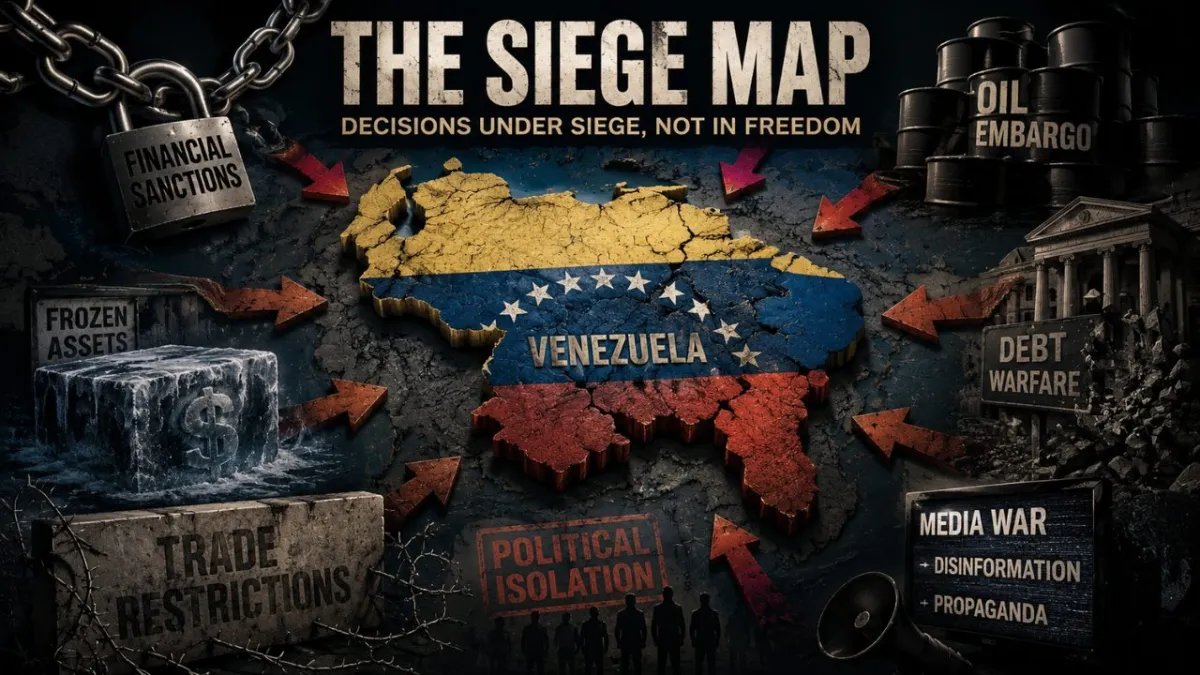
The United States did not merely sanction Venezuela. It attempted to break it. It froze national assets, it openly pursued regime change, backed parallel governments, economically strangled the country, and ultimately launched a military operation to kidnap President Nicolás Maduro and First Lady Cilia Flores from Venezuelan soil.
To understand why Saab became such a powerful figure, one must first understand what Venezuela became under sanctions: a country forced into survival mode.
And now, after the deportation of Saab to the United States and the growing accusations against Delcy Rodríguez, I watch many people speak with the confidence of hindsight. As if everything had always been obvious. As if Venezuelans navigating one of the most aggressive campaigns of economic warfare, destabilization, and military coercion in modern Latin American history had the luxury of moral purity.
As a Venezuelan American, I am struggling too to understand and process this moment. I stood there too. I called for Alex Saab’s freedom when he was detained in Cape Verde during the height of the Trump administration’s maximum pressure campaign against Venezuela. At the time, the reality that existed for many of us was that Saab was a Venezuelan diplomat helping the country navigate sanctions.
Recently, Venezuelan National Assembly President Jorge Rodríguez publicly stated that Alex Saab has maintained relationships with U.S. agencies since 2019. These revelations, combined with Saab’s deportation, have generated painful questions for many people who spent years defending him publicly.
What did we actually know?
What kinds of compromises were going on inside a country trying to survive under siege?
These are painful questions. And at this moment, there are still far more questions than answers.
Maybe painful compromises were made.
Maybe Saab was never what many believed him to be.
Maybe serious betrayals occurred.
Maybe the deportation was justified.
Maybe realities existed behind closed doors that ordinary Venezuelans never had access to. Or maybe decisions were made inside an impossible reality where preventing wider war, deeper collapse, and even greater harm for ordinary Venezuelans became more urgent.
Because since the kidnapping of Maduro, Venezuela has not been operating in an atmosphere of freedom. It is operating under threat.
And it is easy to demand uncompromising heroism from a country under attack when you are not the one responsible for preventing millions of people from falling into even greater catastrophe.
People who defended Saab for years are now confronting the possibility that parts of the story may have been hidden from them. Others are immediately translating uncertainty into accusations of betrayal against Delcy Rodríguez and the entire Bolivarian process.
But I think there is something dangerous about how quickly so many people are rushing toward absolute conclusions while fragments of information, accusations, leaks, and political narratives are still colliding in real time.
Maybe there will come a moment for deeper criticism of Delcy Rodríguez and others within the Bolivarian process. Maybe new information will eventually clarify realities that today remain obscured by contradiction, secrecy, pressure, and war.
But I think there is a certain political myopia in discussing Venezuela’s internal contradictions while removing the broader reality of U.S. pressure and coercion from the story entirely.
Because regardless of what may eventually be revealed about Alex Saab, the larger reality remains unchanged: Venezuela was subjected to years of sanctions, destabilization, economic strangulation, coup attempts, international isolation, and eventually direct military intervention.
The aggressor has not disappeared from the story.
And reducing every painful decision to betrayal while ignoring the enormous machinery of coercion surrounding Venezuela risks reproducing the very fragmentation that external aggression was designed to create in the first place.
It’s difficult not to see the renewed imprisonment of Alex Saab as a disappointing capitulation to U.S. coercion after so many of us fought for his freedom, but we cannot forget the task at hand. If we are serious about ending U.S. aggression towards Venezuela, we cannot allow our solidarity with the Venezuelan people to be deterred. They have shown us how to sustain a revolution amidst contradictions, and that is what we must do.
Michelle Ellner is a Latin America campaign coordinator of CODEPINK. She was born in Venezuela and holds a bachelor’s degree in languages and international affairs from the University La Sorbonne Paris IV, in Paris. After graduating, she worked for an international scholarship program out of offices in Caracas and Paris and was sent to Haiti, Cuba, The Gambia, and other countries for the purpose of evaluating and selecting applicants.
Editor’s Note: At a moment when the once vaunted model of responsible journalism is overwhelmingly the play thing of self-serving billionaires and their corporate scribes, alternatives of integrity are desperately needed, and ScheerPost is one of them. Please support our independent journalism by contributing to our online donation platform, Network for Good, or send a check to our new PO Box. We can’t thank you enough, and promise to keep bringing you this kind of vital news.
You can also make a donation to our PayPal or subscribe to our Patreon.
Please share this story and help us grow our network!
[ad_2]
Source link
