
[ad_1]
In one of the scariest moments in modern history, we're doing our best at ScheerPost to pierce the fog of lies that conceal it but we need some help to pay our writers and staff. Please consider a tax-deductible donation.
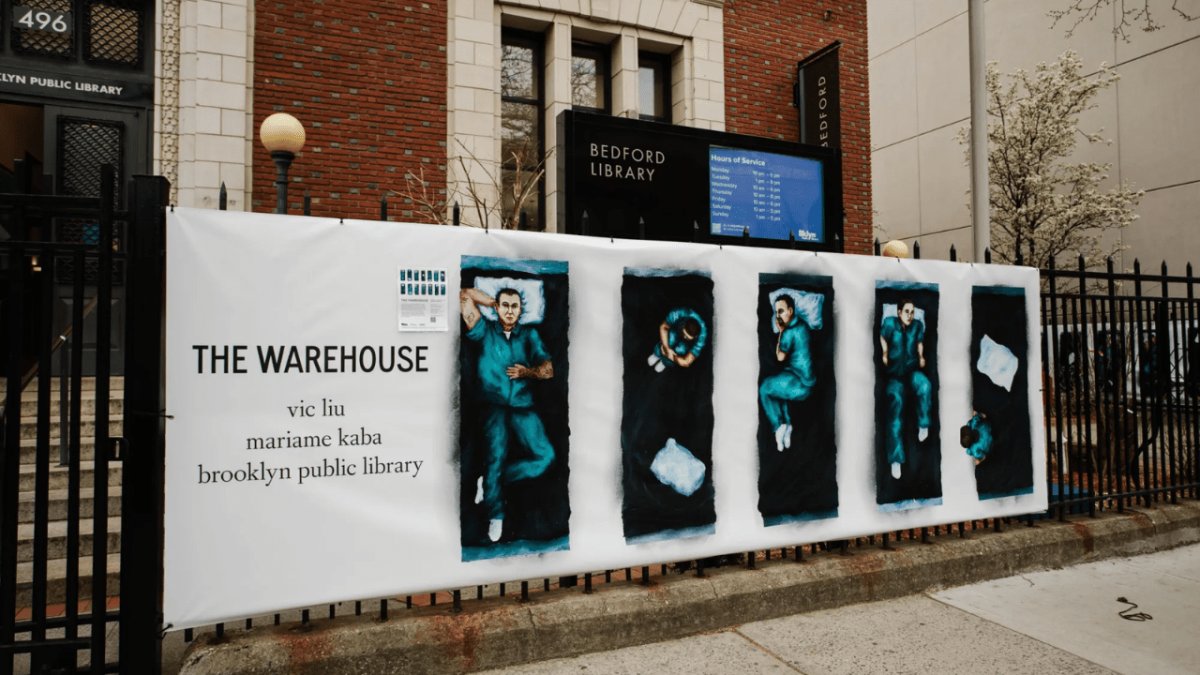
“The Warehouse,” a collaboration between artist Vic Liu and abolitionist organizer Mariame Kaba, builds an environment where visitors can see and feel through the possible answers
Inside Brooklyn Public Library’s Bedford branch, one of the New York City borough’s oldest civic spaces, a new exhibition is asking visitors, what would the world look like without prisons? “The Warehouse,” a collaboration between artist Vic Liu and abolitionist organizer Mariame Kaba, builds an environment where visitors can see and feel through the possible answers one painting at a time.
The exhibition, which opened April 4, features more than two-dozen large-scale paintings alongside public programming that includes workshops, community dinners, and conversations about incarceration and reentry. As immigration detention and incarceration continue to expand across the country, the show considers imagination a political act, one that abolitionists argue is necessary to build alternatives to the current system.
For Liu, the starting point was frustration with how abolition is often discussed within movement organizing.
“When we talk about abolition, it’s become clear to me that we talk so much about what it isn’t that we need to imagine what it looks like in the world around us,” Liu said. “Being descriptive and specific is scary, but also at the same time, it’s necessary so that we know what we’re fighting for, and we understand that these things are tangible and possible.”
That emphasis on specificity shapes the exhibition’s design. “The Warehouse” maps out the conditions that might make prisons unnecessary including access to health care, food, housing, and community support.

One of the exhibition’s central features is a children’s wing that shows what a world can look like outside of prison walls that moves toward abolition. Liu said her approach was shaped by her own experience growing up in public libraries—spaces they see as an extension of home and community, where people expect a sense of safety.
The library as a “safe space” informed how they approached depicting incarceration. Rather than immersing visitors—especially children—in the most graphic or traumatic aspects of prison, Liu said they were intentional about not overwhelming them.
“You have to balance how much you want to showcase the horrors,” Liu said. “We really wanted this exhibition to be about hope as well as platforming the humanity and dignity of people inside affected by incarceration.”

The space invites children to consider their role in their communities and to recognize the people who make those communities function, from neighbors to delivery workers to elders.
Liu is explicit about the things that they do not want their work to reproduce: “trauma porn.”
“I want to make sure that when you look at my work, you are experiencing an expansion of your understanding of the human experience,” Liu said.
Instead of depicting incarcerated people as distant subjects, Liu shifts the viewer’s perspective inward. In one painting, they depict an ankle monitor from the point of view of the incarcerated person who is wearing it.

A series of free public programming will also accompany the exhibition over the next three months, until the exhibit closes on June 27. The programming was created in collaboration with Liu, Kaba, and organizers from Brooklyn Public Library’s Justice Initiatives, which supports incarcerated and formerly incarcerated patrons. Ultimately, the organizers wanted visitors to learn more about jail support directly from the people who have been criminalized.
Kaba additionally suggested a workshop on how to talk to young people about prisons, drawing from her experience running Project NIA, an organization focused on ending incarceration of youth and young adults.
I think of children as human beings. They’re impacted by everything that happens in the world, and that includes, of course, incarceration.Mariame Kaba, abolitionist organizer
“We don’t do very well in this country in terms of incorporating young people into our thinking, into our work,” Kaba said. “I think of children as human beings. They’re impacted by everything that happens in the world, and that includes, of course, incarceration.”
Millions of children across the country have loved ones who are or have been incarcerated or criminalized, Kaba said.
“They have questions, and those questions deserve answers, and we have not done a very good job of listening to them or talking with them about these things,” she said.
The exhibition builds directly on Liu’s earlier work in “The Warehouse: A Visual Primer on Mass Incarceration,” a book they co-authored with abolitionist James Kilgore. Designed as an illustrated guide to the U.S. carceral system, the book uses visual storytelling to make complex ideas about incarceration legible to a broader audience, particularly those often excluded from academic or text-heavy discussions
The project reflects Liu’s broader commitment to accessibility, both in form and in politics. By combining artwork, data, and testimonies from incarcerated people, “The Warehouse” attempts to make visible a system that often relies on distance and invisibility to sustain itself.

The exhibition functions as an extension of that work, bringing the book’s visual language off the page and into a physical space where visitors can move through it.
“I think that text in itself is pretty elitist when we rely only on text as a method of communication,” Liu said, pointing to statistics that show that the average reading level in the U.S. is between sixth and seventh grade, and that over 70% of people in prison do not read above a fourth grade level.
That gap, Liu argued, makes visual storytelling essential, not supplementary.
“I want to make it as intuitive for them as possible, as accessible for them as possible,” they said.
The collaboration began when Kaba wrote a blurb for Liu and Kilgore’s book, and Kilgore told Kaba about the first inception of the exhibition in Philadelphia. Kaba pushed to bring a version of the project to New York, where she was born and raised and still lives, and helped to secure funding to make it happen.
“New York is a city that deals with all sorts of issues. And, of course, hyper and mass incarceration is one of those,” she said.
Echoing the remarks she said she made at the exhibition’s opening, Kaba told Prism that “liberation under oppression is unthinkable by design,” therefore, it is important to “cultivate imagination.”
“Art has a way of helping to remove the ceiling from our imaginations,” Kaba said. “I don’t know that imagination will necessarily lead you to becoming a prison industrial complex abolitionist, but I think it offers room for you to imagine otherwise.”
Kaba hopes visitors leave with a stronger context for the stories of people who have been directly impacted by the prison industrial complex.
“Those people might be encouraged to strengthen their relationships with people in their own communities. They may feel more generous. They may perhaps also consider ways of taking constructive action in the world in some way,” she said. “And in all those ways, that is going to contribute to a prison industrial complex struggle.”
Editorial Team:
Sahar Fatima, Lead Editor
Lara Witt, Top Editor
Rashmee Kumar, Copy Editor
Alexandra is a Cuban-American writer based in Miami, with an interest in immigration, the economy, gender justice, and the environment. Her work has appeared in CNN, Vice, and Catapult Magazine, among others. Follow her on Twitter @alex__mar.
Editor’s Note: At a moment when the once vaunted model of responsible journalism is overwhelmingly the play thing of self-serving billionaires and their corporate scribes, alternatives of integrity are desperately needed, and ScheerPost is one of them. Please support our independent journalism by contributing to our online donation platform, Network for Good, or send a check to our new PO Box. We can’t thank you enough, and promise to keep bringing you this kind of vital news.
You can also make a donation to our PayPal or subscribe to our Patreon.
Please share this story and help us grow our network!
[ad_2]
Source link
