

[ad_1]
On the eve of America’s 250th anniversary, Americans are asked to accept and pay for a government that knows more about us than we do about it, writes Andrew P. Napolitano.

Spies in D.C., code name ‘Giddy Up.‘ (Lorie Shaull, Flickr, CC BY 2.0)
By Andrew P. Napolitano
 When President Donald Trump appointed an obviously unqualified friend, a home builder executive, to be acting director of national intelligence, he inadvertently triggered attention to Section 702 of the Foreign Intelligence Surveillance Act.
The director of national intelligence is the head of the umbrella agency that gathers intelligence from the 17 federal spying agencies and from that data prepares and delivers the president’s daily briefing. Sec. 702, which permits warrantless spying, expires this month.
Trump prefers to receive his briefings directly from the C.I.A. and its foreign colleagues, leaving the DNI as an appendage with little to do.
Nevertheless, the DNI employs hundreds of spies and analysts, and most of them have national security clearances that permit them to view the nation’s most closely guarded secrets and to invade anyone’s privacy.
Section 702 of FISA theoretically permits federal agents to spy without warrants or suspicion on foreign persons. In reality, it is used as a fig leaf to spy on Americans.
A few years ago, Department of Justice lawyers persuaded the FISA court secretly to permit the National Security Agency — America’s domestic spies — to spy on Americans with whom foreign persons communicate; even suspicionless Americans whose communications with foreigners are benign; even Americans removed by six degrees from conversations with foreigners.
Before & After 9/11

Lower Manhattan skyline after a Boeing 767 hit the World Trade Towers on Sept. 11, 2001. (Michael Foran, CC BY 2.0, Wikimedia Commons)
Before 9/11, no one in law enforcement was permitted access to data obtained outside the restraints imposed by the Fourth Amendment to the Constitution.
Those restraints prohibit searches and seizures — in the modern parlance, surveillance and data acquisition — without a search warrant issued by a judge based on probable cause of crime, sworn to under oath. And the warrant itself must specifically describe the places to be searched and the persons or things to be seized.
Since 9/11, the wall between surveillance and law enforcement has collapsed even though the feds still maintain that the Fourth Amendment only regulates law enforcement and not surveillance. This wild proposition is defied by the plain language of the amendment, which protects all persons from all government, and by the history of the colonists dealing with British government agents executing general warrants issued by a secret court in London.
Those warrants permitted the bearers to arrest whomever they wished, to search wherever they chose and to seize whatever they found. Under the pretext of looking for evidence of crimes, like failing to comply with the Stamp Act, these agents were truly looking for what the king considered subversive, like a draft of the Declaration of Independence.
James Madison and his colleagues who drafted the Fourth Amendment surely knew that history and shared the near universal colonial revulsion at general warrants. Hence the requirements in the amendment for probable cause of crime sworn to before the warrant-issuing judge, and specificity in the warrant itself.
All of this was crafted to outlaw general warrants, and protect all persons in America from warrantless government assaults and invasions of their “persons, houses, papers, and effects.”
Back to FISA
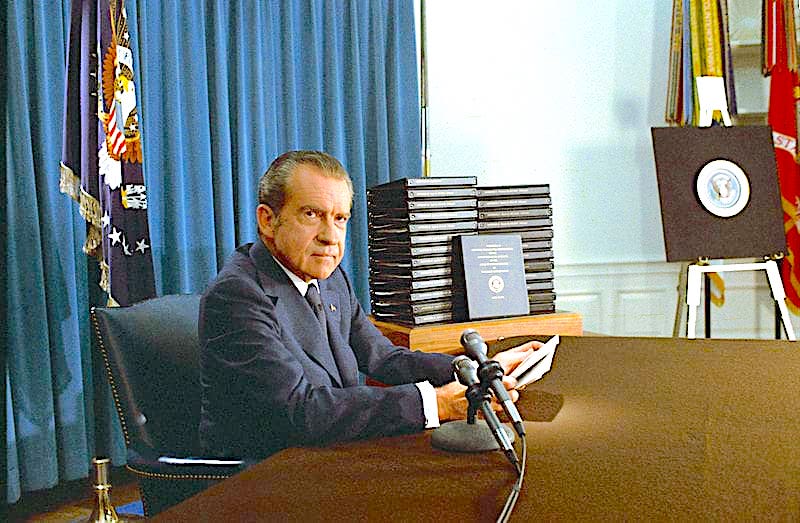
President Richard Nixon, trying to head off impeachment over Watergate, releases edited transcripts of his Oval Office tapes on April 29, 1974. (National Archives / Public Domain)
Now, back to FISA. FISA was crafted in reaction to President Richard Nixon’s use of the C.I.A. and F.B.I. for warrantless domestic surveillance purposes. This was spying on Americans — opponents of the Vietnam War and Nixon’s political opponents — which as we all now know came crashing down on Nixon in the Watergate scandal.
FISA itself is deeply flawed. Rather than simply criminalizing all warrantless surveillance, it lowered the standard for authorizing surveillance and data acquisition, i.e., searches and seizures, from probable cause of crime — Madison’s gold standard for protecting privacy — to probable cause of communicating with a foreign person, a standard that by its nature implicates innocent Americans, unnamed in FISA warrants.
One infamous FISA warrant authorized the feds to seize the telephone records of all Verizon customers, some 115 million at the time.
But there is another side to this fig leaf. According to former NSA agents, FISA itself is a charade, as the domestic spies and their international cousins — that’s the NSA and the C.I.A. — have a manifest indifference to constitutional norms. Stated differently, they don’t care about the Fourth Amendment or probable cause. They spy on whomever they wish whenever they choose and seize whatever data they can.
If these former NSA agents are correct — I have known them for many years and I believe them — we have come full circle from the general warrant days; all under the guise of FISA. FISA is pernicious not only because of its unconstitutional lowering of the standard for judicially issued searches and seizures, it is pernicious because the NSA and the C.I.A. — the latter prohibited by federal law from spying in the U.S. and from engaging in law enforcement — pretend to be complying with FISA court orders, all the while spying on whomever they choose; and lying about it.
Section 702 is a symbol, but it is not substantive. Stated differently, the spies will spy on us with or without 702 until we have a president who stops them; and survives. The battle over 702 is symbolic of authoritarians versus constitutionalists, but its demise will just drive the spies deeper into the deep state.
Section 702 has come to stand for the power and fear the intelligence community wields over the executive branch that employs it and the Congress that funds and approves it.
On the eve of America’s 250th anniversary, we are asked to accept and pay for a government that knows more about us than we do about it. One whose rapacious and insatiable appetite for knowing our thoughts, impressions, feelings and emotions far exceeds anything the British agents sought from the colonists who fought a bloody revolution over this.
The values that underlie the Fourth Amendment — the sovereignty of the individual, the right to be left alone, the promise of limited government — have been rejected by the folks Americans hired to protect them. But they are human values. And they will not rest.
Andrew P. Napolitano, a former judge of the Superior Court of New Jersey, was the senior judicial analyst at Fox News Channel and hosts the podcast Judging Freedom. Judge Napolitano has written seven books on the U.S. Constitution. The most recent is Suicide Pact: The Radical Expansion of Presidential Powers and the Lethal Threat to American Liberty. To learn more about Judge Andrew Napolitano, visit https://JudgeNap.com.
Published by permission of the author.
COPYRIGHT 2026 ANDREW P. NAPOLITANO
DISTRIBUTED BY CREATORS.COM
The views expressed are solely those of the author and may or may not reflect those of Consortium News.
Please Donate to the
Spring Fund Drive!


[ad_2]
Source link
