
[ad_1]
This is part one of a special four-part series by Jeffery Wernick for ScheerPost: How We Got Here.
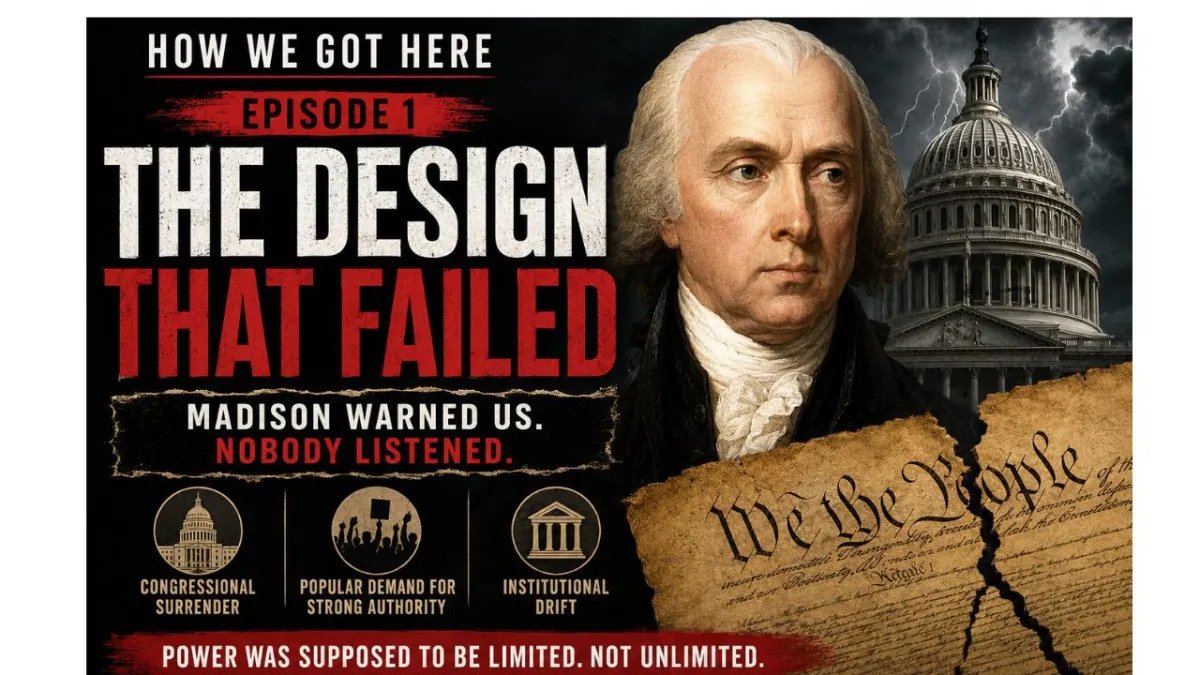
In this opening episode, Wernick examines James Madison’s original constitutional vision and asks a provocative question: Did America’s system of government fail because we abandoned it—or because its safeguards were never enough to restrain power in the first place?
From Madison’s warnings about concentrated authority and congressional surrender to his concerns about monetary power, this episode traces the foundations of a crisis that continues to shape American politics today. The result is a deep exploration of constitutional design, institutional decay, and the forces that transformed the republic Madison hoped to preserve.
Episode 1: The Design That Failed.
► Part 1: James Madison
► Part 2: The Anti-Federalists
► Part 3: Paine, Spooner & Money
► Part 4: What It Means Today
How We Got Here is a ScheerPost series examining the relationship between constitutional power, monetary authority, and the evolution of the modern American state.
Part One:
Transcript
This transcript has been cleaned for readability while preserving the original language and structure.
Episode One: The Design That Failed
Speaker:
I want to talk about James Madison—not the Madison of high school textbooks, not the marble founder invoked in political speeches.
The real Madison. The one who sat in Philadelphia in the summer of 1787 and tried to design a government for human beings he knew were not to be trusted with power.
This is Episode One of How We Got Here. It is about what Madison was trying to do, what he believed his design would prevent, and why that design has not held.
Over the next four episodes, I’m going to walk through three voices who saw the problem with increasing clarity: Madison, the Anti-Federalists, and then Paine and Spooner.
Paine and Spooner together focused on a question Madison and the Anti-Federalists also engaged with, but that has often been treated separately. That question is money.
The series argues that the constitutional question and the monetary question are not separate. They are aspects of the same underlying problem, and the failure of the constitutional project is connected to the operation of the monetary system in ways that have not been adequately recognized.
I want to make this argument carefully and in stages, which is why the series runs four episodes.
By the end, I will have something to say about the present moment and about what the analysis implies for it. But I want to earn the right to say it by walking through the historical and analytical material first.
This episode is about Madison.
The first thing to know about Madison is that he was a profound pessimist about human nature.
This is not the usual portrait. He is remembered as the optimistic architect of a new republic. There is truth in that, but it misses the foundation.
Madison designed a system that could work precisely because he expected ambition, self-interest, and abuse of power. He did not rely on virtue.
From Federalist 51:
“If men were angels, no government would be necessary. If angels were to govern men, neither external nor internal controls on government would be necessary.
In framing a government which is to be administered by men over men, the great difficulty lies in this: You must first enable the government to control the governed, and in the next place oblige it to control itself.”
Later in the same paper:
“Ambition must be made to counteract ambition. The interest of the man must be connected with the constitutional rights of the place.”
Each branch would defend its own power because its members’ personal interests were tied to it.
The result, in equilibrium, would be the prevention of concentration through institutional rivalry.
The second thing to know is what failure mode Madison feared most.
Not invasion.
Not insurrection.
Not a single tyrant.
He feared the gradual accumulation of all powers—legislative, executive, and judicial—in the same hands.
He quoted Montesquieu and called this the structural definition of tyranny.
By this he meant the consolidation in a single institution of powers that should remain separate.
The concern was not about the personality of rulers. It was about the architecture of authority.
Whether the hands holding consolidated power were hereditary, self-appointed, or elective did not change the analysis.
The consolidation itself was what mattered.
He believed the Constitution’s separation of powers, and the principle of ambition counteracting ambition, would prevent this concentration.
The system has not produced what he had hoped.
The third thing is what Madison thought would cause the design to fail.
He identified three main vulnerabilities.
The first is congressional surrender.
The legislature would voluntarily give away power.
The second is popular pressure for strong centralized authority during crisis.
The third is institutional drift—the slow erosion of the branches’ willingness to defend their own prerogatives.
All three have happened in substantial part.
Congressional surrender is the clearest case.
The original Constitution gave Congress the power to declare war.
Article I, Section 8, Clause 11.
The language is clean:
“The Congress shall have power to declare war.”
Congress has not declared a war since June 5, 1942.
Every military engagement since World War II has occurred without a formal declaration of war.
The constitutional requirement has not been amended or repealed.
It has been substantially set aside in practice, with congressional acquiescence, for over eighty years.
The same pattern operates across many substantive areas of federal authority.
Congress writes statutes that grant broad authority to executive agencies.
The agencies then issue regulations that have the force of law, enforce those regulations through their own enforcement divisions, and adjudicate disputes about the regulations through their own administrative law judges.
Each step was authorized by Congress.
The cumulative result is a structure in which most operative rules are produced by entities that the people do not elect.
Popular pressure for concentrated authority has been a recurring feature during crises.
The New Deal expanded federal authority substantially in response to economic collapse.
World War II and the Cold War expanded executive authority in response to military threat.
Post-9/11 surveillance and detention authorities were established in response to terrorism.
The financial bailouts of 2008 and the COVID-era interventions expanded federal capacity in response to economic and public health pressures.
In each case, the public broadly supported the expansions at the time.
Institutional drift is visible in how members of Congress describe their own work.
Most do not understand themselves primarily as defenders of legislative authority against executive encroachment.
They understand themselves in terms of party leadership, donors, committee assignments, and reelection.
The institutional ambition that Madison’s design assumed has substantially been replaced by partisan and personal ambition.
Both are forms of ambition.
They produce different consequences.
I want to introduce something now that has often been treated as separate from the constitutional question, but that Madison himself recognized as inseparable from it.
Madison was a monetary thinker as well as a constitutional thinker.
He understood that monetary authority and political authority were connected.
He saw that the capacity of a government to spend depends in substantial part on the monetary system through which it raises and disperses funds.
He was concerned in specific ways about what would happen if the federal government acquired monetary authority that exceeded what its fiscal responsibilities required.
The clearest expression of this is Madison’s opposition to the First Bank of the United States.
Alexander Hamilton, as Secretary of the Treasury, proposed the bank in 1790.
He argued that a national bank was necessary to manage federal finances, facilitate commerce, and provide a stable currency.
Madison opposed the proposal in the House of Representatives.
His objections had two parts.
The first part was constitutional.
Madison argued that the Constitution did not grant Congress the power to charter a national bank.
The power to charter corporations was not enumerated.
The Necessary and Proper Clause did not extend to actions that were merely convenient rather than necessary.
Madison’s reading was the strict-construction reading that would later become associated with the Jeffersonian tradition.
The federal government, on this reading, had only the powers explicitly granted to it.
The bank was not among those powers.
The second part was structural.
And it was the part that matters for our argument.
Madison saw that a national bank would give the federal government a capacity that the founders had not intended it to have.
The capacity was the ability to expand the supply of currency and credit in ways that exceeded what taxation and ordinary borrowing would have permitted.
The bank, in Madison’s analysis, was not just a financial institution.
It was an instrument that would allow the federal government to escape, in part, the fiscal disciplines that the Constitution had implicitly assumed would constrain it.
Hamilton won the argument.
The First Bank was chartered.
It operated for twenty years.
Its charter expired in 1811 and was not renewed, partly because Madison, by then president, declined to support renewal.
The Second Bank of the United States was chartered in 1816 in the aftermath of the War of 1812, when the federal government’s fiscal situation made such an institution seem necessary.
The Second Bank operated until Andrew Jackson vetoed its recharter in 1832.
The history of the early American republic on monetary questions is the history of repeated attempts to establish federal monetary authority and repeated resistance to those attempts.
Madison was on the resistance side.
So was Jefferson.
So was Jackson.
So was, eventually, a substantial portion of nineteenth-century American political opinion.
The republic operated without a central bank for most of its first century and a half.
The Federal Reserve was not established until 1913—more than a century after Madison wrote against the First Bank.
The gold standard, which provided the operative constraint on monetary expansion under the Federal Reserve in its early decades, was not fully abandoned until 1971.
The federal government’s capacity to expand at the scale we now observe is, in substantial part, a consequence of the monetary authority it acquired in the twentieth century.
Other factors also matter.
Wars created pressure for fiscal expansion.
Entitlement politics produced sustained demand for spending.
The status of the dollar as the global reserve currency permitted financing that smaller economies could not have sustained.
Productivity growth created the wealth that the spending consumed.
Each of these is part of what produced the present situation.
The monetary system is one factor among several.
It is, in my judgment, the enabling factor—without which the others could not have operated at the scale we observe.
But it is not the only factor.
I will develop this argument more fully in later episodes.
Editor’s Note: At a moment when the once vaunted model of responsible journalism is overwhelmingly the play thing of self-serving billionaires and their corporate scribes, alternatives of integrity are desperately needed, and ScheerPost is one of them. Please support our independent journalism by contributing to our online donation platform, Network for Good, or send a check to our new PO Box. We can’t thank you enough, and promise to keep bringing you this kind of vital news.
You can also make a donation to our PayPal or subscribe to our Patreon.
Please share this story and help us grow our network!
[ad_2]
Source link
