
[ad_1]
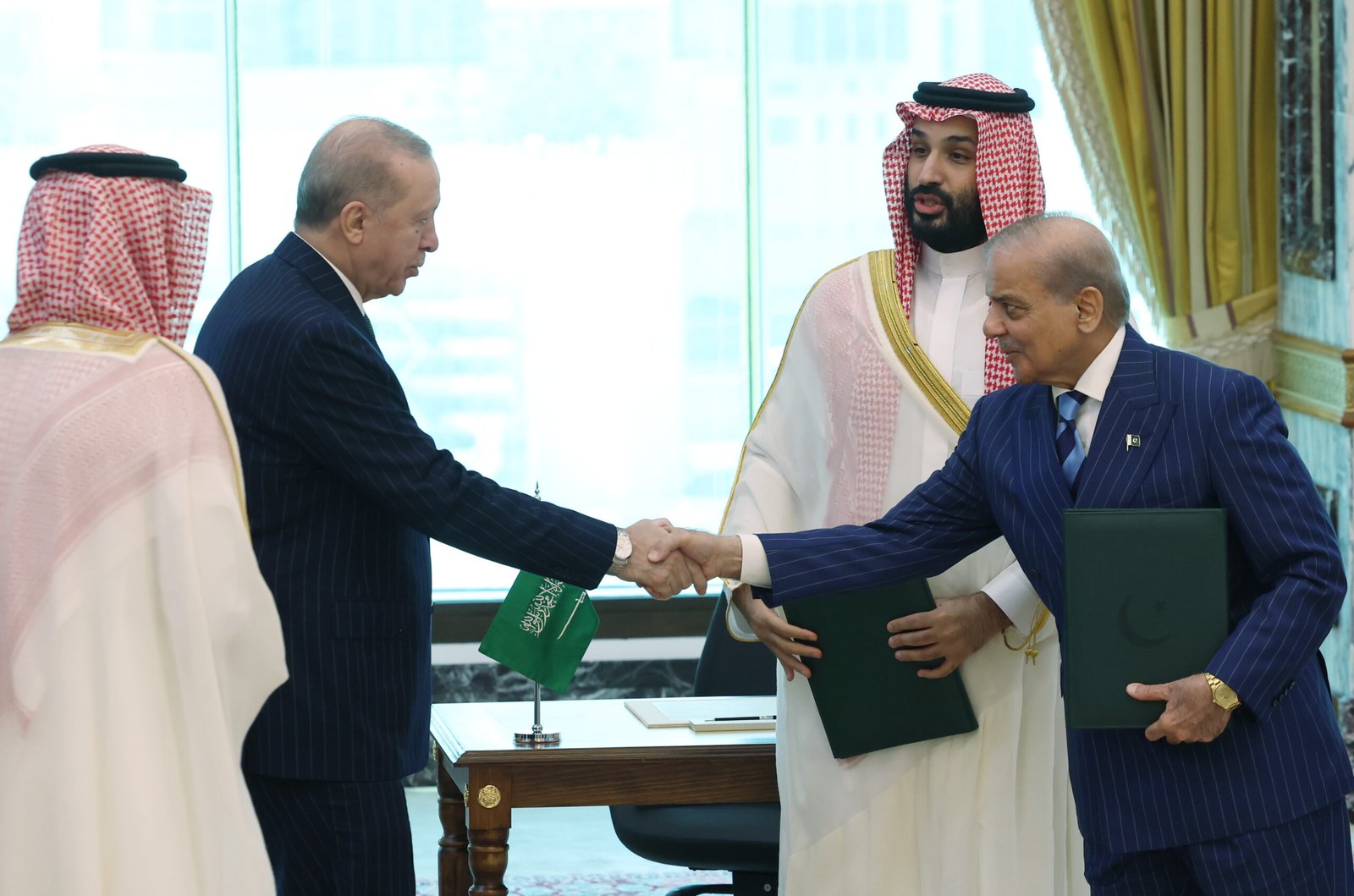
Heartwarming scenes out of Mecca Friday: After the conclusion of a defense pact between Turkey, Pakistan, and Saudi Arabia, those countries’ respective leaders powwowed in a high-rise conference room to get themselves photographed praying towards the Kaaba. The beef over the Saudi dismemberment of Jamal Khashoggi in Turkish territory is just a dim memory. The Mecca Joint Defense Agreement avers that an attack on one member state will be interpreted as an attack on all, a combination that should notionally have some teeth on the strength of Turkish conventional arms, the Pakistani nuclear deterrent, and Saudi money.
Well, paper is paper, and the actual text of the agreement has not yet been published. We’ll see. It should be noted that Riyadh and Islamabad already had a pact along these lines, which did not seem to do much when the Iranians and the Houthis started lobbing ordnance at ARAMCO installations this summer. Granted, the Pakistanis were notionally trying to mediate an end to war at the time, but this point emphasizes the fuzziness of current Pakistani strategy—does Pakistan want to secure its ends by becoming a trusted neutral party, a la Oman or Norway, or by becoming an actual agonist in the international system? (The Pakistanis just seem to be delighted that they’re in so much diplomatic demand these days.) It is not entirely clear what Pakistan gets out of this deal; access to Turkish weapons—less controversial than Chinese suppliers, less expensive than American—and Saudi financing would be the most obvious carrots, but this must remain a guess for now.
The Turkish angle is somewhat clearer: Ankara presumably wants to sell a lot of weapons and is happy to create a market. The Pakistani nuclear deterrent could at least theoretically offset the threat of nuclear blackmail from Israel, where politicians are making increasingly aggressive noises against Turkey, or from Iran, if this whole war thing ends up encouraging the ayatollahs to dash for the bomb. The pact may also encourage the development of deeper economic ties with Saudi, a topic of discussion since the stabilization of Syria has opened a previously difficult trade corridor along what used to be the Ottoman Hejaz railway.
As for the Saudis, Turkey’s military industry and large army and Pakistan’s nuclear deterrent are the obvious attractions. It is perhaps not accidental that defense relations with Pakistan were restated shortly after President Donald Trump functionally nixed the near-term prospects for a Saudi nuclear program.
Subscribe Today
Get daily emails in your inbox
None of these countries shares a border with the others—indeed, Turkey and Pakistan are both peripheral to the region, albeit large—and Saudi is the only Arab country. This preserves Saudi ambitions to regional preeminence, if not hegemony; it is unlikely that Pakistan or Turkey, if only for purely geographic reasons, is voluntarily going to try to exert much force over the rest of the region. While none of the countries has particularly warm relations with Israel and all have expressed disquiet with current Israeli policies, both in Gaza and in the region at large, they have also historically embraced pragmatism above ideology in their relations with Jerusalem. Similarly, none of them is especially enthusiastic about the Islamic Republic of Iran, but prefers getting along most days to most of the alternatives. And all three countries have pretty cozy relations with the United States.
On the whole, this looks like a foundation for a post-retrenchment Middle Eastern order that the U.S. could live with—particularly since Turkey, as a NATO member, will always share certain alignments of interest with the U.S. It’s notable that the Americans were not involved in its creation—if we were, doubtless the thing would have run aground on our insistence on complete normalization with Our Number One Ally in the region—and also that it seems directed as much against Iranian power and aggression as Israeli. With the writing on the wall for American regional involvement, this sort of thing is more or less what you’d expect to happen: the emergence of an equilibrium internal to the system. Perhaps, after all these years, what we needed to do was just leave!
But this is granting that the Mecca pact is something more than words. Saudi is at this point already involved in the Iran War; another round of escalation between the U.S. and Iran could destruction-test the agreement before it has time to be implemented in any kind of concrete way. (God knows how many schemes to bring the Middle East together as a functional, normal bloc have run aground.) That’s another reason to wrap up the war, along with the expense, the weakening of American force posture in more important theaters, and the overall strategic failure without prospect of improvement: At some point, getting out of the Middle East will necessitate, well, getting out of the Middle East, and letting it largely go its own way. Why not give the Mecca Joint Defense Agreement a chance?
[ad_2]
Source link
