
[ad_1]
In a parallel with the 1954 Little Rock school segregation case, if India’s Supreme Court rules that a religious tradition takes precedence over individual rights it will deepen already unprecedented repression under the Hindu nationalist ruling party, writes Betwa Sharma.

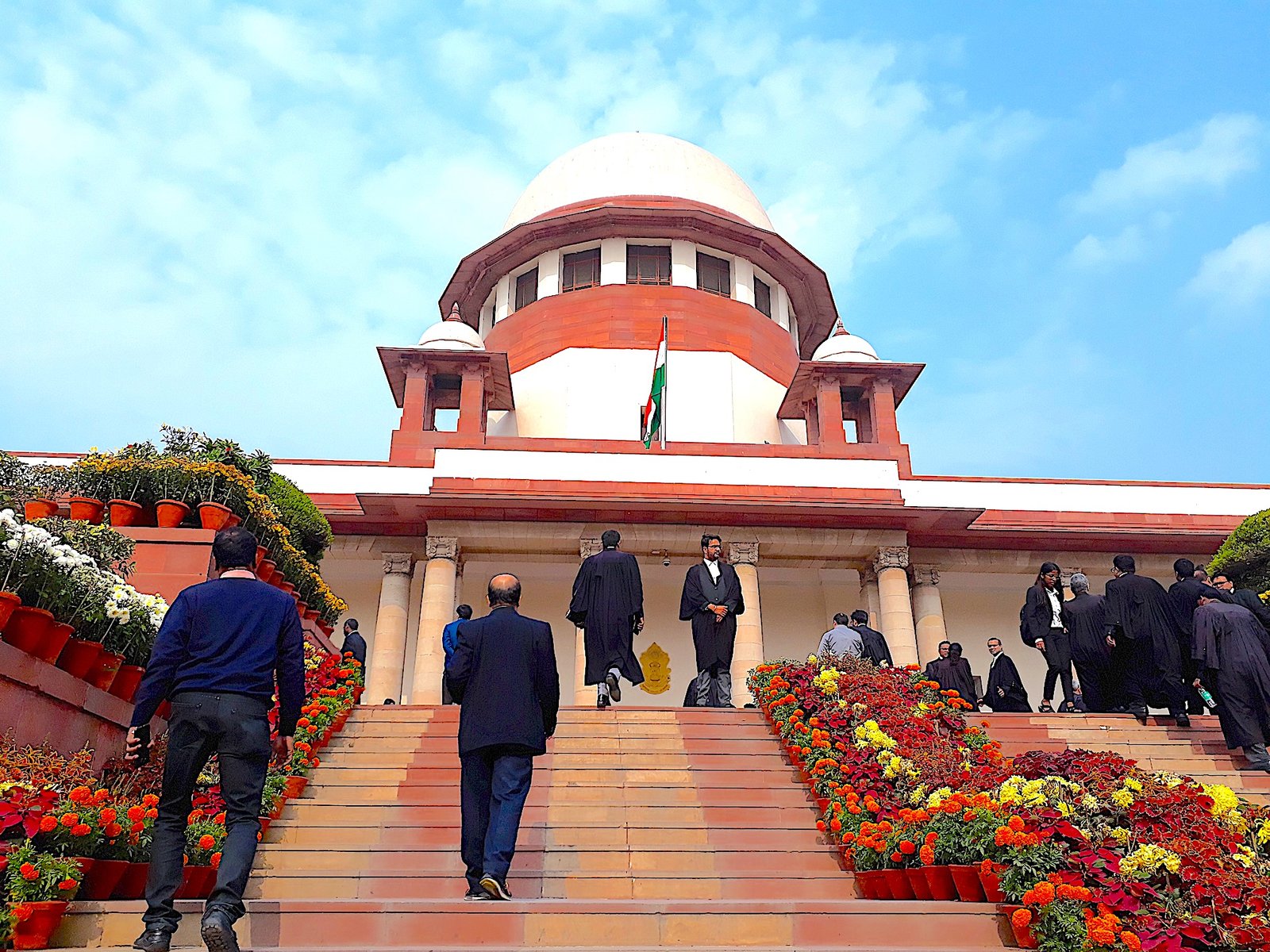
Supreme Court of India, New Delhi, 2018. (Pinakpani / Wikimedia Commons / CC BY-SA 4.0)
By Betwa Sharma
in New Delhi
Special to Consortium News

In 1954, the United States Supreme Court ruled that segregating school children based on race was illegal and ordered that schools in the southern state of Arkansas be integrated.
But because of local resistance, it wasn’t until 1957 that President Dwight D. Eisenhower was forced to order U.S. troops to escort black teenagers into a Little Rock high school.
In 2018, the Indian Supreme Court by a 4-to-1 majority ruled that barring girls and women aged 10-to-50 from entering a temple in the southern state of Kerala was illegal.
This triggered widespread protests across the otherwise progressive state known for its high levels of literacy and strong public health system. The state government of Kerala, led by the Communist Party of India (Marxist), struggled, however, to implement the Supreme Court order against the temple.
In January 2019, two young women, Bindu Ammini and Kanakadurga, were eventually able to enter the temple under police protection, marking a historic moment similar to that of Little Rock in 1957.
Two years later during the farmers’ protest this journalist ran into Ammini, a lawyer who was one of the two women who had entered the temple, who said she had decided to leave Kerala because of the ostracism she was facing.
With the scale of the opposition, public resistance, and protests so intense and volatile, the state government failed to meaningfully implement the court order.
Opposition was so great that the Supreme Court decision was subsequently challenged by religious groups and devotees and the case was referred in 2020 to a larger, nine-judge Supreme Court bench, which only on April 6 began reviewing the case and examining the broader constitutional issues involved.
If the court says religious practices cannot be questioned, it would give religious groups more freedom to follow their traditions without interference.
But if it says courts can review such practices, it would strengthen protections for equality and individual rights, even when they conflict with religion.
The Temple

The Sabarimala temple in 2014. (Vinayaraj/Wikimedia Commons/CC BY-SA 4.0)
The case of the Sabarimala temple in Kerala goes to the heart of the conflict between Hindu religious tradition and modern, democratic rights in India.
The case deals with the question of whether females between 10 and 50 years of age can enter the Kerala temple where their presence could be considered offensive to a revered Hindu deity, Lord Ayyappa, who by tradition is believed to be celibate.
The dispute brings into conflict fundamental rights guaranteed under the Indian Constitution: the freedom of religion, the right to equality and non-discrimination, while also raising the question of the extent to which courts should intervene in religious matters.
In a country as religiously diverse as India, home to Hinduism, Sikhism, Buddhism, Jainism, Islam and Christianity — with Hinduism, Sikhism, Buddhism and Jainism all having originated here — the court is trying to decide whether “essential religious practices” should be subject to constitutional law.
The outcome could determine whether practices that devotees see as “essential,” but others view as discriminatory or at odds with modern constitutional rights, can be challenged or even ended.
If India’s Supreme Court decides religious traditions take priority over individual rights, it will deepen an already unprecedented erosion of constitutional rights in different sectors — freedom of protest, dissent, free speech and expression among them — under the government of the Hindu nationalist Bharatiya Janata Party.
The government is one of several parties pushing back against changes to long-standing religious traditions and questioning the precedence of “constitutional morality” that the Supreme Court of India has previously placed above competing considerations.
This has fueled a growing perception that the Hindu right is suspected of having a broader, more long-term agenda to gradually weaken the Constitution and challenge its socialist, secular and pluralistic foundations.
Debate Over ‘Constitutional Morality’
In the 2018 Supreme Court decision against the temple, the five judges applied the doctrine of “constitutional morality.” In other words, religious practices are protected, but they cannot override fundamental rights. Constitutional values must prevail even when they conflict with long-standing religious or social customs.
In the ongoing Supreme Court hearings, the government, through the solicitor general, has criticised constitutional morality as “elastic,” “vague and subjective,” arguing it lacks fixed legal boundaries, which enables judicial overreach into sensitive areas like religious practices, where judges lack the expertise to assess religious customs.
This argument clearly shows how the government places greater importance on traditions and religious beliefs than on values like equality and dignity. They want courts to stay out of religious matters, which could weaken the Constitution’s role in social reform and protecting people’s rights.
In The Indian Express, Pratap Bhanu Mehta, a well-known political scientist, writing on the government’s critique of the supposed vagueness of “constitutional morality,” cast doubt on the government’s motives while also sharply criticising the Supreme Court’s own failure to consistently uphold constitutional values in recent years.
“It should be clear that the critique of ‘constitutional morality’ is not offered in service of the nation. It is rather part of a broader attempt to hollow it out,” Bhanu writes.
“Question constitutional morality by all means. But a reactionary assault on constitutional morality is a misunderstanding of its character,” he writes. “It is, in effect, to sow the seeds of moral and judicial chaos, an outcome to which our judiciary now seems, regrettably, determined to contribute.”
If the expanded court rules in the government’s favor in this case, it could end legal challenges underway to regressive practices of many of India’s religions. These include the practice of Bal Diksha, which is the entry of children into monastic life in Jainism; and female genital mutilation, practiced by the Muslim Bohra community in Gujarat.
The Indian legal system could be thrown open to the type of political influence evident in 1985, when the Supreme Court ruled that an elderly, divorced Muslim woman should receive alimony. The prime minister at the time, Rajiv Gandhi, passed a law to nullify the judgment because he wanted to appease conservative Muslims who contended courts can’t interfere with their religious laws.
Are Religious Laws Separate From Civil Law?
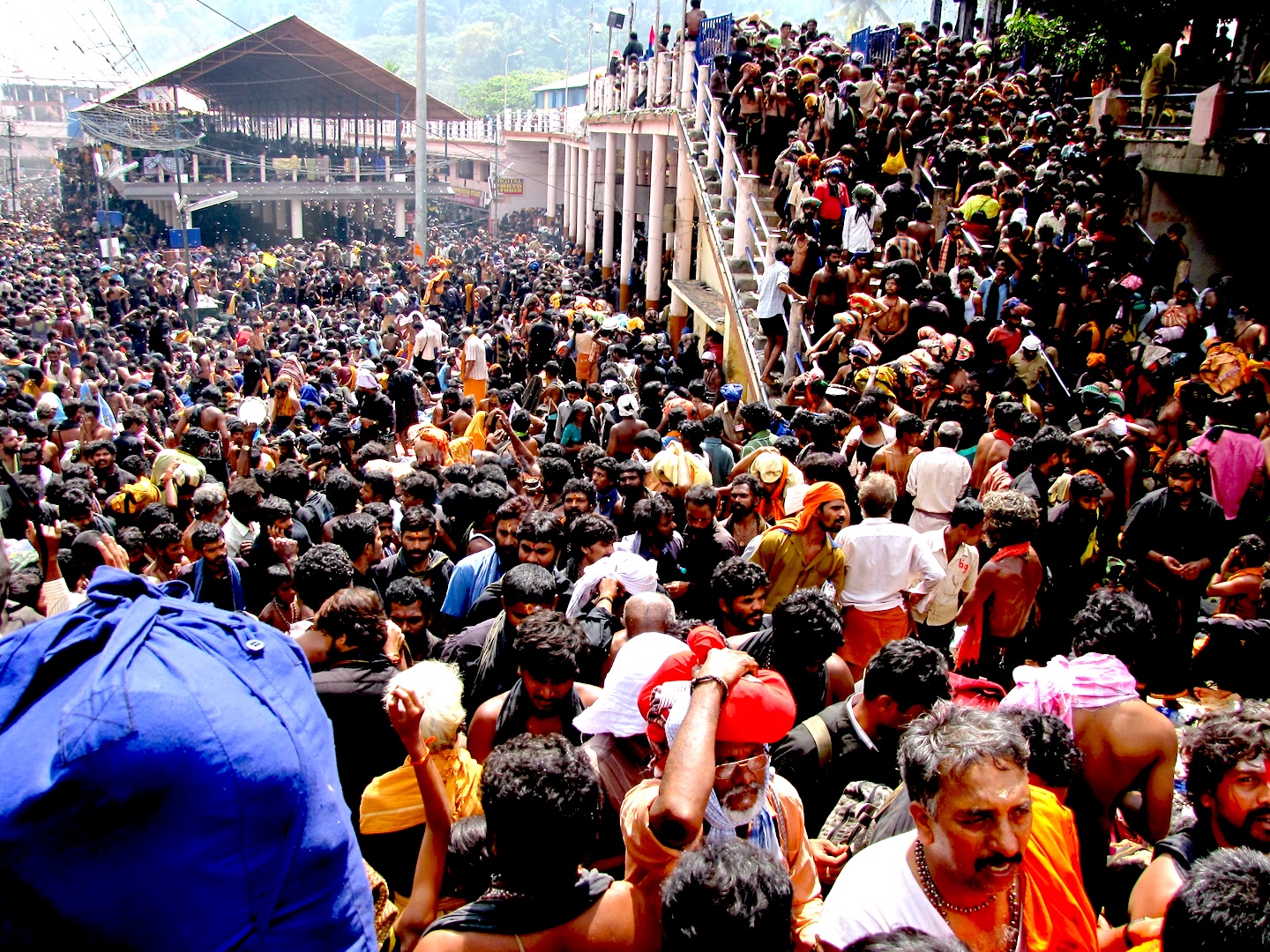
Pilgrims carrying irumudi, or offerings to Lord Ayyappa, at Kerala’s temple in Sabarimala in 2010. (Avsnarayan / Wikimedia Commons /CC0)
Solicitor General Tushar Mehta, who represents the government, has argued that secular courts are scholars of law, not of religion, and lack the competence to decide religious practices.
The main priest of the Kerala temple has told the court that the rights and wrongs of idol worship in Hinduism are judicially indeterminable when rituals are particular to each deity’s manifestation.
The dissenting opinion in the 2018 judgment against the temple ban was written by Justice Indu Malhotra, a female judge, who held that “what constitutes an essential religious practice is for the religious community to decide” and that “notions of rationality cannot be invoked in matters of religion by courts.”
She added that courts should not interfere unless a practice is “pernicious, oppressive, or a social evil, like Sati” — the largely obsolete South Asian custom of a widow immolating herself on her husband’s funeral pyre.
In a tone markedly different from the 2018 judgment, Justice Surya Kant, the chief justice of India, recently said a religion cannot be “hollowed out” in the name of social welfare and reform, and noted the court was grappling with the profoundly difficult task of declaring that deeply held beliefs of millions of people are incorrect.
Justice B.V. Nagarathna, the only woman on the nine-judge bench now hearing the case, said the ban on girls and women cannot be likened to untouchability.
Which Practices Are Protected?
The Supreme Court is revisiting broader constitutional issues beyond the Kerala temple, such as how to define an “essential religious practice,” a legal doctrine used in India to decide which religious practices deserve constitutional protection.
At the same time, the court must consider whether practices that appear discriminatory can still be shielded under the right to religious freedom.
The challenge is how to respect deeply held beliefs in a diverse, deeply religious society, while upholding the fundamental right of equality.
For the devotees, it is not a question of discrimination, but a matter of faith. They contend that religious communities should have the freedom to manage their own practices without interference from the State.
From their perspective, the restriction against women between 10 and 50 is an essential part of the temple’s identity.
For equal rights supporters, excluding those women is fundamentally discriminatory and incompatible with modern constitutional values.
The 2018 judgment reflected this view, holding that the ban violated women’s rights to equality, dignity and non-discrimination and framed the issue as one of “constitutional morality.”
Article 25 of the Indian Constitution, which guarantees freedom of religion, says,
“Subject to public order, morality and health and to the other provisions of this Part, all persons are equally entitled to freedom of conscience and the right freely to profess, practise and propagate religion.”
Then Indian Chief Justice Dipka Misra interpreted the word “morality” in Article 25 not as individual, social, public or religious morality, but as constitutional morality; values like equality, dignity and non-discrimination.
In other words, the Constitution, not tradition, religion, or majority opinion, was the highest moral authority, and courts must enforce constitutional values even against socially or religiously accepted practices if they violate fundamental rights.
The 2018 judgment reads:
“While the Constitution recognises religious beliefs and faiths, its purpose is to ensure a wider acceptance of human dignity and liberty as the ultimate founding faith of the fundamental text of our governance. Where a conflict arises, the quest for human dignity, liberty and equality must prevail. These, above everything else, are matters on which the Constitution has willed that its values must reign supreme.”
Devotees felt the court went too far, questioning whether judges, who are trained in law rather than religion, can decide on religious matters.
A Mormon Parallel
A close parallel in the United States is how the law has dealt with some Mormons who practised polygamy after it became illegal in 1862. Enforcement at first was lax as some Mormons considered the laws an unconstitutional infringement on their religious freedom. Their legal attempts to overturn the law against polygamy based on religious freedom failed however.
Police raids beginning in 1880 led the Mormon church to officially end polygamy, which allowed Utah to become a state in 1896. There have been occasional raids since in several states against polygamists, but punishment was more often meted out instead for cases of underage marriage or sexual abuse, such as against the Mormon leader Warren Jeffs who was convicted and imprisoned for life in 2011.
Jeffs is the leader of the Fundamentalist Church of Jesus Christ of Latter-Day Saints, which broke away from mainstream Mormonism in the early 20th century because of its renunciation of polygamy.
Betwa Sharma is the managing editor of Article 14, the former politics editor at HuffPost India, and the former U.N./New York correspondent for the Press Trust of India. She has also reported for numerous publications, including The New York Times and The Intercept.
Views expressed in this article may or may not reflect those of Consortium News.
[ad_2]
Source link
