
[ad_1]
In one of the scariest moments in modern history, we're doing our best at ScheerPost to pierce the fog of lies that conceal it but we need some help to pay our writers and staff. Please consider a tax-deductible donation.
In our hyper-polarized world, a social experiment showed that we can bridge deep divides by tapping into people’s creativity, curiosity and desire for connection.
Hilary Hodge for Waging Nonviolence
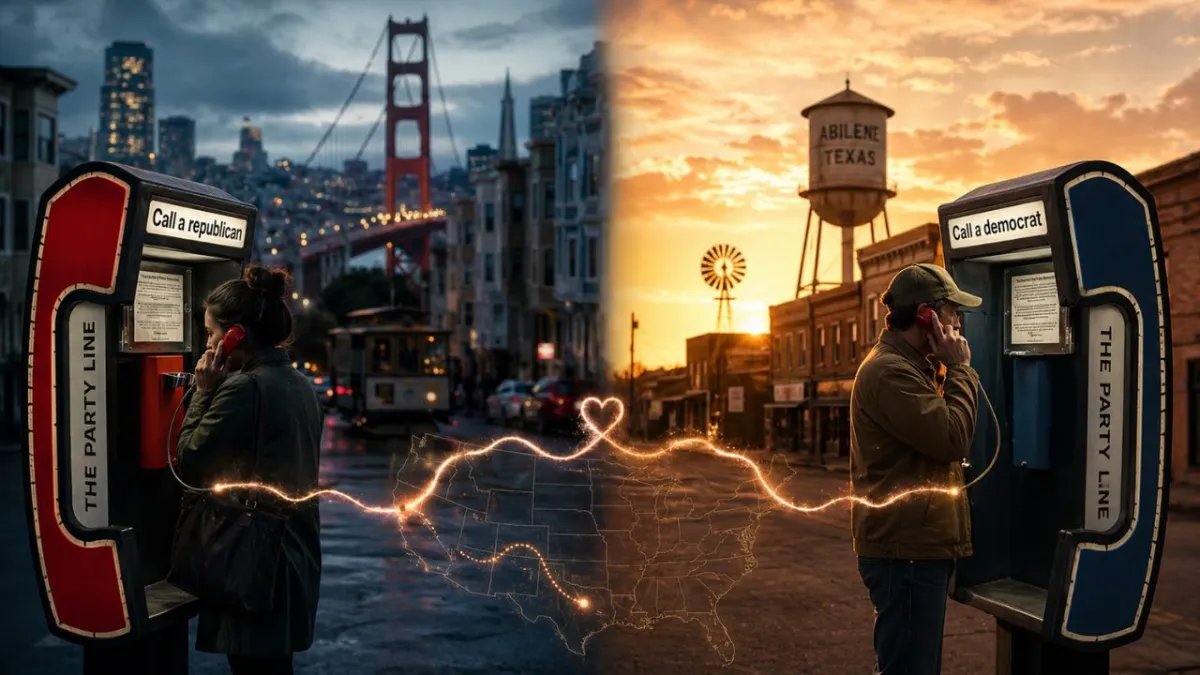
One phone booth was in Abilene, Texas, one of the most conservative pockets of the country, and the other was in one of the most liberal, San Francisco. Signs on the phone booths read, “Call a Democrat” and “Call a Republican,” respectively. Anyone walking by could either make a call or pick up a ringing phone.
There were 387 recorded conversations during the six-week “party line” experiment and, even though many were short, they were surprisingly profound. The word “love” was used 398 times (six times more than “Trump”) and people frequently showed solidarity toward one another, saying things like, “It’s us against the world, man.”
The man who installed the phones works for Matter Neuroscience, a self-described “emotional fitness” organization whose mission is to help people become more aware of how hormones and other brain chemicals impact one’s everyday outlook. The company is interested in exploring how seeking connection can help retrain our brains to boost feel-good neurotransmitters like dopamine and cannabinoids.
While the party line experiment may have been held in the name of neuroscience, it holds five key lessons for how we can organize more effectively in a hyper-polarized, digitally mediated world by prioritizing connection, curiosity and creativity.
1. People are eager to find common ground outside of politics
The participants in the conversations instinctively sought out areas of connection, no matter how small. They giggled about how odd it was to suddenly find themselves on the phone with a stranger. They chitchatted about the weather and their plans for the day.
When one caller from San Francisco introduced himself as Christopher, the other excitedly replied, “Chris, man, that’s my brother’s name!” Steven and Stephanie chuckled at the similarities in their names. Another pair was amused to realize they were both 46 years old.
When a woman in Texas asked a man in San Francisco what housing prices were like in the city, she was shocked by his reply that you can’t get a one-bedroom apartment for less than half a million. In Abilene, she said, you can get a house for $200,000.
But she added that a recently built data center had brought 15,000 new employees who were buying up homes in the city. They moved into discussing whether data centers use too much water and energy and wistfully agreed they wished we could return to the 1990s, a simpler time before the internet and artificial intelligence.
And of course there is the state of the country.
When one caller asked another, “Do you see the world as crazy as I do?”, she sighed and replied, “I do. It’s getting worse and worse every day.”
2. Many people don’t fit neatly within party lines
Although the phones were labeled with the names of political parties, many of the callers were quick to point out they didn’t identify as either Republican or Democrat.
When one caller in San Francisco asked a woman in Abilene if she was a Republican, she laughed and said, “Yes, I am.” But she then paused and backtracked. “Well, no. Hmm, I’m probably an independent, I would say, as I’ve gotten older.”
Previous Coverage

Why I keep building bridges even when I’m full of doubt
Early on in another conversation, a man in California began the conversation by saying, “I am not a Democrat per se. … I kind of abandoned the Democratic party.”
More than 40 percent of callers said they didn’t identify with either party, which is an accurate reflection of the country: A record 45 percent of Americans now identify as Independent (while only 27 percent identify as Republican and 27 percent as Democrat).
Importantly for organizing, the transcripts of these calls remind us that people are often more committed to values like fairness, stability and opportunity than to party labels.
3. Creative activities are an accessible way to engage people
A recent Pew poll found that 90 percent of Americans feel exhausted when thinking about politics.
When people are burned out, creativity can be one of the most effective ways to reengage them. While many of the people who made or answered party line calls might have been wary of, say, talking to a stranger campaigning on the street, the phone booths gave them a way to engage with politics that was novel and self-led.
Activities like these don’t have to be expensive or complicated. In this case, Matter Neuroscience bought the phone booths on Facebook Marketplace for $300, painted them, got permission from two stores to install the phones in front of them, and put Verizon SIM cards in the phones to allow them to work like cell phones.
Organizers can take inspiration from other participatory art, such as Yara El-Sherbini’s political art installations based on children’s games. For example, her piece “Border Control” reimagines the game BuzzWire. Participants have one minute to “cross” a wire shaped like the U.S.-Mexico border. If they touch the wire, sounds and lights flash. Or take New York Mayor Zohran Mamdani’s recent scavenger hunt, which led 5,000 New Yorkers along a route with seven stops leading to landmarks named after former mayors (with the prize of a bag of potato chips — a playful poke at former mayor Eric Adams passing a bribe to a reporter in an empty potato chip bag).
By thinking creatively, organizers can draw people into activities and conversations that give them an unexpected, fresh and less combative way to engage with one another and with political issues.
4. People are keen to see hopeful messages online
In a media environment that is optimized for outrage, it’s refreshing to see images and videos that capture genuine human connection. They stand out because they resist the dominant narrative of polarization.
Matter Neuroscience’s first few party line videos were liked by more than a quarter million people, and the comment sections were filled with people saying things like, “We all have more in common than we think,” “This is the answer. People talking,” and “This made me tear up. What a beautiful idea to bring us back together.”
Organizers who focus their online messaging on authentic connection and kindness can create the kind of community that people are excited to be part of.
5. Clear guidelines influence behavior
Putting simple guidelines in place can help potentially inflammatory activities run more smoothly. For example, on each phone booth, there was a description of the party line experiment that included the line, “The goal for this project is for people from different places to have a meaningful conversation and enjoy common humanity.”
That simple prompt seemed to work, as only five percent of calls had any kind of negative interactions (and none had sustained confrontation).
Many calls have ended with both people saying they felt better and more positive about the country after the call.
In a moment fraught with division, the party line experiment is a welcome lesson for organizers that to build the biggest, broadest coalitions possible, we must find creative ways for people to connect across their differences in order to seek out and nurture solidarity.
Hilary Hodge is a writer and educator. She has written and contributed to textbooks for Oxford and Cambridge University Presses, Pearson, McGraw-Hill and National Geographic, and her writing has appeared in Slate and Hemispheres. She served as an adult education teacher and administrator for nearly two decades and now devotes much of her writing to people who have chronic health conditions and other invisible disabilities. She is an ambassador for Braver Angels.
Editor’s Note: At a moment when the once vaunted model of responsible journalism is overwhelmingly the play thing of self-serving billionaires and their corporate scribes, alternatives of integrity are desperately needed, and ScheerPost is one of them. Please support our independent journalism by contributing to our online donation platform, Network for Good, or send a check to our new PO Box. We can’t thank you enough, and promise to keep bringing you this kind of vital news.
You can also make a donation to our PayPal or subscribe to our Patreon.
Please share this story and help us grow our network!
[ad_2]
Source link
