
[ad_1]
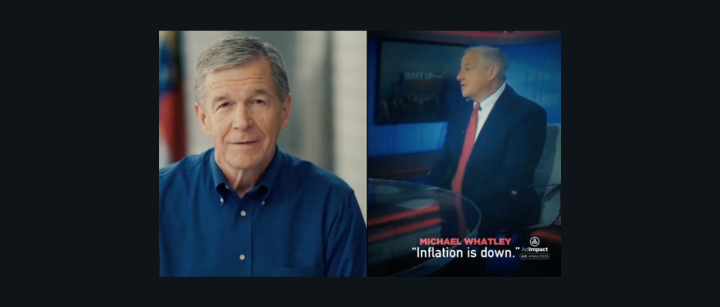
In his campaign’s latest TV ad, Democratic Senate candidate Roy Cooper of North Carolina highlights the issue of affordability using direct quotes from his Republican opponent — “No AI, no special effects, just Michael Whatley in his own words.”

They are, in fact, direct quotes from Whatley — but they are a bit dated, and some of the comments were more defensible or true at the time when Whatley made them.
The ad starts with a quote from Whatley: “Grocery prices are down, gasoline prices are down, housing prices are down, inflation is down,” he says.
“Unbelievable,” Cooper comments.
Judged by today’s metrics, Whatley’s statements are wrong. Grocery prices between January 2025, when Trump took office, and July have increased 3.35%. That’s larger than the 2.58% increase in the year and a half before Trump took office. Gasoline prices are up almost $1 from the price the week before Trump took office. Housing prices have risen 1.6% between 2024 and 2025. And the Consumer Price Index — the most commonly cited measure of inflation — increased 3.4% over the 12 months ending in July, according to the Bureau of Labor Statistics. That’s up from the annualized 3.0% that Trump inherited.
But Whatley, then chair of the Republican National Committee, made those comments in a NewsMax interview in July 2025. Things were a little different then. That’s before the war with Iran and before the effect of Trump’s tariffs had kicked in, among other things.
Gasoline. At that time, gasoline prices were almost exactly what they were when Trump took office, according to the Energy Information Administration — the national average for regular gas was $3.11 per gallon when Trump was sworn in versus $3.12 for the week ending July 21, 2025. Gasoline prices would gradually decline from there, dipping to $2.78 per gallon in January 2026.
The Cooper campaign noted to us that Whatley continued to claim gasoline prices were down in an interview in mid-November 2025. At that point, gasoline prices were down slightly, about 5 cents a gallon from the price Trump inherited.
Then the war with Iran, which began in late February, caused prices to soar. The price per gallon reached $4.50 in May and was $4.07 for the week ending Aug. 31 (nearly 31% higher than when Trump took office). Whatley has been supportive of Trump’s war with Iran, saying it is necessary to prevent Iran from obtaining a nuclear weapon.
Inflation. As we said, inflation has continued to rise in Trump’s second term. But when Whatley made his statement in July 2025 that “inflation is down,” the annualized rate of inflation, as measured by the Consumer Price Index, was 2.7%. That was down from 3.0% in the 12 months before Trump took office.
So prices were still rising, but the annualized rate of inflation was lower. (We’ve pointed this out repeatedly when Trump has claimed that prices are “plummeting downward.”)
Less defensible was Whatley’s claim from an interview with Real America’s Voice in January — highlighted in the Cooper ad — that “there is no inflation.” Whatley added (not in the Cooper commercial), “Inflation has fallen off a cliff since President Trump came in.” The annualized rate of inflation at the time was 2.7%. That’s not “no inflation” but it is lower than the rate Trump inherited. As we noted earlier, since then the CPI has risen, and is higher than the annualized rate when Trump took office.
Home prices. According to the Federal Reserve Bank of St. Louis, the average sales price of homes in the U.S. dropped from $514,200 in the first quarter of 2025 to $502,700 in the second quarter of 2026. The median price of new homes also fell from $423,100 in the first quarter of 2025 to $410,700 in the second quarter of 2026, per the bank.
The median price of an existing single family home has continued to rise in Trump’s second term, according to sales figures from the National Association of Realtors, albeit at a much slower rate than during Biden’s presidency, and, for that matter, during Trump’s first term.
According to NAR, the seasonally adjusted annual median price rose from $412,500 in 2024 to $419,300 in 2025. That’s a 1.6% increase. But it’s slower than the overall rate of inflation.
“It is welcoming to see incomes rising faster than home prices, which has helped boost affordability—but the big short-term challenge to affordability is coming from rising mortgage rates,” NAR Chief Economist Dr. Lawrence Yun said in August.
During Biden’s presidency, the median sales price of existing single family homes rose 37.4%. The median price also rose 27.5% during Trump’s first term. Both of those increases well outpaced overall inflation growth during their presidencies.
Groceries. It was not true then nor is it now, that grocery prices “are down.” The Bureau of Labor Statistics’ CPI for “food-at-home” — products bought at a grocery store or supermarket — overall grew by 0.7% between January and July 2025, when Whatley made his comment. So grocery prices were not lower. But the rate of growth was slower than in the previous six months, 1.48%. Grocery prices have continued to climb since then, and have risen a total of 3.35% from when Trump took office and July of this year.
As we wrote around the time Whatley made his comment in July 2025, there were some exceptions to the overall rising prices. The price of energy, airfare, new and used vehicles and eggs and were all down. But overall, prices continued to climb, and many experts cautioned that the president’s tariffs were likely to cause further price increases.
“DC insider Michael Whatley has been insisting for months that prices are down and there is no inflation while hardworking North Carolinians are getting crushed by high prices,” a spokesperson for the Cooper campaign told us via email. “From groceries to gas to health care – families are struggling while Whatley gets richer.”
While we are unable to search Whatley’s day-to-day comments on the campaign trail, we didn’t find any interviews since January where he spoke about lower prices or no inflation.
Whatley campaign spokesman DJ Griffin pushed back on Cooper’s campaign slogan “make stuff cost less,” claiming that Cooper’s policies had done the opposite.
“Facts are that Michael Whatley supports policies that allow working families to earn more and keep more,” Griffin told us via email.
Editor’s note: FactCheck.org does not accept advertising. We rely on grants and individual donations from people like you. Please consider a donation. Credit card donations may be made through our “Donate” page. If you prefer to give by check, send to: FactCheck.org, Annenberg Public Policy Center, P.O. Box 58100, Philadelphia, PA 19102.
[ad_2]
Source link
