
[ad_1]
This is a critique of Michael Shermer’s moral case for dropping atomic bombs on Hiroshima and Nagasaki.
Michael Shermer has spent much of his career teaching others how not to fool themselves. As the founder and editor-in-chief of Skeptic, he has made a profession of demanding evidence, distinguishing what is known from what is inferred, warning against confirmation bias, and urging people to apply the same standards to their own beliefs as to others’ beliefs.
There is, however, one superstition before which even professional skeptics can be tempted to kneel: the moral innocence of their own country. In his recent essay, “The Moral Case for Dropping the Atomic Bombs,” Shermer revives one of the most consoling tenets of the American civic catechism: Hiroshima and Nagasaki, dreadful as they were, saved “very probably millions of lives, both Japanese and American,” because the alternative was an invasion of Japan.
It is an efficient doctrine. It explains horror, absolves those responsible, and turns victims into instruments of a higher providence. The civilians who died are weighed against the soldiers and civilians who might otherwise have perished. History is considerably less elegant.
Three propositions must be distinguished. First, the atomic bombings contributed to Japan’s surrender. Second, without them, substantially more people would likely have died. Third, therefore, the destruction of Hiroshima and Nagasaki was morally justified.
These propositions are not equivalent: Causal efficacy is not counterfactual necessity, and neither alone establishes moral permissibility.
The Arithmetic of the Unborn Dead
Shermer writes that Truman’s advisers estimated that an invasion could cost between 250,000 and 1,000,000 American lives. The historical record, however, is far less settled.
At the White House meeting on June 18, 1945, the Joint Chiefs explicitly stated that the Pacific experience was too diverse to justify a numerical estimate for the Kyushu invasion. The memorandum nevertheless provided comparisons: Luzon had cost about 31,000 American casualties—killed, wounded, and missing—and it stated that the first thirty days on Kyushu might not exceed that price. Admiral King suggested that a realistic figure would fall between those for Luzon and Okinawa. The same meeting also recorded General Marshall’s view that Soviet entry might prove decisive in pushing Japan toward capitulation.1
Hypothetical deaths do not have the evidentiary status of observed deaths.
But casualties are not deaths, and wounded and missing soldiers cannot be quietly counted as “lives lost” and then compared with the dead from Hiroshima and Nagasaki. More fundamentally, nobody knows how many people would have died in an invasion that never happened. That does not make counterfactual reasoning illegitimate; every serious evaluation of wartime decisions requires it. But hypothetical deaths do not have the evidentiary status of observed deaths.
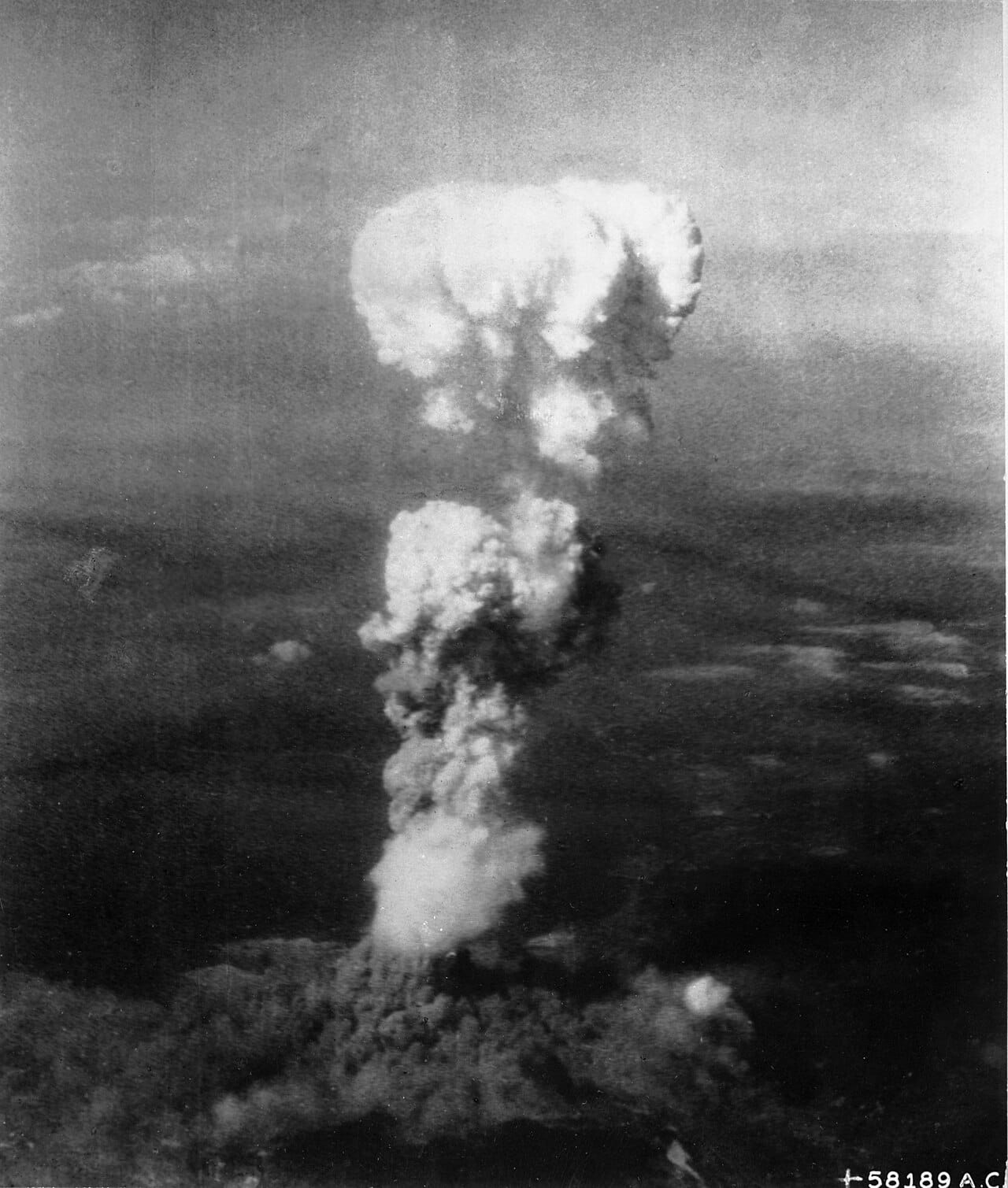
Shermer is entitled to argue that an invasion was probable and would have been catastrophic. What he cannot do without further argument is treat a disputed projection of an unrealized future as though its victims had already been counted.
Arithmetic is not morality.
Even if the casualty estimates were certain, a separate moral difficulty would remain. Imagine a terrorist group holding fifty children hostage in a kindergarten. Unless stopped, the terrorists will detonate a device inside a military installation, killing one thousand soldiers. The government cannot locate the device, but it can destroy the school before the signal is sent. The attack will certainly kill the fifty children but save the thousand soldiers.
Would we therefore say that bombing the kindergarten is justified because the arithmetic saves 950 lives? The arithmetic is impeccable, but the moral conclusion does not follow.
The analogy is deliberately schematic. Hiroshima was not a kindergarten, and wartime cities contain military, industrial, and civilian functions simultaneously. The thought experiment isolates a narrower question: whether the deliberate destruction of civilians can become morally permissible merely because it is expected to reduce a larger number of deaths elsewhere.
The point is not that every soldier voluntarily accepts the risks of war; many are conscripts. The deeper distinction is normative. Combatants and civilians occupy distinct roles in armed conflict. If civilian destruction becomes a means of coercion rather than an incidental consequence of an attack on a military objective, arithmetic alone cannot settle its permissibility. Even perfect arithmetic would not settle whether a state may intentionally destroy an inhabited city in order to reduce expected military losses.
Shermer broadens the argument by claiming that the bombings probably saved Japanese lives as well. That makes the calculus less nationalist but not philosophically simpler. It now depends on a demanding consequentialist principle: deliberately exposing a smaller civilian population to destruction may be permissible whenever doing so is expected to prevent a larger number of deaths later.
A consequentialist may defend that principle, but it must be defended as a moral principle. It cannot be smuggled into the argument as though it were merely arithmetic.
The counterfactual must work both ways.
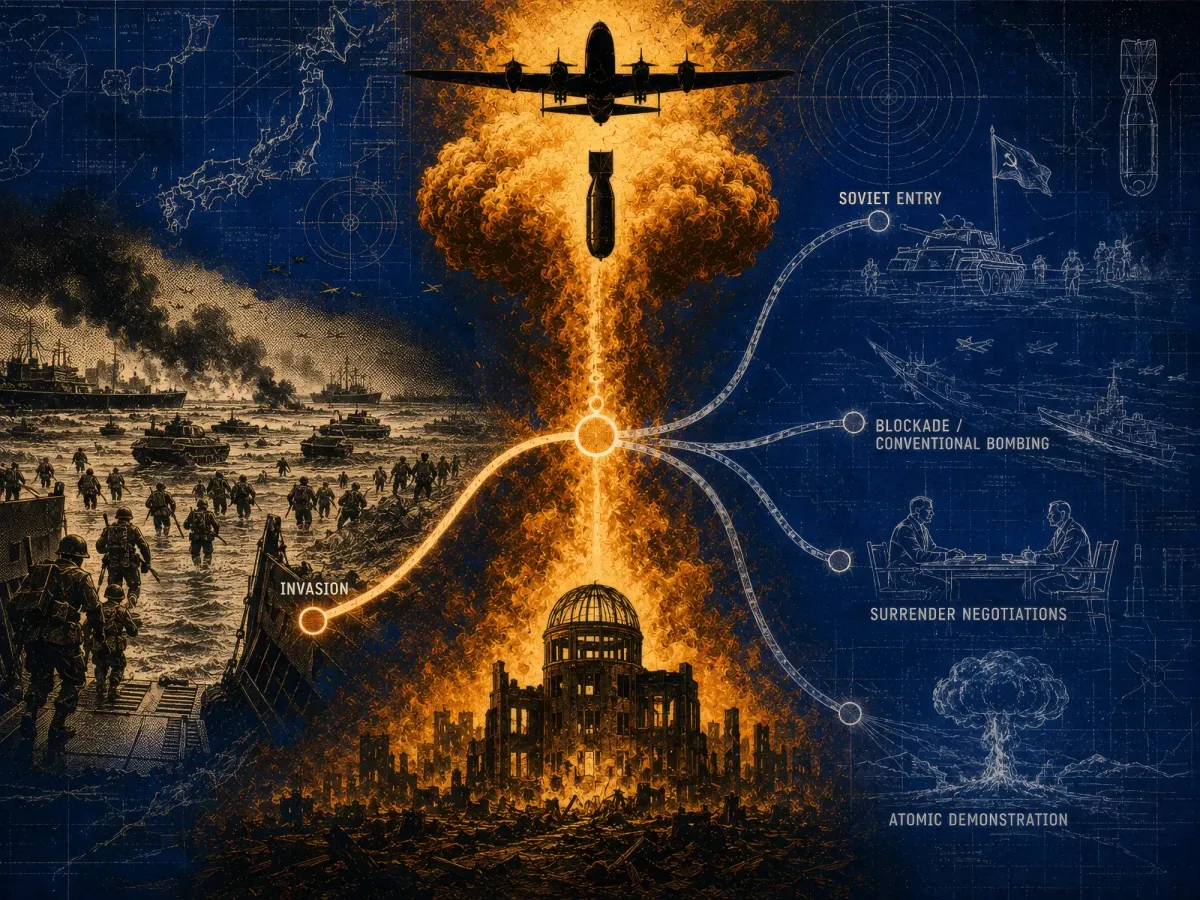
There is also an epistemic asymmetry in the standard defense. The preferred counterfactual runs like this: without the bombs, the United States would have invaded Japan; the invasion would have been catastrophic; therefore, the bombs saved enormous numbers of lives.
But why must the next event in the unrealized history be an American invasion?
At the aforementioned June 18 meeting, Marshall described Soviet entry as potentially decisive. On August 8, the Soviet Union declared war on Japan and launched an offensive against Japanese forces in Manchuria, destroying Japan’s remaining hope that Moscow might mediate an end to the war.
If a moral principle is genuine, the nationality of the actor cannot alter it.
So, consider another possible history: Hiroshima is bombed on August 6, but Nagasaki is not destroyed three days later. Washington waits while Tokyo confronts Hiroshima’s atomic destruction and the Soviet entry into the war, almost simultaneously. Perhaps Japan still refuses to surrender. An invasion may eventually become necessary. But perhaps it does not.
Shermer cannot dismiss that possibility merely because it is speculative. His million saved lives are speculative too. Once counterfactual history is admitted, competing counterfactuals must be admitted as well. Alternatives were not guaranteed to work; nothing in war is certain. But the real question is whether their expected consequences were sufficiently worse, and the evidence sufficiently strong, to justify the destruction of inhabited cities.
Hiroshima is not Nagasaki.
Nagasaki makes this problem particularly difficult. Hiroshima was destroyed on August 6. The Soviet Union entered the war against Japan on August 8. Nagasaki was destroyed on August 9. Japan had scarcely begun to absorb the first catastrophe when the strategic situation shifted again.
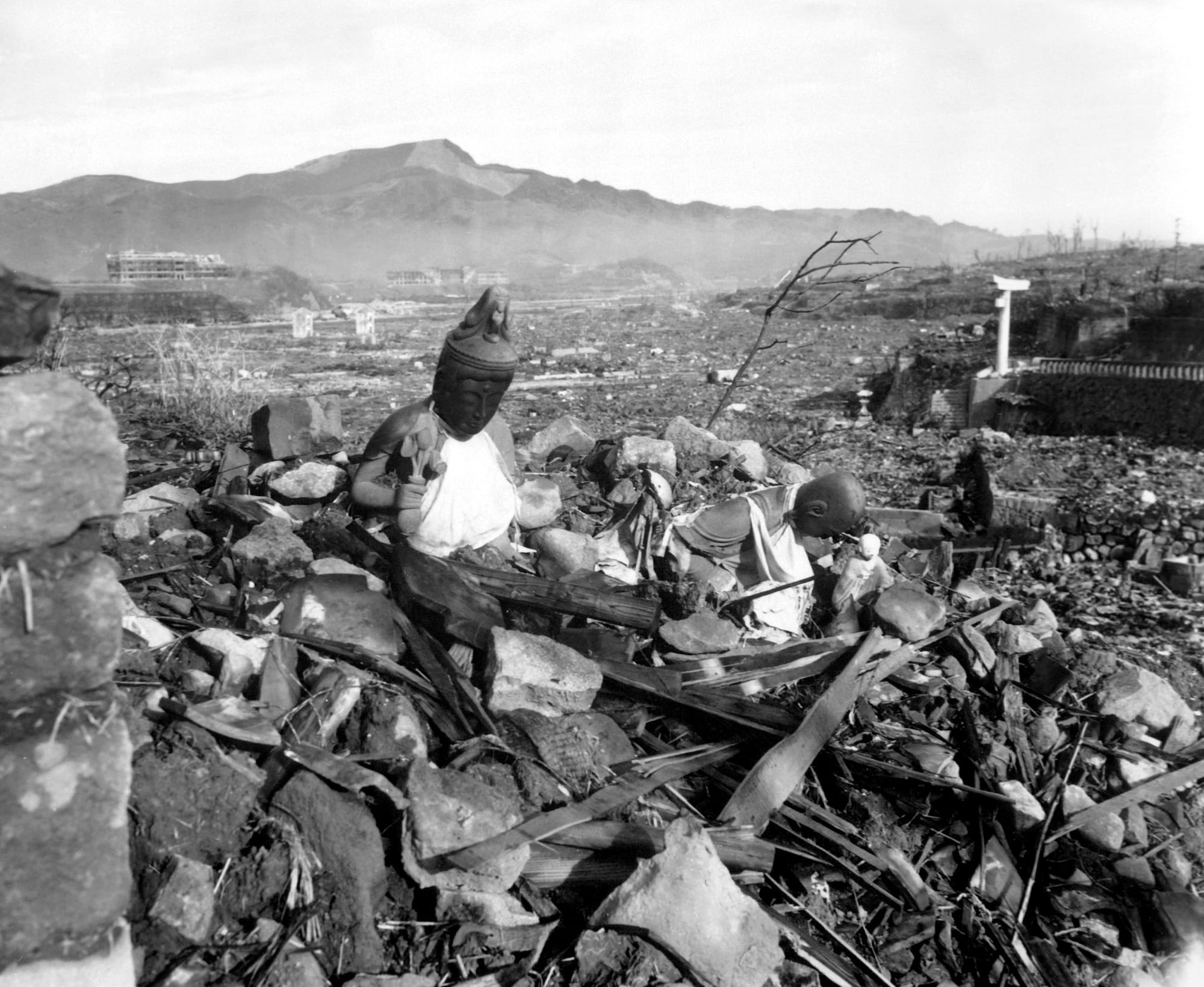
The atomic attack order issued in late July authorized the first attack to be conducted after August 3. It also provided that additional bombs were to be used against the listed targets as they became available.2 Thus, Nagasaki was not preceded by a wholly new presidential decision following an extended assessment of Hiroshima’s effects. This is worth noting because Hiroshima and Nagasaki need not stand or fall together morally.
Even if one granted, solely for the sake of argument, that Hiroshima was necessary, Nagasaki would still require its own justification. Only one day after the Soviet entry and three days after Hiroshima, was it already necessary to destroy another inhabited city?
Remove the flag.
A cleaner test is available: Remove the American flag. Suppose Stalin’s scientists had developed a weapon capable of burning a city in a single attack during the final campaign against Germany. Soviet generals estimate that destroying two German cities would kill 200,000 civilians but save 500,000 Soviet soldiers and perhaps another million Germans who would otherwise die in a prolonged conquest.
Skepticism that stops at the border of national innocence has ceased, at precisely the moment it is most needed in order to be skepticism.
According to the arithmetic of the bargain, Stalin has not killed 200,000 civilians. He has saved 1.3 million lives. Would we accept the calculation? Would we regard the deaths of German children as a necessary sacrifice if it meant saving more lives? Would we approve choosing an inhabited city over an empty demonstration site because civilian destruction would exert greater pressure on Berlin?
Changing the perpetrator is a test of universality. If a moral principle is genuine, the nationality of the actor cannot alter it.
Civilians and Psychological Effect
At the May 31 meeting of the American Interim Committee, participants sought the “greatest psychological effect.” They described the most desirable target as a vital war plant employing many workers and closely surrounded by workers’ houses.3 A separate group of Manhattan Project scientists, in the Franck Report, urged a demonstration of the bomb in a desert or barren area rather than a surprise attack on Japan.4
While this does not prove that American policymakers desired civilian deaths as an end in themselves, the destruction of an inhabited city was considered to hold strategic value, in part because of the psychological effect it was expected to have.
Civilian suffering was therefore not wholly incidental to the coercive mechanism if the devastation of a city was valuable partly because it shocked a government and its population into surrender. In that case, civilians were no longer merely accidental bystanders to the strategy, instead, they had become part of the strategy.
Shermer also argues that without atomic bombing, Curtis LeMay’s B-29s might have continued destroying Japanese cities, with equal or greater loss of life. Perhaps so. But if the alternatives had become “kill civilians this way” or “kill more civilians another way,” that tells us something horrifying about the range of methods already normalized. It does not by itself confer moral legitimacy on either.
More Than Two Variables
American officials were considering more possible courses of action: blockade and conventional bombing, Soviet entry, possible modification of surrender terms regarding the Emperor, and a demonstration of the atomic weapon. The Franck Report is direct evidence that the demonstration option was proposed. These alternatives may have failed. Their existence nevertheless demonstrates that the retrospective perceived binary of choice was artificial.
Geopolitics also played a role. Before Trinity, American leaders sought Soviet assistance against Japan; the minutes taken on June 18 make that explicit. After the successful test, Stimson’s diary records discussions about whether Soviet entry was still necessary and notes Truman’s increased confidence after receiving the detailed report from Trinity.5 After Japan’s surrender, Stalin sought a Soviet role in the surrender and occupation of northern Hokkaido; Truman rejected the proposal.6
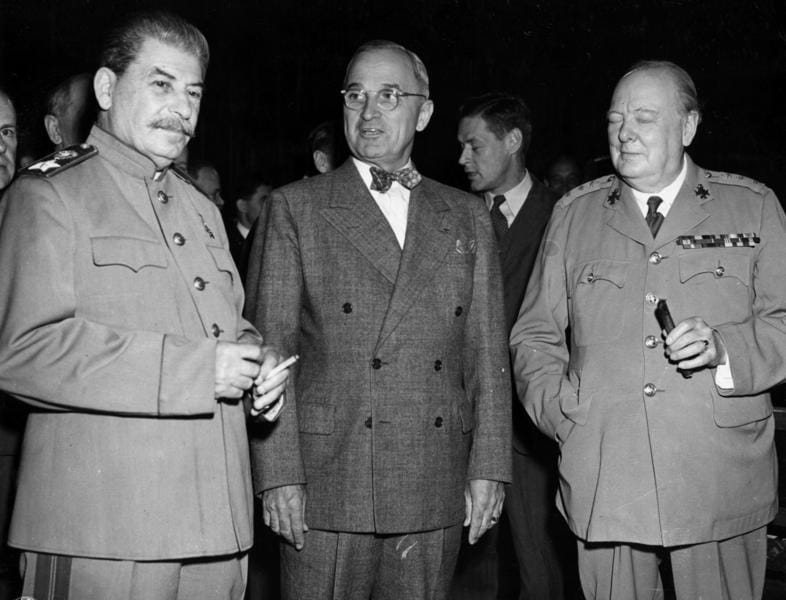
None of this proves the crude thesis that Hiroshima was bombed to frighten Stalin. The evidence does not justify that certainty. It establishes something more modest and more defensible: American decision-making was based on much more than only the two variables of Japanese deaths and American deaths. Soviet power, occupation, territory, and the emerging postwar balance also belonged to the strategic environment.
Once that is admitted, the immaculate retrospective equation—destroy two cities now or sacrifice vastly more soldiers later—begins to look less like history than moral simplification.
Victory and Moral Vocabulary
Shermer is probably right that Hiroshima and Nagasaki are not usefully described as genocide. Truman did not seek the extermination of the Japanese people. But not every atrocity is genocide, and rejecting that category does not settle the larger moral question.
The harder issue is whether a state may intentionally destroy an inhabited city, knowing that enormous numbers of civilians will die, when the destruction is expected to coerce an enemy government into changing its behavior.
Power changes moral vocabulary more easily than it changes moral character.
Saint Augustine understood the privilege of power long ago. In The City of God, a pirate tells Alexander the Great that they do essentially the same thing; the difference is that one commands a small vessel and is called a robber, while the other commands a great fleet and is called an emperor.7 Power changes moral vocabulary more easily than it changes moral character.
Robert McNamara made a related point in Errol Morris’s film The Fog of War. Recalling Curtis LeMay’s remark that they might have been prosecuted as war criminals had the United States lost, McNamara agreed and asked, what makes an act immoral if one loses but not immoral if one wins?8
Victory may confer immunity. It may determine who conducts the trials, issues the communiqués, builds the monuments, and writes the schoolbooks. It cannot alter the moral character of an act.
The Skeptic’s Test
And this brings us back to skepticism.
Shermer’s argument uses counterfactuals. He should. He also weighs consequences, and consequences matter. American leaders faced an appalling decision after years of extraordinary brutality and with incomplete information.
The problem with Shermer’s argument is the asymmetry. Actual civilians are weighed against hypothetical victims drawn from a disputed future. One counterfactual—catastrophic invasion—is granted enormous evidentiary weight, while competing alternatives are dismissed as speculation. A moral conclusion is allowed to emerge from aggregate numbers before the independent problem of civilian immunity has been resolved. And a strategic world involving Soviet entry, surrender terms, blockade, demonstration, occupation, and geopolitics is compressed into a binary: bomb now or lose vastly more lives later.
That is a great deal of certainty to extract from an uncertain history and there is something almost theological about the structure: Terrible suffering occurred, yet it served a higher purpose. Innocent people died, but a greater evil was averted. The victims did not die in vain, and out of evil came a greater good.
Lourdes is easy. Astrology is easy. Ghosts, creationism, telepathy, and alien abductions are easy. The serious test of skepticism begins when the same discipline threatens a belief tied to one’s nation, political tribe, or sense of historical innocence. The dropping of atomic bombs on Hiroshima and Nagasaki are one such test. Skepticism that stops at the border of national innocence has ceased, at precisely the moment it is most needed in order to be skepticism.
Read Michael Shermer’s response to this article.
[ad_2]
Source link


