
[ad_1]
With all the recent hype around The Telepathy Tapes podcast, people might think that claims of telepathic abilities in nonspeaking individuals with profound autism are new. They are not. They are decades old.
FC (used here as an umbrella term for all facilitator-dependent techniques) is, purportedly, a communication technique in which the previously silenced thoughts of individuals with profound autism can be accessed through “spelling” while using a simple letter board. Proponents claim FC works primarily through a trust-bond between a literate assistant (called a facilitator), who provides physical and emotional support, and the nonspeaking individual. Critics of the technique point to facilitators’ visual, auditory, and physical cueing as the source of FC-generated messaging.
Almost from FC’s inception, there were reports by some facilitators that their clients could spell out answers to the questions they (the facilitators) hadn’t yet asked. Paul Haskew and Anne Donnellan, in a 1993 book titled Emotional Maturity and Well-Being: Psychological Lessons of Facilitated Communication claimed (without scientific proof) that some facilitated individuals had a “sixth sense” that translated into telepathic abilities. Purportedly, these individuals could communicate with their facilitators or with each other telepathically (even without being in the same room).
Early critics of FC, including magician and skeptic James Randi, suspected facilitator cueing and control over letter selection due to small unconscious muscle movements (e.g., the Clever Hans effect) (Spitz 1997; Von Tetzchner 1996). When Randi was contacted by Donnellan in 1992 to test the psychic abilities of facilitated individuals at the University of Wisconsin-Madison, Randi suggested that they first conduct authorship testing to rule out any (inadvertent) control over letter selection by the facilitators before moving on to testing telepathic abilities. He wanted to make sure the FC-generated messages were the words of the clients, not those of the facilitators. Predictably, Randi was dismissed from the project (Randi 2017).
Apparently, Donnellan and Haskew, just like Ky Dickens (producer of the podcast The Telepathy Tapes), were more interested in advancing the idea of psychic abilities in nonspeaking people with autism than they were in making sure the facilitators weren’t (inadvertently) controlling letter selection. After all, without FC, proponents’ claims of psychic abilities in their clients with profound communication difficulties vanish into thin air.
Ironically, FC founder Rosemary Crossley, in her 1994 Facilitated Communication Training, cautioned that claims of telepathy were likely the (unconscious) creations of facilitators whose clients were “picking up physical cues” from their facilitators (Crossley 1994, 110). This is the only time I’ve seen in print where Crossley agreed with critics of FC regarding facilitator cueing and control over letter selection. Crossley believed facilitator-dependent techniques were “independent” during “regular” communication—even when making allegations of abuse (Heinrichs 1992). She even came to the defense of disgraced former Rutger’s philosophy professor Anna Stubblefield when Stubblefield was charged with and convicted of aggravated criminal sexual contact with a severely disabled man with cerebral palsy, whom she claimed communicated his consent through FC-generated messages obtained while she was his facilitator (as seen in the documentary Tell Them You Love Me) (Shane 2024; Vyse 2024). But for Crossley, believing in the telepathic powers of nonspeaking individuals with profound autism was a step too far.
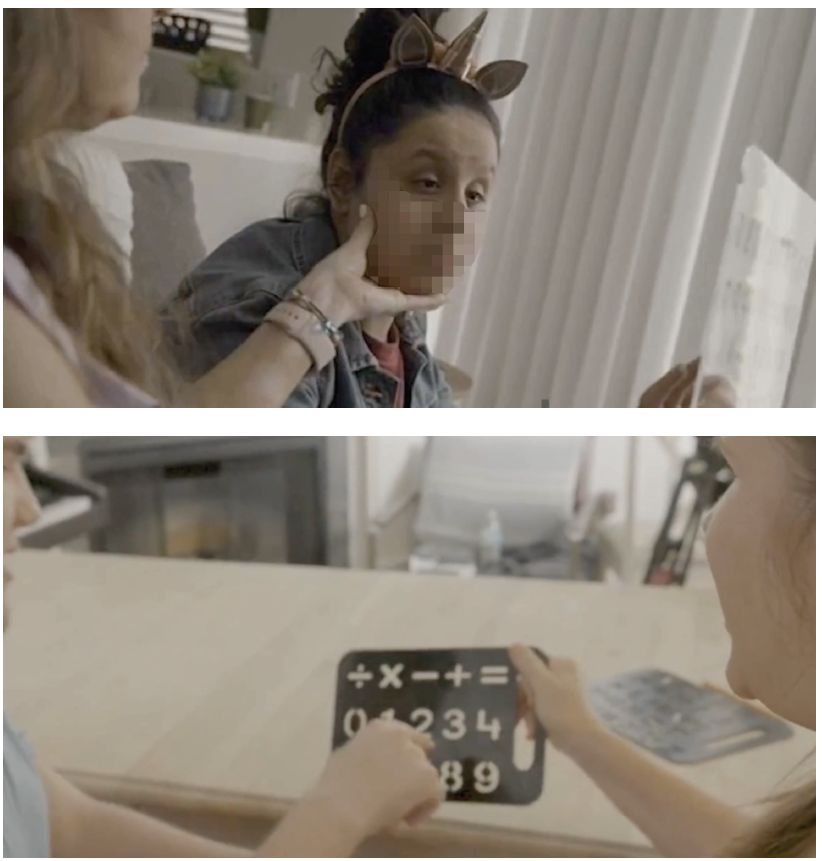
 Physical cueing is, perhaps, one of the easier forms of cueing to detect, because in “traditional” FC, facilitators hold the wrist, elbow, shoulder, or other body part of their clients during letter selection. Many early critics of FC focused on the question of “Who is doing the pointing?,” and dozens of controlled studies designed to separate facilitator behaviors from the behaviors of their clients during the spelling activity proved what critics of FC suspected: the facilitators were (to varying degrees of conscious awareness) controlling letter selection through physical touch.
In Figure 1, an image from The Telepathy Tapes website, the facilitator holds onto her daughter’s face during letter selection. By flexing her fingers and/or gently pushing her daughter’s face to the left or right, the facilitator can guide the daughter’s gaze to the target letter on a plastic letter board the facilitator holds in the air. This form of FC seems to be a hybrid of traditional “touch-based” FC with the newer forms of FC, such as spelling to communicate (S2C) or rapid prompting method (RPM).
Knowing that physical cueing raises questions about facilitator interference with letter selection, facilitators have invented FC variations that look more convincing than the “traditional” form Crossley invented. (See Katharine Beals’s article in this issue for more information about the evolution of FC.) Instead of touching the client, facilitators hold a letter board in the air while the client extends a finger toward it. Facilitators pride themselves on the idea they can’t cue their clients if they aren’t touching them (which isn’t true). It is these so-called “no-touch” forms of FC, or “modern spelling methods”—namely S2C and RPM—that are primarily featured in season one of The Telepathy Tapes.
In Figure 2, a facilitator from The Telepathy Tapes holds a number stencil in the air while the individual being subjected to S2C extends a finger toward it. The numbers or letters called out by facilitators don’t always match where on the stencil the individual touches. Facilitators (to varying degrees of conscious awareness) control access to the letter board, often moving the stencil up or down, left or right, backward or forward to aid in letter selection.
Because visual cues (e.g., hand signals, shifts in body weight) and verbal cues (e.g., directional cues such as “up, up, up!” or “right next door!”) are so common in S2C/RPM, modern day facilitators (now called “communication regulation partners,” or CRPs) may not realize the extent to which these nonphysical cues can and do influence letter selection. Furthermore, despite claims that touching during letter selection is “taboo,” S2C/RPM practitioners do use physical touch to reposition their clients and/or control access to the letter board by holding it in the air, offering it to the client, and/or taking it away as the facilitators judge necessary.
Figure 3, another screenshot from The Telepathy Tapes, shows an RPM session and captures the same moment during the session from two different camera angles. In the picture on the left, it looks like the individual is selecting letters independently, but in the picture on the right, we see that the facilitator is touching the young man’s back. Even subtle physical touch can guide letter selection.
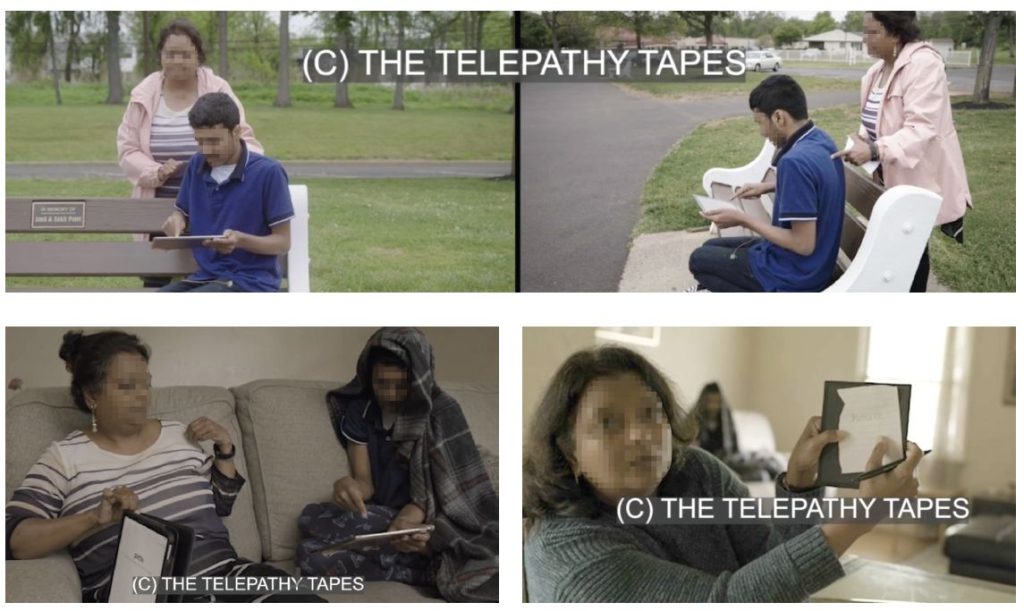
is touching the young man on the back. Figure 4 (bottom left). A facilitator appears to make hand signals while her son types on a keyboard. Figure 5 (bottom right). A facilitator (the mother
of the young man behind her) showing the word house to the camera that she claims to have telepathically transmitted to her son. (All photos are screenshots from The Telepathy Tapes website.)
S2C/RPM facilitators are trained that it’s unethical to participate in reliably controlled authorship testing—which, to me, is an indicator that deep down facilitators know who is controlling letter selection and what would happen if they participated in such tests. It is possible, however, to detect facilitator cueing and control over letter selection by analyzing pro-FC/S2C/RPM films, YouTube videos, and the videotaped “telepathy” sessions shown on The Telepathy Tapes (available on the podcast’s website for a fee). Such analysis has its limitations. We cannot, for example, determine an individual’s language and literacy skills from these videos. But we can analyze the videos for signs of facilitator cueing: head nods, hand signals, shifts in body weight, verbal cueing, moving the letter board in the air, controlling access to the letter board, and the like.
In Figure 4 we see that even though the young man appears to be selecting letters on a keyboard he holds in his hand, the facilitator uses hand signals to guide letter selection. By watching the facilitator’s movements, we can see that the young man’s movements are synchronized to the visual cues. A full analysis of this facilitator/client pair with time stamps is available on my FCisNotScience YouTube channel (view “The Telepathy Tapes and Facilitated Communication (IZARD)”).
Even in what is purportedly one of the most impressive examples of telepathy in The Telepathy Tapes podcast, the facilitator positions herself in a room while her son sits on the couch behind her (see Figure 5). She holds up the word house written on a piece of paper to the camera while her son proceeds to “telepathically” spell out, then say the word house. However, a close analysis of this session shows that the facilitator is clandestinely saying the sounds of the letters in the verbal prompts she is giving her son. And yet these visual, verbal, and physical cues continue to be undetected or rationalized away by the producers of the podcast. See my video analysis on YouTube (“The Telepathy Tapes and Facilitated Communication: Verbal Cues in No Touch FC (House)”).
Although protocols have been in place since the 1980s to test authorship in FC, modern-day facilitators refuse to participate in such testing (most likely because all the controlled authorship testing done in the early-to-late 1990s in the United States resulted in clear demonstrations of facilitator control over letter selection). And though Dickens claims to be scientifically minded, none of the tests for telepathy in season one controlled for facilitator influence over letter selection.
In fact, in a move that was antithetical to proven reliably controlled authorship protocols, Dickens and her team gave facilitators the answers to test questions and blinded the nonspeaking autistic individuals to test stimuli—exactly the opposite of what should have been done. Dickens conducted these experiments throughout the series, but they are only featured in episodes 1 and 2 of season one of The Telepathy Tapes. In authorship testing, the facilitators should be blinded to test stimuli so that the individuals being subjected to FC can have an opportunity to demonstrate their understanding and use of written language (if those skills exist) without interference from the facilitators.
In a screenshot from The Telepathy Tapes shown in Figure 6, the young woman is blindfolded while her mother holds her forehead and hands her colored popsicle sticks to sort into piles. In my YouTube video critique, it is clear that the mother moves the girl’s head left and right depending on where she would like the daughter to place the colored popsicle stick (“Telepathy Tapes Critique of Episode 1 (Supplemental) | Cueing in Touch-based Forms of FC”).
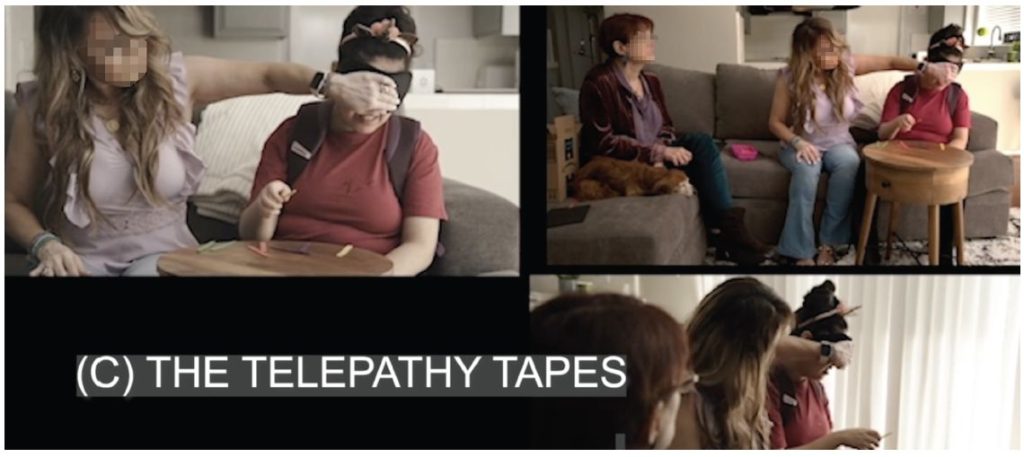
In test after test, the facilitators in The Telepathy Tapes were shown words, pictures, or math problems, and then they “assisted” their clients (often their own children) in spelling out words on a letter board. Dickens’s team seemed impressed as the nonspeaking individuals typed out the “telepathically” transmitted messages—information the facilitators knew but their clients or loved ones did not. If the individuals were typing independently using FC/S2C/RPM, there would be no “transmission” of information. They would simply type their answers on a keyboard without the need of a facilitator. However, given that these methods require another person to work, a simpler explanation of these purported “telepathic abilities” is that the (literate) facilitators knew the correct target words or letters (or, in the case of the popsicle sticks, tasks) and guided the nonspeaking person to the right answer through visual, auditory, and/or physical cueing.
Sadly, The Telepathy Tapes podcast seems to have breathed new life into a technique that was thoroughly discredited in the United States by the mid-1990s (and even earlier in other countries).
To me (and the scientific community), the claims in The Telepathy Tapes of unexpected literacy skills in nonspeaking individuals with profound autism would have been much more impressive if the facilitators were out of visual and auditory range when the nonspeaking individuals were presented with the test stimuli (e.g., pictures, numbers, words, popsicle sticks) and the clients were then asked to spell out their responses. I’m with James Randi on this one. Let’s prove authorship in facilitator-dependent techniques first before moving on to claims of telepathic abilities in individuals targeted for pseudoscientific communication techniques. I suspect that rigorously controlled authorship studies of FC/S2C/RPM (with a focus on facilitators’ behaviors) would both answer questions about who is controlling the “spelled” communications and resolve any issues about the claims of telepathic abilities being uncritically promoted by Dickens on The Telepathy Tapes.
References
Crossley, Rosemary. 1994. Facilitated Communication Training. New York, NY: Teachers College Press.
Heinrichs, P. 1992. Suffering at the hands of the protectors. The Sunday Morning Herald (February 16). Online at https://www.smh.com.au/national/suffering-at-the-hands-of-the-protectors-20090821-esuq.html.
Randi, James. 2017. The farce known as ‘FC’. Skeptical Inquirer 41(4) (July/August). Online at https://skepticalinquirer.org/2017/07/the-farce-known-as-fc/.
Shane, Howard. 2024. Netflix’s hit documentary ‘Tell Them You Love Me’ highlights a misleading promise. MSNBC (July 7). Online at https://www.msnbc.com/opinion/msnbc-opinion/netflix-new-documentary-tell-them-that-you-love-me-rcna160480.
Spitz, H. 1997. Nonconscious Movements: From Mystical Messages to Facilitated Communication. Oxfordshire, UK: Routledge.
Von Tetzchner, S. 1996. Facilitated, automatic and false communication: current issues in the use of facilitating techniques. European Journal of Special Needs Education 11(2): 151–166. Online at https://www.tandfonline.com/doi/abs/10.1080/0885625960110201.
Vyse, Stuart. 2024. When silence speaks: The harmful pseudoscience of facilitated communication. Reality’s Last Stand (June 24). Online at https://www.realityslaststand.com/p/when-silence-speaks-the-harmful-pseudoscience.
[ad_2]
Source link
