

[ad_1]
Belief in telepathy in autistic individuals, as promoted in The Telepathy Tapes podcast, stems from forces of modernity so inexorable that, were we to rewind the gears of history and try it all again, we’d end up right back where we are. The forces I’m implicating are disparate: the spread of literacy, the rise of the nuclear family, the disability rights and neurodiversity movements, trends in modern education, the accumulating research on autism, the “god-shaped hole” caused by growing secularism, the rise of mass media and then social media, the tendency of methodologies to evolve through implicit learning mechanisms and skeptical feedback toward increasing apparent plausibility, and, last but not least, the realities of profound autism.
But the most immediate reason widespread belief in autism telepathy was inevitable is that widespread belief in facilitated communication was inevitable.
The Inevitable Belief in Facilitated Communication
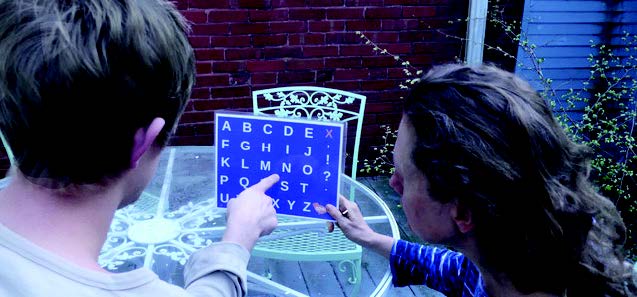
Facilitated communication (FC) is a pseudoscientific technique that purports to unlock language and literacy skills in nonspeaking or minimally speaking individuals with intellectual disabilities, particularly profound autism. A “facilitator” makes contact with the person’s body, moves around a letterboard, and/or hovers near the person and provides vocal and physical prompts and cues, while the person points to letters with an index finger. Through their touch, spoken prompts, gestures, and cues—however subtle and unintentional they may be—facilitators can completely control the messages their clients allegedly author.
But the extent of that control is not obvious to most people, and FC has long lurked as a theoretical solution to the enormous communication challenges of profound autism—challenges that have long resisted established therapies and teaching methods. FC’s adoption simply awaited motive and method. The spread of literacy skills and writing tools into most homes by the early twentieth century provided the method; the rise of nuclear families, together with the civil rights movement of the 1960s, provided the motive. One offshoot of civil rights was disability rights and the deinstitutionalization of children with cognitive disabilities, including profound autism (Braddock et al. 1990). Suddenly, large numbers of parents, especially mothers, were deeply invested as never before in the realities of profound autism. Not long afterward came the first public reports of facilitated pointing to letters by nonspeaking individuals (see Oppenheim 1974). Tellingly, the first messages that these “unlocked” individuals reportedly typed are just what parents long to hear: “I AM IN HERE”; “I AM INTELLIGENT”; “I LOVE YOU MOM AND DAD” (see “Prisoners of Silence” 1993).
But FC’s spread beyond isolated homes and clinics awaited its “professionalization,” that is, the emergence of FC practitioners and promoters with the resources and credentials to attract media attention. No sooner did these influencers emerge—Rosemary Crossley in Australia in the late 1970s and her protégé, Douglas Biklen, in the United States in the late 1980s—than the first FC crazes erupted (“Prisoners of Silence” 1993). But late twentieth-century FC, as yet untested by widespread scrutiny, looked crude and awkward: the facilitators mostly held their clients’ hands or wrists, and the clients often looked away while pointing. The fact that the public nonetheless took FC seriously speaks to the abiding thirst for stories of awakening—as well as to the intrigue of profound autism. The absent speech, or limited and often mysteriously echoic speech, along with the opaque body language, make profound autism a blank slate for wishful thinking. The most wishful thought of all—the notion of intact intelligence and language—dates back at least sixty years (Bettelheim 1967).
Still, some people raised questions about who was really authoring the messages. When the stakes were sufficiently high, some practitioners agreed to participate in facilitator-blinded message-passing tests. When these tests consistently showed facilitator authorship, FC version 1.0 was roundly discredited. But, in a testament to its resilience—indeed, its inevitability—FC never went away. It merely evolved.
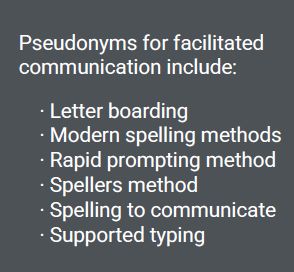
FC evolved, in part, through the implicit learning that inevitably occurs during any kind of repeated practice. Longtime FC users learned to respond to ever more subtle cues, such that their facilitators could shift from hands and wrists to shoulders or backs—or in some instances merely hover close by and hold up the keyboard and/or move their own bodies around. FC evolved, in addition, through adjustments by promoters and practitioners in response to public scrutiny, the most salient manifestation of which was the rebranding of FC as rapid prompting method (RPM). RPM, which entered the Anglophone world in the early 2000s (Iversen 2006) and persists to this day, “corrected” many of the problematic optics, making FC look much more convincing, even in its initial stages with novice clients.
Most obviously, RPM has replaced hand or wrist holding with letterboard holding. Because observers tend to look at the person selecting letters rather than at the facilitator, the increased physical separation between the two parties makes the facilitator’s letter-cueing behaviors—board movements and gestures—much less salient. Second, RPM has replaced electronic keyboards with plastic letterboards, at least for the initial stages of FC. This has eliminated electronic transcriptions and allowed the facilitator, now doubling as a scribe who calls out and writes down letters, to decide when a letter was selected and which letter it was. Faulty judgments are hard for observers to notice unless they have a clear, head-on view of the letterboard and unless the facilitated person points slowly. Third, practitioners of RPM variants—the rebranding goes on, giving us spelling to communicate (S2C) and spellers method (“spelling”)—have had some success training facilitated individuals to look at letterboards when pointing (see Notaro 2023). Fourth, the 1990s debacle has deterred practitioners from participating in blind testing, and some FC certification programs require practitioners to sign agreements promising not to test the premises and claims (see Beals 2024).
All this has made FC 2.0 look much more convincing, especially to parents of profoundly autistic children, desperate as they still are for bigger improvements in communication than evidence-based methods have delivered (Brignell et al. 2018). But they aren’t alone. Facilitator cues are sometimes so subtle that even some autism experts have declared FC works for some autistic nonspeakers (Hemsley et al. 2025). And in the carefully filmed and edited videos that dominate YouTube, those cues can sometimes be practically invisible.
Meanwhile, a growing body of autism research now includes articles that have boosted FC’s scientific credibility. Earlier, FC proponents had to resort to mere assertions of their pro-FC claims, namely that rather than being the socio-cognitive disorder that its diagnostic criteria (informed by decades of clinical observation and empirical research) have defined it as, autism is instead some sort of motor disorder or body apraxia that impedes both speech and fine motor skills and is compounded by additional problems with sensory and emotional regulation (Biklen 1990). This purportedly accounts for the poor performance by those with profound autism on language tests; their inability to demonstrate comprehension by following directions; and their need for facilitators to help steady their arms, bypass their fine motor difficulties, and/or provide emotional, sensory, or attentional support through vocalizations and board movements (see the pro-FC website I-ASC.org). While no research supports any of this, some studies have found coordination difficulties and sensory sensitivities in autism, and proponents now routinely misconstrue these studies as validating FC (see Jaswal et al. 2020). Journalists and others ill-equipped to recognize misrepresentations of highly specialized research have readily accepted proponents’ sciencey-sounding claims that autism is a sensorimotor disorder or a type of apraxia.
Certain studies are especially popular with FC proponents. The fact that profound autism is randomly distributed across sectors of society means that it eventually gets diagnosed in the families of reputable researchers in psychology and neuroscience, some of whom have reacted by opting for FC—both personally and professionally. The resulting studies, biased and methodologically unsound though they are, have crept into academic journals and added to FC’s credibility (see Jaswal et al. 2020). Further securing that credibility is the staunch unwillingness of any of today’s practitioners to participate in blind testing.
The growing denial by the general public of the realities of intellectual disability is also FC-friendly. This mindset, part of a well-meaning, civil-rights-adjacent egalitarianism, has extended the idea that everyone is equally worthy to the idea that people are in some sense equally intelligent. The education world, in parallel, has extended the right of students with disabilities to an education, as stipulated by laws dating back to 1975, into a right to the same education that everyone else gets, as stipulated by the Every Student Succeeds Act of 2015. Teachers must now ensure that all but the most cognitively disabled 1 percent meet the same “challenging State academic standards” as specified by their state, and that the remaining 1 percent meet alternative standards that are still “aligned” with those “challenging state standards” (Every Student Succeeds Act 2015). Both expectations are problematic, but the second is especially so; it entails a deep denial by education policy makers of the realities of profound cognitive disabilities. Nowhere is that denial more evident than in Dynamic Learning Maps (DLM), a new computer-based assessment system currently in use in twenty states and intended as a Common Core alternative.
DLM’s chief purpose is to connect the dots between Common Core goals and alternative goals. It does so by extracting the so-called “essential elements” of the former and formulating three “precursor” goals (“initial,” “distal,” and “proximal”) that link more basic objectives to the essential elements. Consider the Common Core’s Fifth-grade Reading Literature goal (RL5.9), “Compare and contrast stories in the same genre (e.g., mysteries and adventure stories) on their approaches to similar themes and topics” (The Core Standards 2010). Per DLM as implemented by the State of Kansas, which has published this information online, the essential element is “Compare stories, myths, or texts with similar topics or themes.” Working backward, the proximal precursor is “Can identify and recall how characters’ actions affect the consequences that occur in the story afterwards”; the distal precursor is “Can understand adjectives in others’ speech”; and the initial precursor is “Can indicate an object when it is referred to by name” (Kansas Department of Education 2020). For fifth graders with the profound comprehension challenges inherent to profound autism, however, even the initial precursor can be totally elusive—even if applied only to the most basic of objects. By ninth grade, the initial precursors, items such as “Can identify the concrete details, such as individuals, events, or ideas in familiar informational texts,” are several orders of magnitude further out of reach.
Also combining unattainability with a reductio ad absurdum of general education content are DLM’s reading materials. Their topics are “drawn from texts that are often used in general education,” for example To Kill a Mockingbird. One of the texts drawn from To Kill a Mockingbird is Friends Are Great (ATLAS n.d.a). It consists of thirteen pages of sentences paired with photographs, and its first three sentences are exemplary (ATLAS n.d.b):
- “Friends are great.”
- “Friends help each other.”
- “Friends can help each other study for school.”
While this text is orders of magnitude simpler than To Kill a Mockingbird, it is still beyond the comprehension skills of most profoundly autistic high school students, particularly the abstract, social word friend, which appears on every page.
To assess comprehension in Friends Are Great, the teacher first gathers objects that are related or unrelated to the story, reads the story, and points to the objects as their names come up. Then, page by page, the teacher rereads and asks questions, holding up pairs of objects as multiple-choice items. For the “Friends can help each other study for school” page, for example, the teacher holds up “one object that is used to study” and “another object that is unrelated to studying” and asks, “Which do you use to study?” (ATLAS n.d.b). DLM provides no guidelines on how to avoid unintentionally cueing the correct object, say by holding it closer to the student than the incorrect one—just as a facilitator might do with the target letter on a letterboard.
As for writing goals, DLM stipulates that all students need access to letter production, whether through pen and paper or through some sort of keyboard, even if they normally use non-alphabet–based augmentative and alternative communication (AAC) tools. As the video that details these options optimistically proclaims, “Everyone writes!” (ATLAS n.d.c).
Six years ago, I interviewed several dozen teachers of profoundly autistic students on various matters, and they uniformly decried the alternative goals and tests as a complete waste of time. Indeed, to anyone who knows anything about profound autism and takes a close look, the absurdities are patently obvious. But most people aren’t looking closely, and the assumption behind these policies—the denial of intellectual disability—extends far beyond education world groupthink.
Other manifestations of that denial are the pseudoscientific notions of multiple intelligences and learning styles, which have recast cognitive strengths and weaknesses as differences in cognitive style (see Newton and Miah 2020). These have readily caught on with the general public, as has the neurodiversity movement’s recasting of autism, including profound autism, as neurological differences rather than deficits (Kapp et al. 2013). Now many teachers and others consider all students to be equally capable but uniquely different, with different students simply needing different ways to “demonstrate understanding”: an essay for the “verbal”; a diorama for the “visual”; and a dance for the “bodily-kinesthetic” (Boutelier and Smalligan 2018). From here, it is a short step to objects or letterboards for “neurodiverse” learners to point to.
As of this writing, letterboards are a bridge too far; parents have had only limited success getting schools to accept them. But two other trends have helped boost FC use with school-aged children: the loosening regulations around homeschooling and the rise of online schools and classes (Molnar et al. 2023; Texas Homeschool Coalition 2025). Only some online schools accept FC, but no one is routinely monitoring private homes to validate the authorship of online submissions or homeschool portfolios.
The extension of “different but equal” to profound autism has been vital in boosting FC. So has another popular notion that harks back to the century-old progressive education movement that began as a reaction against traditional, teacher-centered “drill and kill” classrooms and continues to this day. This is the largely pseudoscientific notion that students can acquire academic skills without direct instruction and become literate through print-rich environments (see Christodoulou 2013). Together, these address the one glaring question that persists even in the most convincing instances of FC 2.0: How have facilitated nonspeakers acquired the sophisticated vocabulary and informational content that appears in so many of their FC-generated messages? How can people who haven’t had any formal instruction in spelling, vocabulary, or natural history spell, understand, and intend to communicate words such as poignant and amber? The purported answer is that they, like everyone else, can learn by osmosis.
The more credible FC 2.0 becomes, the more it inspires credulous accounts, and the more people start using it. Conversely, the more credulous accounts there are, the more credible it becomes, and the more people start using it. With the rise of platforms such as YouTube, the emergence of influencers with personal ties to profound autism and FC 2.0, and a public always hungry for feel-good news, we now have a steady stream of stories about letterboards unlocking communication and social connection—the two things that every parent wants most.
And so it is that many people, inevitably, believe in FC—so much so that the most iconic images of profound autism in post-industrial society are no longer of children in institutions wearing white linens or straightjackets but of children out in the real world spelling out poetry and pro-FC advocacy on held-up letterboards.
Why Widespread Belief in Autism Telepathy Is Inevitable
Reports of autism telepathy are nearly as old as FC (see Janyce Boynton’s article in this issue). The largely subconscious control by facilitators over messages means that some facilitators will inevitably start noticing their own thoughts, spelling quirks, and/or private knowledge occasionally leaking out onto letterboards. The reason for this leakage, of course, is too hard to face, particularly if the facilitator (as is so often the case) is also the parent. So a red flag for facilitator control becomes a revelation of something far more uplifting: My child can read my thoughts.
What has changed since these first reports is the huge increase in FC use; this has drastically increased the numbers of facilitators who think their children or clients are telepathic. FC groups on social media provide a venue for disclosing impressions and finding others who share them. Gaining confidence in numbers and reassurances that their revelations aren’t crazy, some start disclosing them to outsiders. Eventually, those revelations reach a rogue neurologist who starts doing telepathy experiments. Those experiments catch the attention of an established producer who deems it fruitful to make a podcast about telepathy in individuals with profound autism (Jarry 2024). The only question is why such a podcast would win over so many people with no personal stake in profound autism or autism telepathy—especially if it provides minimal video documentation to support its extraordinary oral testimonials about telepathic communication.
Consider, first, the so-called “god-shaped hole” left in many people’s minds by a world that has increasingly abandoned traditional religion: a vacuum into which a variety of pseudoscientific convictions have already rushed (Partridge 2006). Where there are beliefs about energy healing and alien visitations, there is plenty of room for telepathy. Remember, next, the tabula rasa of profound autism. This permits fantasies not just that autistic nonspeakers are intellectually and linguistically intact but that they’re also spiritually gifted. Consider, finally, what may be the most convincing factor: the voices of the parents. They sound sincere, sympathetic, and totally convinced (presumably because they are convinced) that the telepathy they are witnessing is real.
 All the messages that purportedly show telepathic ability in The Telepathy Tapes podcast and its videos, of course, are generated through FC 2.0 (Vyse 2025). This telepathy-mediating FC has been refined by years of conditioning of facilitated people to respond to increasingly subtle cues and years of adjustments by proponents in response to public scrutiny. Carefully chosen camera angles and carefully timed cuts make it difficult (if not impossible) for most viewers to spot the letter-directing cues. If, as some have claimed, there is simply no way for the messages to be controlled by cues that they themselves can’t detect, then there is no other explanation. All the profoundly autistic nonspeakers on the podcast—and probably many others as well—must be telepathic.
But even for those denizens of twenty-first-century post-industrial society who haven’t (yet) fallen hard for telepathy, it is hard to accept that something far more sinister is afoot.
References
Accessible Teaching, Learning, and Assessment Systems (ATLAS). N.d.a. Dynamic Learning Maps® English Language Arts Familiar Text Information – Grades 9–10. Online at https://dynamiclearningmaps.org/sites/default/files/documents/Familiar_Texts/IE_Familiar_Text_Grades_9-10.pdf.
———. N.d.b. Initial Precursor Webinar. Online at https://dynamiclearningmaps.org/sites/default/files/Initial_Precursor_Slides_with_Transcript.pdf.
———. N.d.c. English and Language Arts Dynamic Learning Maps Writing Testlets (video). Online at https://dynamiclearningmaps.org/instructional-resources-ye/english_language_arts/writing.
Beals, Katharine. 2024. Spelling to communicate goes on trial, part IV. Online at https://www.facilitatedcommunication.org/blog/spelling-to-communicate-goes-on-trial-part-iv.
Bettelheim, Bruno. 1967. The Empty Fortress: Infantile Autism and the Birth of the Self. Glencoe, IL: Free Press of Glencoe.
Biklen, Douglas. 1990. Communication unbound: Autism and praxis. Harvard Educational Review 60(3): 291–314.
Boutelier, Stefani, and Neisa Smalligan. 2018. Playing to students’ strengths: A framework for giving students choice in demonstrating their understanding of course content. Edutopia (November 13). Online at https://www.edutopia.org/article/playing-students-strengths/.
Braddock, David, Robert Hemp, George Fujiura, et al. 1990. The State of the States in Developmental Disabilities, 3rd ed. Baltimore, MD: Brookes Publishing Company.
Brignell, Amanda, Karen V. Chenausky, Huan Song, et al. 2018. Communication interventions for autism spectrum disorder in minimally verbal children. Cochrane Database of Systematic Reviews 11: CD012324. Online at https://doi.org/10.1002/14651858.CD012324.pub2.
Christodoulou, Daisy. 2013. Seven Myths about Education. Abingdon, UK: Routledge.
Every Student Succeeds Act (ESSA). 2015. Section 1111(b)(2)(D). Online at https://www.congress.gov/114/plaws/publ95/PLAW-114publ95.pdf.
Hemsley, Bronwyn, Katharine Beals, Russell Lang, et al. 2025. Safeguarding the communication rights of minimally- or non-speaking people who are vulnerable to facilitated communication, rapid prompting (spellers method) and variants. Research and Practice in Intellectual and Developmental Disabilities 12(2): 158–178. Online https://doi.org/10.1080/23297018.2025.2544116.
Iversen, Portia. 2006. Strange Son: Two Mothers, Two Sons, and the Quest to Unlock the Hidden World of Autism. New York, NY: Riverhead Books.
Jarry, Jonathan. 2024. The Telepathy Tapes prove we all want to believe. McGill Office for Science and Society (December 13). Online at https://www.mcgill.ca/oss/article/critical-thinking-pseudoscience/telepathy-tapes-prove-we-all-want-believe.
Jaswal, Vikram K., Allison Wayne, and Hudson Golino. 2020. Eye‑tracking reveals agency in assisted autistic communication. Scientific Reports 10:7882. Online at https://doi.org/10.1038/s41598‑020‑64553‑9.
Kansas Department of Education. 2020. Essential Elements by Linkage Level Data GRADE 3 – GRADE 10. Online at https://dynamiclearningmaps.org/sites/default/files/documents/StateBonusItems/Essential_Elements_by_Linkage_Level_Data_Grade%203-10.pdf.
Kapp, Steven K., Kristen Gillespie‑Lynch, Lauren E. Sherman, et al. 2013. Deficit, difference, or both? Autism and neurodiversity. Developmental Psychology 49: 59–71. Online at https://doi.org/10.1037/a0028353.
Molnar, Alex (ed.), with Gary Miron, Steve Hagle, et al. 2023. Virtual Schools in the U.S. 2023. Boulder, CO: National Education Policy Center. Online at http://nepc.colorado.edu/publication/virtual-schools-annual-2023.
Newton, Paul M., and Mahallad Miah. 2020. Evidence‑based higher education—how common is belief in the learning styles neuromyth, and does it matter? Frontiers in Education 5: 602451. Online at https://www.frontiersin.org/articles/10.3389/feduc.2020.602451/full.
Notaro, Pat (director). 2023. Spellers. Oceanside, CA: Spellers Freedom Foundation and Flow Film Co.
Oppenheim, Rosalind C. 1974. Effective Teaching Methods for Autistic Children. Springfield, IL: Charles C. Thomas.
Partridge, Christopher. 2006. The Re-Enchantment of the West, vol. 2: Alternative Spiritualities, Sacralization, Popular Culture and Occulture. London, UK: T&T Clark.
Prisoners of silence. 1993. Frontline. Public Broadcasting Service (October 19).
Texas Homeschool Coalition. 2025. THSC’s Homeschool Regulation Study and Response to Criticism. Online at https://thsc.org/thscs-homeschool-regulation-study-and-response-to-criticism/.
The Core Standards. 2010. English Language Arts Standards » Reading: Literature » Grade 5 » 9. Online at https://www.thecorestandards.org/ELA-Literacy/RL/5/9/.
Vyse, Stuart. 2025. The Telepathy Tapes: A dangerous cornucopia of pseudoscience. Skeptical Inquirer 49(3) (May/June): 16–20.
[ad_2]
Source link
