
[ad_1]
Eighty years of the same campfire story, and how a myth quietly became folklore
In 1950, a retired Marine Corps major named Donald Keyhoe published The Flying Saucers Are Real and, with it, authored the operating system that ufology still runs on three-quarters of a century later. The claim was never simply that strange things are seen in the sky; people have reported that since antiquity. Keyhoe’s contribution was the second half, the one that holds the whole story up: that the United States government knows what those things are, that the answer is extraterrestrial, and that it is being deliberately hidden.
Everything that has happened since—Roswell, the abductions, the crash-retrieval programs, the whistleblowers, the perpetually-imminent “disclosure”—is an elaboration on a thesis that was floated, fully formed, before the first color television was sold. Three-quarters of a century is long enough for a real line of inquiry to settle something. Ufology has spent it restating Keyhoe.
Myth Accretes, History Distills
There is a simple way to tell a genuine historical claim from a folkloric one, and it has nothing to do with how strange the claim is. Watch which direction the story moves over time.
Real history sharpens. As professionals process primary sources—documents, physical evidence, cross-checked testimony—the account gets more constrained, more settled, and often more boring. Details that don’t survive scrutiny fall away. The map of D-Day or the Cuban Missile Crisis is more precise now than it was in 1965, and it will not suddenly sprout a dramatic new chapter, because the evidentiary base is fixed and the professionals have done their work. History is a process of subtraction: you start with the rumor and noise after the first journalistic accounts, and end with a smaller, harder core of what actually happened.
By way of example, while researching my book on the Grand Union, The First American Flag, I went into the primary sources and found the earliest known documentary use of the phrase “United States of America”: a letter written on January 2, 1776, by Stephen Moylan, an acting secretary to George Washington, from the Continental Army’s Cambridge headquarters. The previous day, that flag flew over Prospect Hill to inaugurate the “new establishment” of the Continental Army. For two centuries the question of who first set down the nation’s name had been muddled and misattributed to Jefferson, Paine, and Franklin. A single dated manuscript narrowed it—earlier than the prior consensus, and fixed to a person, a place, and a week. Then the process did what real history does: other scholars pressure-tested the finding, contested adjacent points, forced corrections, and the account grew sharper still. That is the precise inverse of how ufology moves. History converges on a dated letter and survives peer review; myth diverges into ever-richer retellings and survives only by repetition.
Myth runs the opposite way. It accretes. Each retelling adds characters, stakes, and detail, and the additions arrive precisely when the story needs them to stay compelling. Roswell is the textbook case, and it is worth being blunt: as an extraterrestrial event, Roswell is entirely a myth, and you can watch it being built. In July 1947 an Army airfield in New Mexico put out a careless press release about recovering a “flying disc,” retracted it within a day as a weather balloon, and the story stayed dead for thirty years.
There were no bodies in 1947, no multiple crash sites, no autopsies, no surviving alien, no recovered metal that “remembered” its shape. Those elements did not exist in the contemporaneous record because they were not yet invented. They were added, layer by layer, starting in the late 1970s, then a book in 1980, the bodies and the second and third crash sites through the 1980s, the “alien autopsy” film in 1995, with each new author topping the last. The 1947 event is the only part anchored to primary sources, and they describe a balloon. In fact, what crashed at Roswell was a Project Mogul balloon outfitted with acoustic equipment to listen for upper atmosphere explosions of a feared Soviet atomic bomb test.
History is a process of subtraction: you start with the rumor and noise after the first journalistic accounts, and end with a smaller, harder core of what actually happened.
You can even watch the keystone witness being manufactured. Jesse Marcel was the Army Air Force intelligence officer who actually drove out to the ranch in 1947 and gathered the debris, the single most important firsthand source the entire legend rests on. Yet in the contemporaneous record, made while the memory was fresh and before any mythology existed to flatter it, he describes mundane wreckage: tinfoil and rubber. Nothing about a craft. Nothing of alien origin. Then the event vanished from public life for three decades. It was the ufologist Stanton Friedman who went looking for Marcel in 1978, and only then—thirty-one years on, sought out and courted by people who already believed—did Marcel’s memory acquire its extraterrestrial cast.
Watch his on-camera interview from the 1980 In Search Of… episode that Leonard Nimoy hosted, shot on location near Roswell, and the most telling thing is not certainty but the absence of it. Marcel is hesitant and hedging, almost apologetic, a man reaching back across thirty-three years and visibly retrofitting significance onto an old memory, as if conceding that he hadn’t understood at the time what he now feels he must have been holding. He says that he and his commander “knew differently” than the weather-balloon line, but that knowing is a product of 1978, not 1947. Later investigators documented outright embellishments in his accounts, including false claims about his own military record and schooling, and the celebrated “alien hieroglyphics” his son remembered would turn out to match the printed tape of a New York toy company, the very material a Project Mogul balloon train was built from. The keystone of the whole edifice is a sincere old man’s reconstructed memory, shaped by the believers who came to harvest it.
That is the fingerprint of eschatology; history leaves a different one. Consider how, within a singlereligious tradition, you find not one account of the end times but hundreds: competing, mutually incompatible, endlessly revised, each generation regenerating the apocalypse in its own idiom. No new evidence ever arrives, yet the literature grows richer every century, because the stories are doing emotional and communal work, not evidentiary work. Ufology behaves identically. The canon expands but the evidence does not.
Human Systems Do Not Keep Secrets Like This
Set aside the question of whether craft are real and ask a narrower, more tractable one: Is the conspiracy structurally plausible? Because the disclosure thesis makes a specific claim about how information behaves inside human institutions, and that claim is testable against everything we know about how information actually behaves.
The thesis requires that for roughly eighty years, across multiple presidential administrations of both parties, through the entire Cold War and after, the single most consequential fact in human history—that we are not alone, and that recovered non-human technology exists—has been kept secret by, on the advocates’ own telling, thousands of people—contractors, scientists, military officers, intelligence personnel, and many others. And it requires that not one of them, across eight decades, ever produced a single authenticatable artifact. Not a verified internal document that survives forensic review. Not a photograph of a body that withstands examination. Nothing but testimony, and testimony almost always about what someone else allegedly saw or was told.
Roswell is the textbook case, and it is worth being blunt: as an extraterrestrial event, Roswell is entirely a myth, and you can watch it being built.
That is not how human systems operate; in fact, they almost always leak. The Manhattan Project was penetrated by Soviet intelligence while it was still running. The Pentagon Papers came out. Abu Ghraib, the NSA’s bulk collection, the diplomatic cables: secrets involving thousands of cleared people have a half-life, and that half-life is measured in years, not lifetimes. Add the international dimension and the implausibility compounds: the disclosure narrative quietly requires the United States to hold near-monopoly control over a global phenomenon, as though physics arranges for the craft to fall only on American soil, and as though the Soviet, Russian, and Chinese services, who would have killed for a genuine technological edge, either never recovered anything or perfectly matched the silence. It would be a miracle if, for eighty years, every rival intelligence apparatus on Earth kept essentially the same secret, as if choreographed. And yet the core story, the conspiracy theory at the center of the whole enterprise, only survives on exactly that: miracles.
I should disclose a regional bias. I write from Missouri, the Show-Me State, whose motto is usually traced to Congressman Willard Vandiver in 1899: “frothy eloquence neither convinces nor satisfies me. I am from Missouri. You have to show me.” Fittingly for this essay, even that origin story is contested; the phrase was already in circulation before the man it made famous, which is how folklore works. But it is the right epistemology here. Eight decades of frothy eloquence about recovered craft, and no one has shown us. Even today, weeks after President Trump lifted the restriction of NDAs signed by whistleblowers who breathlessly proclaimed that they know where the aliens and their spaceships are stored, remain silent.
The Inoculation of Falsifiability
The Martian canals that competent astronomers sincerely mapped for decades died the instant a probe flew past Mars and photographed bare rock. Those belief systems remained exposed to reality, and reality, given time, closed in.
Ufology sealed that exit. It absorbed the cover-up into the theory. The absence of an alien body, their spaceship, or convincing documents or photographs is no longer a problem for the claim; it has been redefined as confirmation of the suppression. “We have no evidence” is rewritten as “look how well they’re hiding it.” Exposed frauds are not refutations but impurities: yes, that psychic medium used cheesecloth, yes, that alien contactee was a charlatan, but the real phenomenon is untouched. Once a belief can metabolize its own exposed frauds as proof of its persecution, no possible observation can disconfirm it. At that point it has stopped being a hypothesis at all.
What the Advocates Actually Say When You Pin Them Down
The most telling evidence is not what the skeptics say. It is what the advocates concede. Christopher Mellon is as serious and well-placed a proponent as the movement has, former Deputy Assistant Secretary of Defense for Intelligence, former staff director on the Senate Intelligence Committee, a man who oversaw special access programs, and is now chairman of the Disclosure Foundation. And Mellon has said plainly, for years, that during his time with that access he personally saw no hard evidence of U.S. possession of non-human craft or bodies. His case rests on the genuinely puzzling sensor encounters, the Tic Tac and its cousins, and on his conviction that the whistleblower claims deserve investigation. Retired Rear Admiral Tim Gallaudet occupies the same posture, an advocate whose argument runs on others’ encounters, sensor data, and the belief that the topic was wrongly stigmatized, not on physical proof he has personally verified.
You did not have to read between the lines to see this. At the Disclosure Forum the foundation convened in the Russell Senate Office Building on June 25, 2026—Mellon in the chair, Gallaudet on the program, lawmakers in the room—the moderator put to the two men the only question that ultimately matters: the smoking gun eludes us, so is there anything real behind the rumors, anything that could put this to bed today? Neither man claimed there was.
Mellon allowed that the best classified videos he has seen would “move the needle”—better than what has been released, but nothing like definitive proof, and nothing, he conceded, likely to settle the issue short of a presidential announcement. Gallaudet was plainer: “I’ve not seen with my own eyes,” he said, “even though I know people who have.” And they said so at a podium beneath the forum’s own theme, “Humanity at the Edge of Discovery.”
The foundation’s framing gives the game away even more plainly: by its own description the conversation “remains stuck in the era of proving existence.” That is an extraordinary admission to find at the center of a disclosure movement: the people demanding that the government reveal the proof are themselves conceding, on the record, that the proof has not been established.
The keystone of the whole edifice is a sincere old man’s reconstructed memory, shaped by the believers who came to harvest it.
This matters enormously, and it should be said gently because these are sincere men. The strongest insiders in the field, asked the simple question: Have you yourself seen the recovered craft, the bodies, the reverse-engineered material? Answer: no. The entire crash-retrieval edifice rests not on what its most credible champions have witnessed, but on what they have been told others have witnessed. That is the architecture of a rumor, however distinguished the people repeating it, and however sincerely they repeat it.
The Tic Tac That Never Multiplies
There is a quieter inconsistency that has become harder to ignore the longer the disclosure cycle runs. In 2021, when Rocky Swanson and I interviewed Luis Elizondo for the Intention podcast, I asked a deliberately narrow question: of the cases he had reviewed, how many possessed the kind of multi-sensor, cross-referenced data that made the 2004 Nimitz “Tic Tac” encounter so difficult to dismiss? Elizondo’s answer, at minute 48 of the episode, was categorical. The evidence was “overwhelming” and “beyond compelling”; of cases like the Tic Tac there were, he said, “many, many, many more.” That same year, Christopher Mellon told Joe Rogan that the Nimitz incident remained, in his judgment, the single most compelling case on record.
If a large trove of equally or more robust multi-sensor events existed inside the system, the post-2017 transparency window was the moment to surface at least one of them. Instead, the Tic Tac UAP has remained the high-water mark. No subsequent release, no congressional hearing, no AARO product, and no insider disclosure has produced a second case that matches or exceeds its combination of radar, infrared, and multiple pilot testimony under controlled conditions. Mellon was right: it is still the strongest publicly documented event. Elizondo’s implication of a deeper, still-hidden archive of superior cases has not been borne out by the behavior of the very people who claim access to that archive.
This is not a minor discrepancy. It is the same pattern the rest of the field exhibits: the claim of vast withheld evidence is repeatedly asserted, yet the evidentiary ceiling never rises. The most sophisticated sensor encounter on the public record in 2004 remains the most sophisticated sensor encounter on the public record in 2026. When the official investigative body created by Congress and given broad access, AARO—the All-domain Anomaly Resolution Office— returns empty-handed on recovered technology and exotic programs, the response is not recalibration but the familiar reframing: it is a deeper cover-up; why would you trust the government anyway; it is the old intelligence trick of admitting a little truth to protect the rest. Wait for the next disclosure.
The Jig That Was Already Up
The real reckoning came when the believers got exactly what they had demanded for decades: an official, legally mandated investigation with full access.
Once a belief can metabolize its own exposed frauds as proof of its persecution, no possible observation can disconfirm it.
Congress wrote it into law. The Pentagon stood up AARO and gave it unrestricted access to chase down every named program, person, company, and document. It located them. It interviewed the executives and officials the witnesses had pointed to. And in March 2024 it reported that there are no reverse-engineering programs, no recovered off-world technology, that the named secret projects were either misidentified ordinary national-security programs or never existed, and that a celebrated “alien” metal sample was ordinary terrestrial material with no exceptional properties. The thing the movement had said it wanted, a real investigation with real access, happened, and it came back empty.
The response was the one the inoculation predicts. The report was rejected out of hand. It was a cover-up, a limited hangout, a whitewash; the very thoroughness of the access was reframed as evidence of how high the conspiracy reaches. And the movement pivoted, in a single motion, to David Grusch’s congressional testimony, testimony that the Inspector General found worth investigating, but which is, in its substance, an account of programs Grusch was told about, not ones he witnessed, a distinction his public account has since begun to blur. The unfalsifiable machine did what it does: it converted a disconfirmation into fuel.
Old Fairies, New Greys
None of this is new, and Carl Sagan named it precisely thirty years ago. In The Demon-Haunted World, he pointed out that the modern alien-abduction narrative—the paralysis, the small uncanny beings, the missing time, the abductee returned subtly changed—is structurally the same storyhumans have always told about being taken by the Otherworld. The incubus and succubus of the medieval night, the fairy abduction and the swapped changeling: the grammar is identical, only the costume has changed. The elves became greys. The hollow hills became the saucer. The candle Sagan was guarding against the dark was exactly this: the human appetite for a story so satisfying that the absence of evidence stops feeling like a problem.
The entire crash-retrieval edifice rests not on what its most credible champions have witnessed, but on what they have been told others have witnessed.
So watch the field honestly, despite the Disclosure forums in Washington, despite a new Spielberg picture and a documentary stacked with retired officials, despite the genuine cultural updraft of the moment. Strip away the production values and what remains is what was there in 1950: an eighty-year-old assertion that has never once distilled into a fixed, evidenced core, that grows more elaborate exactly as it grows more disconfirmed, whose best insiders admit they have seen nothing firsthand, and which now answers every empty investigation with the same line: trust me; the proof is one disclosure away.
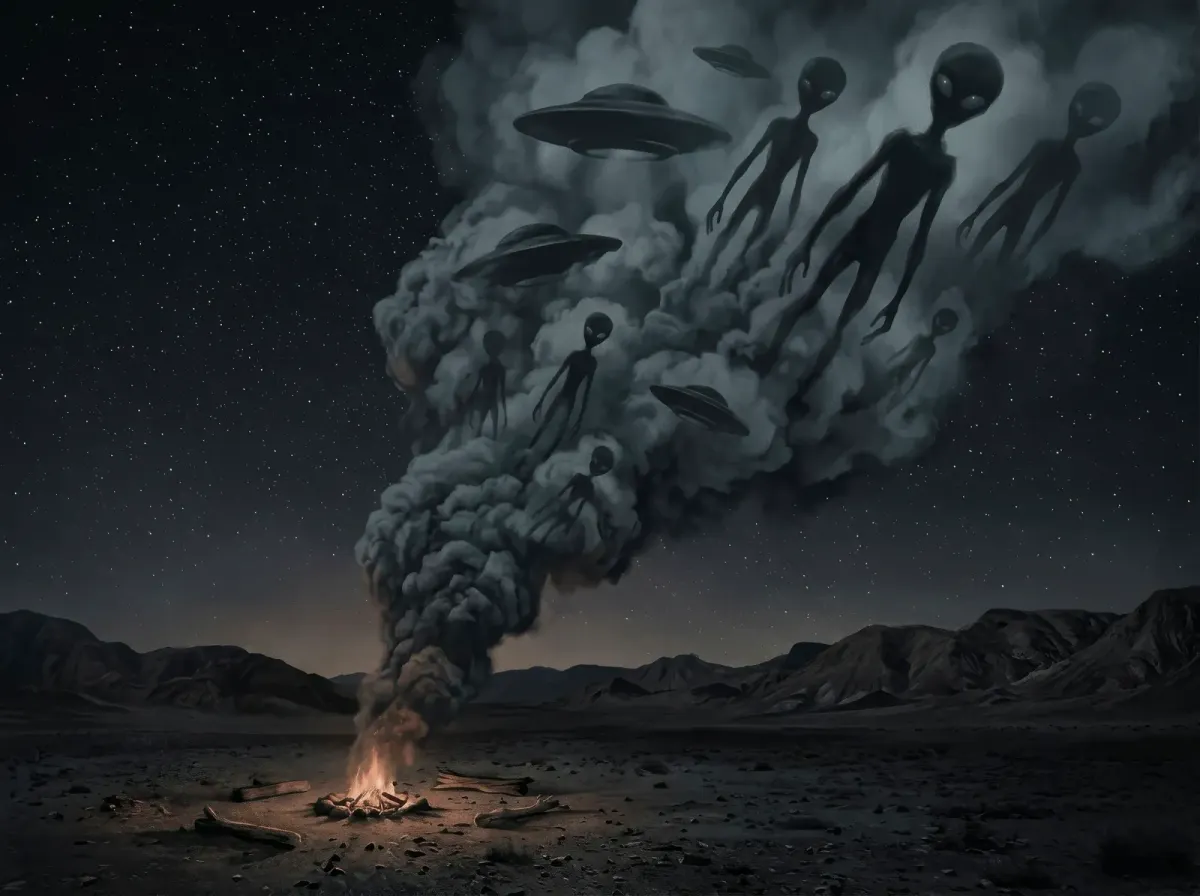
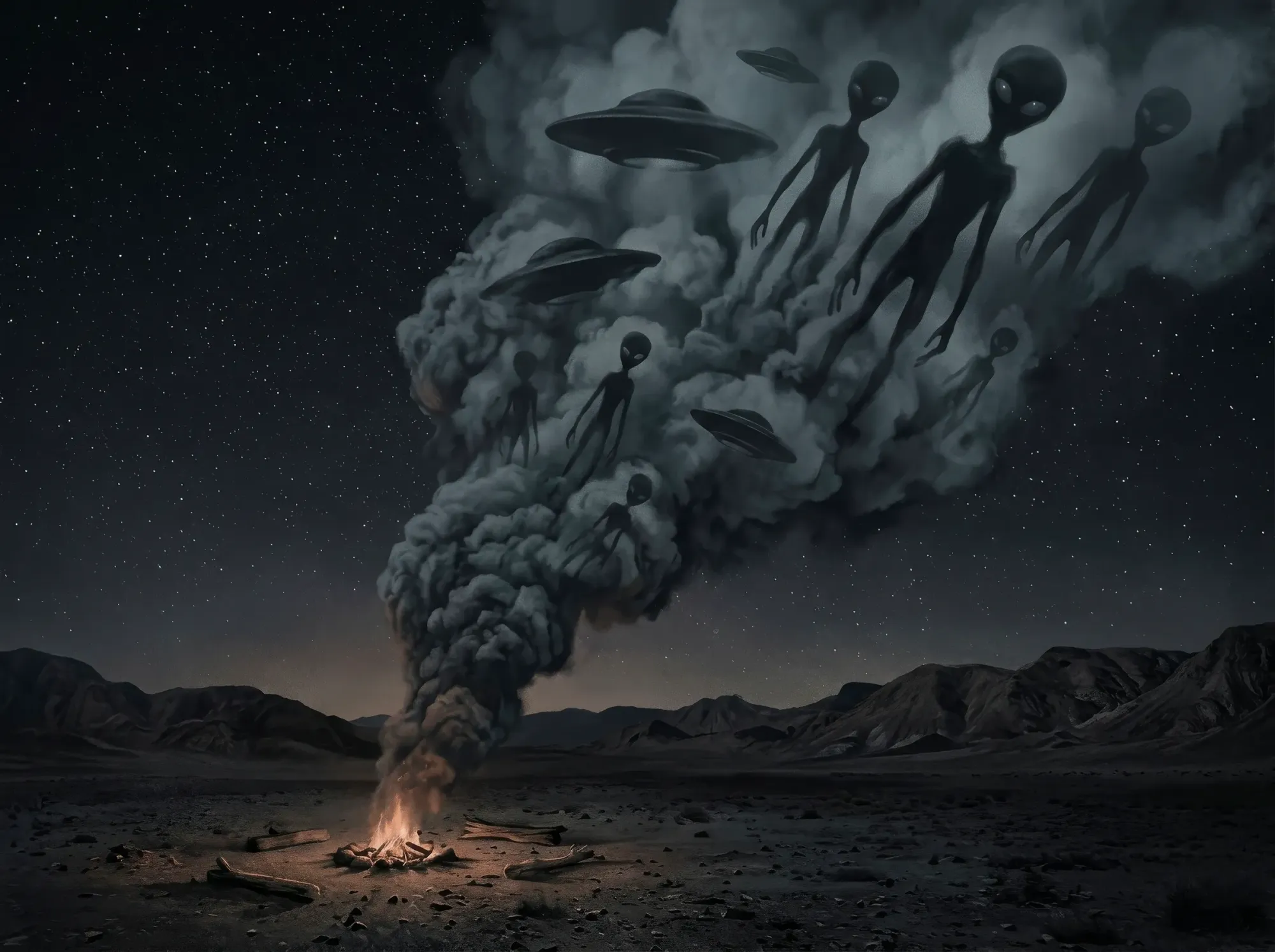
No science on the verge of a breakthrough behaves this way. Folklore does. And the real story, the one that has been true the whole time, is not in the sky. It is the oldest one we have: people, gathered in the dark, telling each other something they need to be true. The hunger underneath ufology is not foolish. Strip away the crash retrievals, the reverse-engineering programs, the withheld archives, and what remains is a longing to stand in relation to another intelligence, not to conquer it, not to be conquered by it, but to be related to it, as a member of a family we did not know we belonged to. A galactic family. It is a wish to be small in a way that welcomes rather than diminishes, and to learn that the universe has company in it.
[ad_2]
Source link
