
[ad_1]
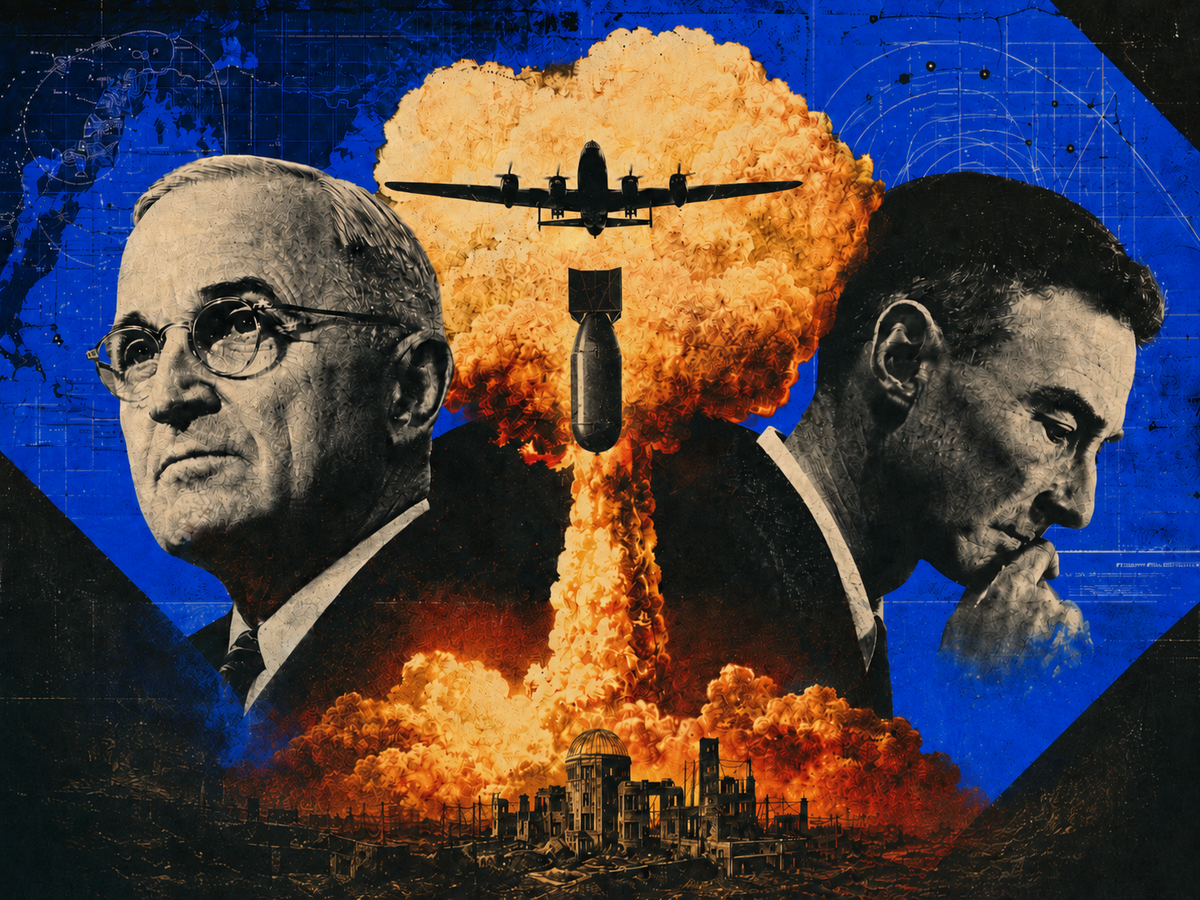
On this, the 81st anniversary of the atomic bombing of Hiroshima (August 6) and Nagasaki (August 9), it is altogether fitting to revisit the moral question of their development and use.
Operating under the best intelligence that indicated the Nazis were working on their own bomb project, it was clearly rational for the U.S. to undertake its own bomb project, initially instigated by Albert Einstein (aided by Leo Szilard) in the now-famous 1939 letter to President Roosevelt that “a nuclear chain reaction in a large mass of uranium” could lead “to the construction of bombs, and it is conceivable—though much less certain—that extremely powerful bombs of a new type may thus be constructed. A single bomb of this type, carried by boat and exploded in a port, might very well destroy the whole port together with some of the surrounding territory.”
Through numerous twists and turns, it came down to Leslie R. Groves—the military administrator and driving force behind the U.S. atomic bomb program—finding the right scientist, J. Robert Oppenheimer, to orchestrate a pantheon of independent thinkers and focus them on building the bomb before the enemy did.
But what if this ultimate weapon also ushers in a new world in which its development results in an arms race in which each side believes that the most rational strategy is to arm to the teeth … just in case the other side does? This is called the Hobbesian Trap (after Thomas Hobbes who first articulated the problem), or the security dilemma (after game theory analysis) or the other-guy problem—“I don’t want nukes but the other guy does, so….”
Thus, the approach-avoidance conflict that confronted Oppenheimer during and after Los Alamos. “We may be likened to two scorpions in a bottle, each capable of killing the other, but only at the risk of his own life,” he analogized.
♦ ♦ ♦
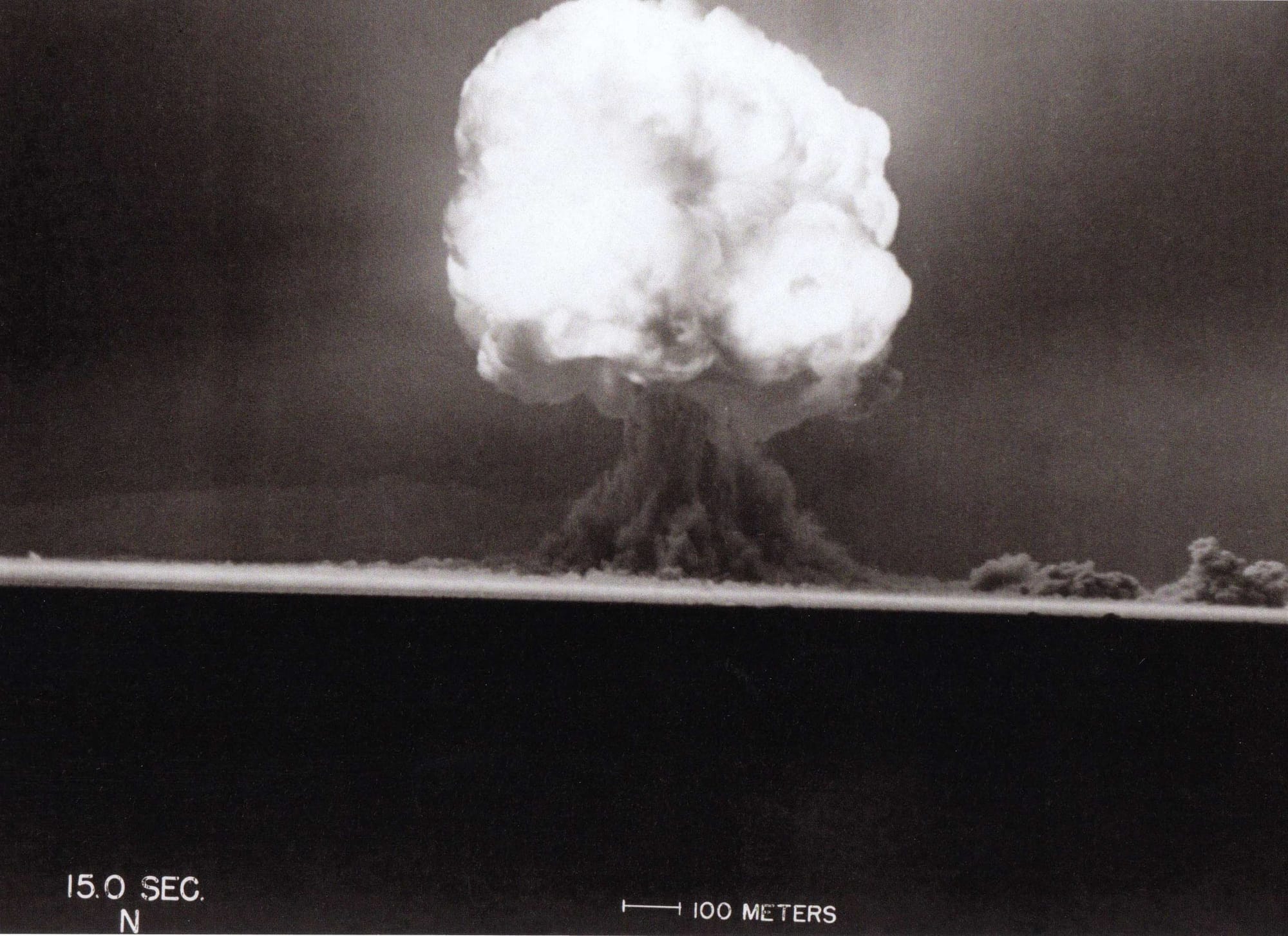
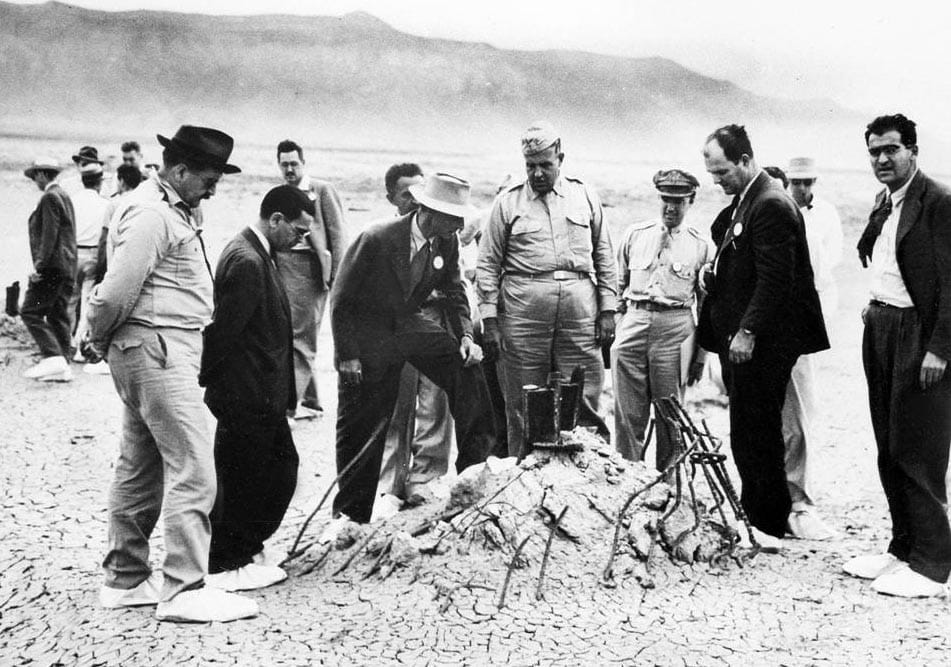
On July 16, 1945, the Trinity plutonium bomb was detonated at the newly established White Sands Proving Ground in New Mexico, marking the first detonation of a nuclear weapon in history. Modern radiochemical analyses estimate its yield at approximately 25 kilotons of TNT. The blast sent a mushroom cloud roughly 38,000 feet (11.6 kilometers) into the atmosphere and left a broad, shallow crater at ground zero, where the intense heat fused desert sand into a radioactive greenish glass known as trinitite. The flash, sound, and shock wave were detected across a wide area of the Southwest; the explosion was visible as far away as El Paso, Texas, roughly 150 miles away.
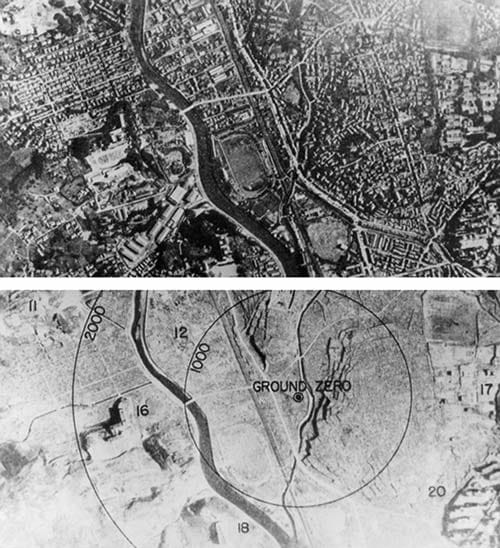
On August 6, 1945, the Little Boy gun-type uranium-235 bomb exploded with an energy equivalent of 16–18 kilotons of TNT, flattening 69 percent of Hiroshima’s buildings and killing an estimated 80,000 people and injuring another 70,000.
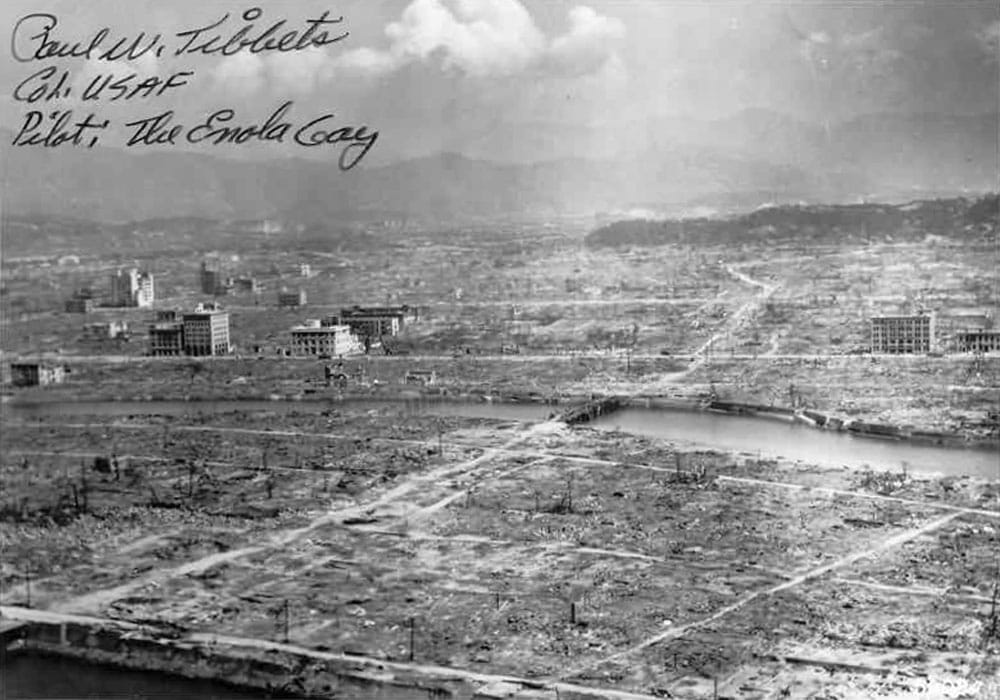
Three days later the Fat Man plutonium implosion-type bomb with the energy equivalence of 19-23 kilotons of TNT leveled around 44 percent of Nagasaki, killing an estimated 35,000 to 40,000 people and severely wounding another 60,000.1
As documented in the memo below dated August 10, 1945, if the Japanese had not surrendered Major General Groves had another Fat Man-type plutonium implosion bomb ready to go after August 24 that would have likely killed another 50,000 to 100,000 people.
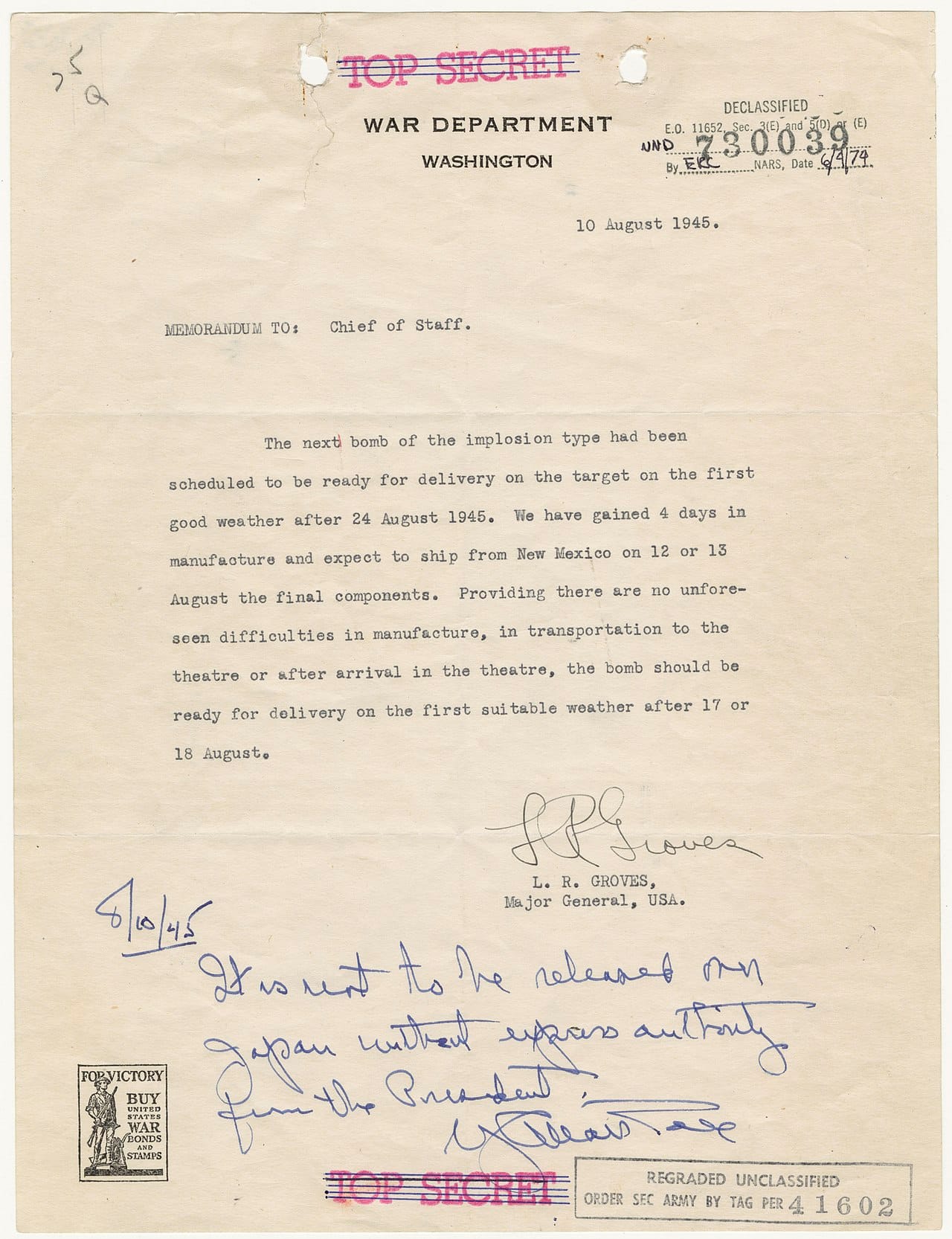
Had the Japanese military hardliners had their way to continue the war into the fall, Groves had three more bombs readied for September and another three for October. Here he instructs his Chief of Staff that the next bomb will be ready to drop on after August 24. Emperor Hirohito capitulated on August 15, thereby saving millions of lives of his citizens. U.S. President Harry Truman was not exaggerating when he threatened Japan with “a rain of ruin from the air, the like of which has never been seen on this Earth.”
Like Oppenheimer, Truman agonized about dropping more nukes on Japan, troubled as he was by the thought of more innocents and noncombatants being killed. He wrestled that decision away from the military. (Note Groves’ handwritten addendum to his memo above that “It is not to be released on Japan without express authority from the President.” U.S. presidents have had sole authority to use nuclear weapons ever since.)
However, further bombings proved unnecessary. On August 15 Emperor Hirohito, against the wishes of many of Japan’s military leaders, who were plotting to kidnap him and force the nation to fight until the bitter end (they had five million soldiers and many millions of civilians prepared to resist invasion to the point of death), announced on the radio that Japan would capitulate. On September 2 they signed the surrender documents in Tokyo Bay, ending the Second World War.
Was the Atomic Bomb project necessary? Since 1945 a cadre of critics have proffered the claim that atomic bombs were unnecessary to bring about the end of World War II (or, at least, the Fat Man Nagasaki bomb was superfluous), and thus this act was immoral, illegal, or even a crime against humanity. Robert Oppenheimer and other physicists like Leo Szilard who worked on the Manhattan Project expressed reservations. “The physicists have known sin,” Oppenheimer opined. He went to Truman and confessed “Mr. President. I feel I have blood on my hands,” to which the President recalled “I told him the blood was on my hands—to let me worry about that.” Truman promptly dismissed Oppenheimer and told Secretary of State Dean Acheson, “I don’t want to see that son-of-a-bitch in this office ever again.”4
In 1946 the Federal Council of Churches issued a statement declaring, “As American Christians, we are deeply penitent for the irresponsible use already made of the atomic bomb. We are agreed that, whatever be one’s judgment of the war in principle, the surprise bombings of Hiroshima and Nagasaki are morally indefensible.”5 In 1967 the linguist and longtime critic of U.S. foreign policy Noam Chomsky called the two bombings “the most unspeakable crimes in history.”6
More recently, in his history of genocide titled Worse Than War, the historian Daniel Goldhagen opens his analysis by calling the U.S. President Harry Truman “a mass murderer” because in ordering the use of atomic weapons he “chose to snuff out the lives of approximately 300,000 men, women, and children.” Goldhagen opines that “it is hard to understand how any right-thinking person could fail to call slaughtering unthreatening Japanese mass murder.”7 Goldhagen defines “genocide” broadly enough to equate it with “mass murder” (without ever defining what, exactly, that means). In morally equating Harry Truman with Adolf Hitler, Joseph Stalin, Mao Zedong, and Pol Pot, Goldhagen allows himself to be constrained by the categorical thinking that prevents one from discerning the different kinds, levels, and motives for large scale military aggression. By this reasoning, nearly every act that kills a large number of people could be considered genocidal because there are only two categories—mass murder and non-mass murder.
By contrast, continuous thinking allows us to distinguish the differences between types of mass killings (some scholars define genocide as one-sided killing by armed people of unarmed people), their context (during a state war, civil war, ethnic cleansing), motivations (termination of hostilities or extermination of a people), and quantities (hundreds to millions) along a sliding scale. In 1946 the Polish jurist Raphael Lemkin created the term genocide and defined it as “a conspiracy to exterminate national, religious, or racial groups.”8 That same year the U.N. General Assembly defined genocide as “a denial of the right of existence of entire human groups.”9 More recently, in 1994 the highly respected philosopher Steven Katz defined genocide as “the actualization of the intent, however successfully carried out, to murder in its totality any national, ethnic, racial, religious, political, social, gender, or economic group.”10
By these definitions, the dropping of Fat Man and Little Boy were not acts of genocide. The difference between Truman and the others is in the context and motivation of the act. In their genocidal actions against targeted people, Hitler, Stalin, Mao, and Pol Pot had as their objective the total elimination of a group. The killing would only stop when every last pursued person was exterminated (or if the perpetrators were stopped or defeated). Truman’s goal in dropping the bombs was to end the war with Japan (which it did), not to eliminate the Japanese people (which it didn’t). That the U.S. provided considerable financial, personnel, and material support to help rebuild Japan into a world economic power puts the lie to the eliminationist accusation.11
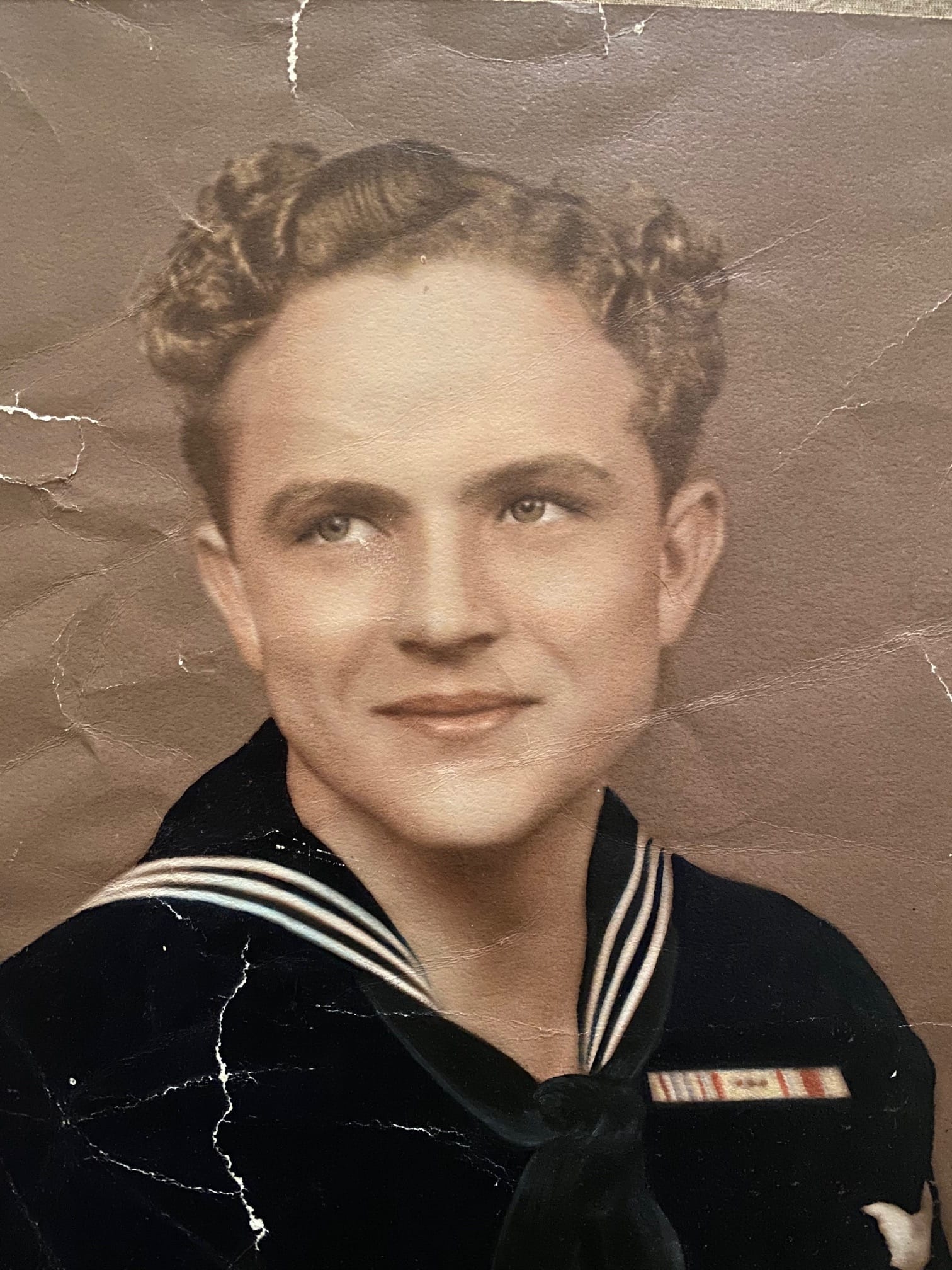
More broadly morally, if we ground morality in the survival and flourishing of sentient beings,12 by that measure, then not only did Fat Man and Little Boy end the war and stop the killing, the bombs saved lives—very probably millions of lives, both Japanese and American. My father, Richard Shermer, was possibly one such survivor.
During the Second World War he served aboard the USS Wren (DD-568), a Fletcher-class destroyer assigned to protect aircraft carriers and other large capital ships from Japanese submarines and from Kamikaze planes on what was called antiaircraft radar picket watch. His ship was so attacked several times but sustained no major damage. The Wren was part of the larger fleet that was working its way toward Japan, escorting the carriers whose planes were bombarding the Japanese homeland in preparation for the planned invasion. My father told me that everyone onboard dreaded that day because they had heard of the horrific carnage resulting from the invasion of just two tiny Japanese islands—Iwo Jima and Okinawa. If that was any indication of what was to come with a full-scale invasion, the contemplation of it was almost too much to bear.13
During the invasion of Iwo Jima there were approximately 26,000 American casualties that included 6,821 dead in the 36-day battle. How fiercely did the Japanese defend that little volcanic rock 700 miles from Japan? Of the 22,060 Japanese soldiers assigned to fight to the bitter end, only 216 survived.14 The subsequent battle for Okinawa, 340 miles from the Japanese mainland, was fought even more ferociously, resulting in a staggering body count of 240,931 dead, including 77,166 Japanese soldiers, 14,009 American soldiers, plus an additional 149,193 Japanese civilians living on the island who either died fighting or committed suicide rather than let themselves be captured.15 With an estimated five million Japanese soldiers and 28 million Japanese civilian militia prepared to defend their nation to the death,16 it was clear to all what an invasion of the Japanese mainland would entail.
It is from these cold hard facts that Truman’s advisors estimated that between 250,000 and one million American lives would be lost in an invasion of Japan.17 General Douglas MacArthur estimated that there could be a 22:1 ratio of Japanese to American deaths, which translates to a minimum death toll of 5.5 million Japanese.18 By comparison, cold though it may sound, the body count from both atomic bombs—about 200,000–300,000 total (Hiroshima: 90,000–166,000 deaths, Nagasaki: 60,000–80,000 deaths19)—was a bargain.
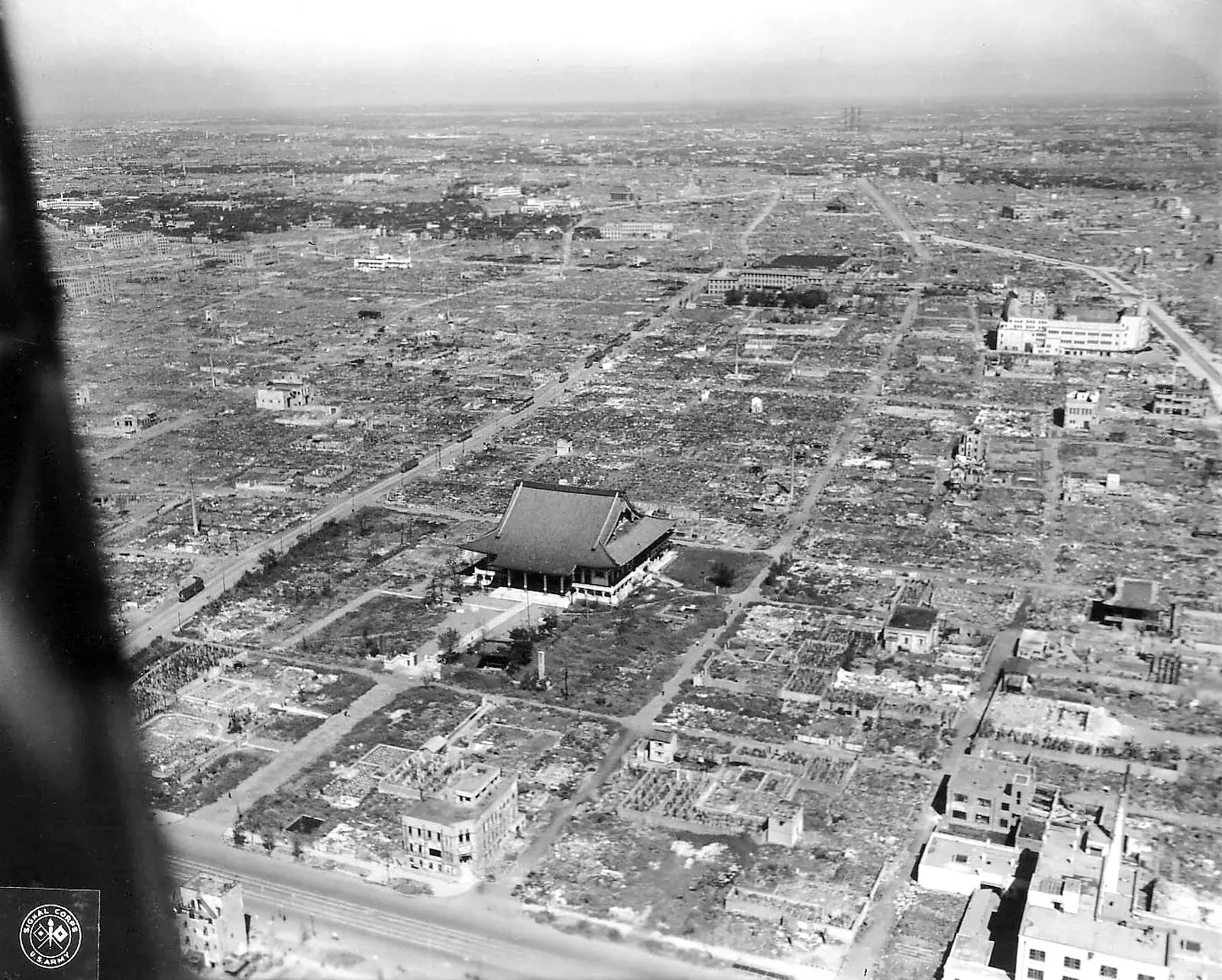
In any case, if Truman hadn’t ordered the bombs dropped, General Curtis LeMay and his fleet of B-29 bombers would have continued pummeling Tokyo and other Japanese cities into rubble. When asked to predict when the war would end based on his bombing program, LeMay said September 1, because that was when there would be nothing left of Japan to bomb. The death toll from conventional bombing would have been just as high as that produced by the two atomic bombs, if not higher. Previous mass bombing raids had produced Hiroshima-level death rates, and it is likely that more than just two cities would have been destroyed before the Japanese surrendered.
Compare, for example, Little Boy’s energy equivalent of 16,000–19,000 tons of TNT to the U.S. Strategic Bombing Survey estimate that this was the equivalent of 220 B-29s carrying 1,200 tons of incendiary bombs, 400 tons of high-explosive bombs, and 500 tons of anti-personnel fragmentation bombs, with an equivalent number of casualties. In fact, on the night of March 9-10, 1945, 279 B-29s dropped 1,665 tons of bombs on Tokyo, leveling 15.8 square miles of the city, killing 88,000 people, injuring another 41,000, and leaving another million homeless.20
These facts also help refute the claim that the alternative scenario of dropping an atomic bomb on an uninhabited island or bay to demonstrate its destructive force would have worked to convince the Japanese to surrender. Given that Japan refused to capitulate even after numerous cities were obliterated by conventional bombs and Hiroshima was erased from the map by an atomic bomb, it seems unlikely this more benign strategy would have worked.21 And as noted earlier, even after the two atomic bombs were dropped, Japan’s military leaders were still determined to drive the country into total Götterdämmerung.
On balance, then, dropping the atomic bombs was the least destructive of the options on the table. Although we wouldn’t want to call it a moral act, it was in the context of the time the least immoral act by the criteria of lives saved. That said, we should also recognize that the several hundred thousand killed is still a colossal loss of life. The fact that the invisible killer of radiation continued its effects long after the bombings should dissuade us from ever using such weapons again.
Along that sliding scale of evil, in the context of one of the worst wars in human history that included the singularly destructive Holocaust of six million murdered, it was not, pace Chomsky, the most unspeakable crime in history—not even close—but it was an event in the annals of humanity never to be forgotten and, hopefully, never to be repeated.
[ad_2]
Source link
