
[ad_1]
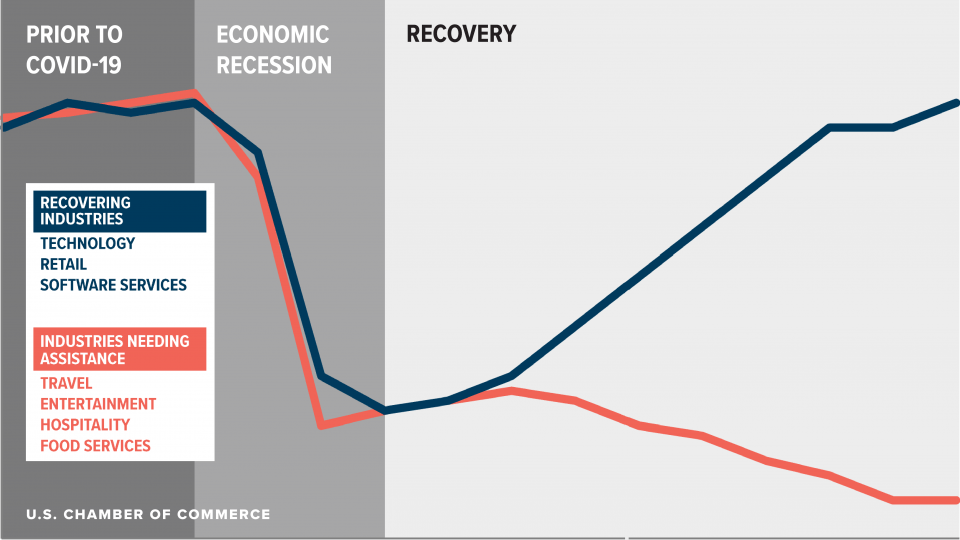
An example of a K-shaped recession during COVID-19. Image Source: US Chamber of Commerce – Public Domain
The corporate press has a new obsession, the so-called K-shaped economy. This metaphor is meant to describe a system in which one group of people, represented by the top, inclining line of the K, watches their fortunes rise as the other group’s fortunes fall. The idea is that Americans who are already doing well financially are doing better, while conditions worsen for those already struggling to make ends meet.
The problem is that when we use this letter K shorthand, we lose almost all of the information that’s important to analyzing the broader problem, and we therefore help an extremely concentrated ruling class hide the truth of what has happened. First, the group following the upward path on the K is extremely small and shrinking every day, and this group is assisted and enabled at every turn by the power of the state. And the declining group is not roughly half of us, but is in fact the overwhelming majority of people, fed to the wolves by our system. The K gives the false impression that about half are moving up while about half are moving down.
Thoughtful, politically literate people should stop talking about a “K-shaped economy” that doesn’t exist. This way of explaining current economic conditions obscures deeply structural and historical relations of domination; it pretends these results are a merely neutral divergence in outcomes, roughly evenly split amongst the population; and it further advances the absurd notion that the prevailing state of affairs is some kind of post-pandemic anomaly. Instead of “K-shaped economy,” we would do much better to call it an extraction economy or a rentier economy, perhaps an oligarchy. But whatever we call it, it is far worse than is conveyed by the shape of the letter K.
The K metaphor suggests something like two equally split and structurally neutral paths one could take, when these results show our political-economic system’s extractive, exploitative, and shockingly unbalanced nature. In the world we actually live in, domination and exploitation, represented by the state and capital, work together and historically co-create one another. And the beneficiaries of this old system are never half of society.
The odd sudden fixation on the K-shaped economy also gives the impression that this is somehow a new set of phenomena, one that perhaps emerged in the aftermath of the Covid-19 pandemic. But the clear fact is that the ultra-rich American ruling class has been hollowing out the middle class and looting from working people for decades, really centuries. The ridiculous sudden outpouring of headlines about something called a K-shaped economy has a tendency to obscure the fact that this has been a long-running historical process of upward wealth redistribution. This is a system of socialism and special privileges for the grotesquely rich and cutthroat, edge-of-survival competition for everyone else.
The scale of this system’s extraction is staggering. An analysis by economists at UC Berkeley recently revealed that in 2024, the 19 richest households in the United States added $1 trillion to their wealth. “This was the largest one-year increase on record and an amount that’s greater than the entire economy of Switzerland.” More broadly, Oxfam reports that “[i]n 2025, the world’s 12 richest men owned more wealth than half of humanity.” Yes, you read that right: a dozen obscenely rich individuals, all of whom use maximums of coercive state power to enrich themselves at the public expense, have more wealth than more than 4 billion people combined. We’re meant to see this kind of result as natural and politically neutral, the product of some abstract notion of economic freedom.
Our functionally illiterate pundit class has missed another problem with the K-shaped model, its treatment of these diverging outcomes as independent, parallel phenomena rather than deeply interconnected and indeed inextricable processes. The kinds of extreme and growing accumulation and inequality we see today within the thin top tranche could not be possible absent the dedicated extraction of value from the economic base: the rest of us.
In her 2019 book, The Code of Capital, legal scholar Katharina Pistor explains how capital obtains its special powers within our social and political system. She shows that the legal system, not supply and demand or other economic forces, can turn ordinary assets into means of compounding, effort-free accumulation by imbuing them with special rights and powers. Certain features of the law are “used to give the holders of some assets a comparative advantage over others.” As Pistor notes, “Accumulating wealth over long stretches of time requires additional fortification that only a code backed by the coercive powers of a state can offer.” She explicitly addresses the deep confusion that so inhibits clear analysis of political economy today: “Indeed, the fact that capital is linked to and dependent on state power is often lost in debates about market economies.”
Longstanding trends have been aggravated by the concentration of wealth and gains in the technology industry. The U.S. tech sector is simply not a legitimate market phenomenon; it has never been anything remotely close. Big Tech has always depended on taxpayer funding of riskier upstream research, which has often come in the billions through federal government agencies like the Pentagon. Between the bleeding edge of technological “progress” and Washington’s military empire, there has been little daylight. The companies themselves then proceed to privatize the massive profits associated with these technologies by embedding themselves even further with the state through privileges like IP protections and federal contracts and the creation of legal and regulatory moats around the industry.
There is nothing new about the inherently corrupt and collusive process itself, and there’s nothing new about corporations playing by different rules to take advantage of a nebulous and unorganized public. When tech executives refer to a competitive and dynamic free market in technology, they could be describing something like the opposite of how our system works. Their power has been built step-by-step through massive levels of state financial support, special legal privilege, and procurement. The state erects legal and institutional structures to ensure the continuing shell game, whereby we provide the resources and host bodies for these parasitic companies, and wealth continues to move upward and away from the popular masses.
While the tech sector is now among the key culprits in this story, the system we’re discussing far precedes high tech. These results are a design feature of the state-capital complex that rules our society. If a free, competitive economy is one in which the rules are applied symmetrically, everyone playing the same game, then capitalism is a game of deep structural asymmetries in which the state intervenes on behalf of capital. Within capitalism, the state steals and encloses common-pool resources; creates special benefits like corporate limited liability, IP monopolies, bailouts, grants, tax breaks, loan guarantees, and government contracts; forecloses natural opportunities by preventing us from providing for ourselves and our neighbors; and tightly controls the labor pool through a host of tools that include our country’s system of mass imprisonment. In 2026, it would be difficult to overstate the total value of the special favors that the state grants capital, completely free of charge. Economic freedom describes a system that is decentralized, organized from the bottom-up, not a command and control structure at the center of which is the Pentagon’s global empire.
The notion of a K-shaped economy is a red herring, an artifact of state-capitalist ideology that draws our attention away from the fact that we occupy a system of extraction and exploitation. We should discard this euphemistic description and recognize the reality: this economic system is a state-enforced oligarchy, increasingly optimized for the continuous upward redistribution of wealth.
[ad_2]
Source link
