
[ad_1]
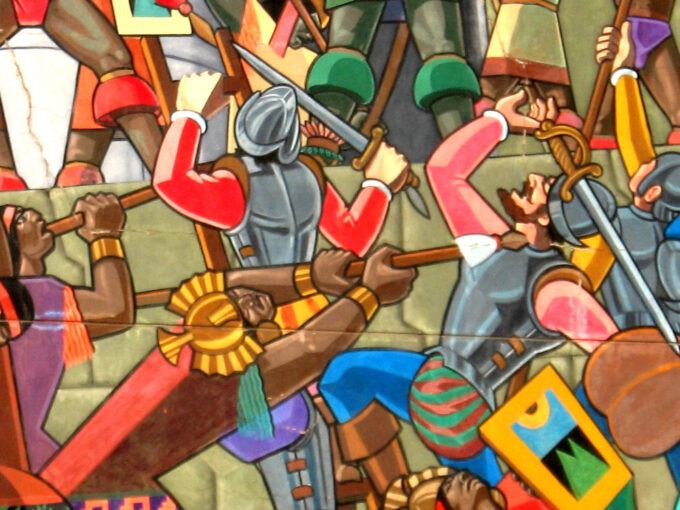
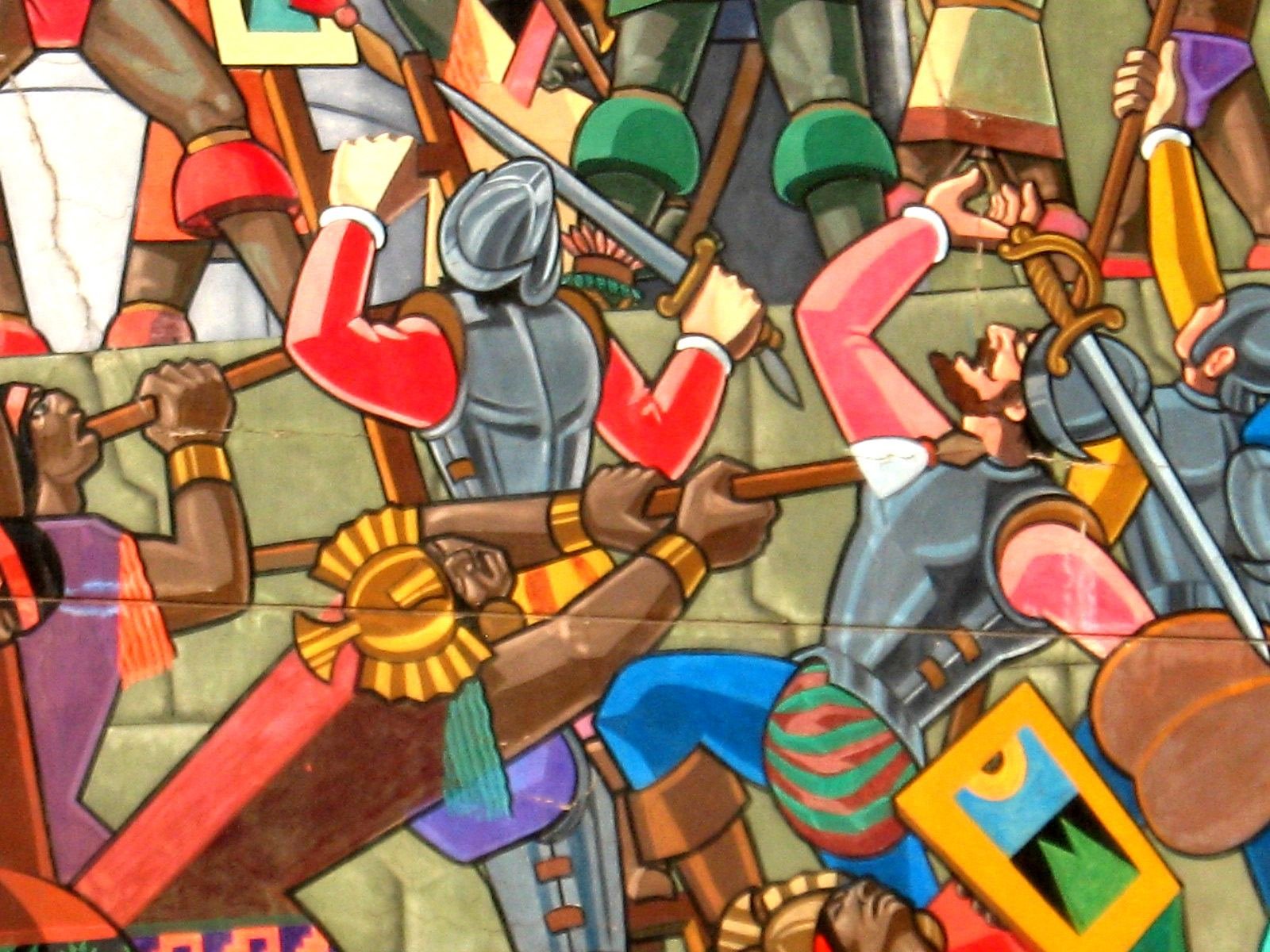
Uno soldado Inca ataca uno conquistador español. Image Source: Scarton (talk · contribs) – Detalle de la pintura de Juan Bravo sobre la “historia de Qosqo” para la municipalidad de Cusco – CC BY-SA 3.0
Scholar Olga Rodriguez-Ulloa argues that dominant narratives in Peruvian academia have made it difficult to think of subversives as peers.
Olga Rodriguez-Ulloa is an Assistant Professor in the Department of English, American Studies, and the Latino Studies Program at Indiana University Bloomington. She is the author of Sadistic Cholas: Transfeminist Provocations in Contemporary Peru (University of Texas Press, 2026). Chola is a racial slur that has been reclaimed by revolutionary collectives in resistance to political power. Her work privileges the voices of cholas and “seeks to position [their] overlooked anti-colonial aesthetics.” Rodriguez-Ulloa has been featured in the Journal of Latin American Cultural Studies, e-flux, and Ill Will. In this exclusive interview, Rodriguez-Ulloa discusses her main arguments, source material, and how the progressive left can interrogate the intersectionality of class and identity.
Daniel Falcone: What do you argue in Sadistic Cholas and how did you structure your book?
Olga Rodriguez-Ulloa: While tracing the long durée of cholas’ survivance, from colonial times to the present, the book focuses on contemporary visual arts, literature, activism, and music that reappropriate and embrace the racial slur to redefine it as a source of political potency. To be called “chola” in public settings was once a feared occurrence, a humiliating experience. Like other racial terminologies, the term is relational, shaped by social class, formal education, speech, and other social markers.
In recent years, collectives (colectivas) and individuals, myself included, have finally dared to name ourselves as cholas, unveiling the racial and misogynist violence of the country while affirming our bodies, sexual pleasures, and political desires. The book is structured through a series of provocations in which I contextualize my interpretation of these oeuvres within histories of colonialism, U.S. imperialism, anti-Indigeneity, and anti-Blackness; bridging hemispheric dialogues that are, I believe, much needed in Latin American Studies, Latine Studies, and American Studies.
Daniel Falcone: Can you describe the term “cholas” for the readers? What is the historical significance of this term and how was the term politicized, especially as it relates to your work?
Olga Rodriguez-Ulloa: According to one of the most important colonial chroniclers, El Inca Garcilaso de la Vega, the masculine form “cholo” was an insult Spaniards used against the progeny of mulattoes and Indigenous peoples. Cholos were considered “mutts,” characterized by their roguish nature. Within the violent racial order of the colonies, cholas circulated as “bitches”: mixed-race women perceived as prone to promiscuity but also associated with financial independence and wayward mobility within the colony — which tells us that cholas were simultaneously targets of racial, sexual, and reproductive exploitation, while also embodying a potency that threatened patriarchal power. The blackness of cholas was stripped away by Peruvian anti-blackness and the whitewashing ideals of mestizaje. The proximity between indigeneity and blackness was for long unthought.
I interrogate it closely by following the lead of Afro-Indigenous artists and activists such as Yanna (Brenda Carpio) and members of the collective Collera, including the poet Rocío Fuentes. The book traces these intimate and social possibilities. One grows up hearing “chola” used both as an insult and as a form of delicate and loving intimacy. For example, my grandmother used to call me “my chola,” while my cousins, who had more money and wanted to be whiter, nicknamed me, “Cholga.”
Daniel Falcone: How do identity, resistance, and mobility factor into what you are trying to capture in this work?
Olga Rodriguez-Ulloa: One of the central ideas of the book is that the chola is inseparable from a praxis grounded in ways of sharing and inhabiting the world. For example, the work of the collective Chola Contravisual brings into its artistic practice the Quechua concept of munay, translated as both “willpower” and “radical love.” The collective develops a chola gaze that guides viewers through a variety of Indigenous cultural manifestations in which local music, lyricism, and festivities function as central articulators of Indigenous memory, critique, and joy. One encounters in this music a beautiful and courageous vitality that, within academia, often circulates under the rubric of anti-colonial or decolonial theory.
At the same time, the book considers mobility through the transientness of the chola figure. Since colonial times, she has been represented as an urban character, a traitor to an indigeneity imagined as fixed within rural spaces. Cholas’ marginality derives precisely from their centrality to socio-economic and financial systems. There is neither colony nor nation without them, much in the way Hortense Spillers theorizes black women in the U.S. Likewise, Sayak Valencia’stransfeminism is a capacious category to think and be in a feminism that is trans-, travesti, racialized, working class, and migrant. In action, it solves day-to-day struggles and procures care communally. Transfeminism maintains a hyper-local focus while situating itself within a global anti-colonial, anti-state, and anti-capitalist theoretical framework.
Daniel Falcone: As you specify very important terms such as criollo, cuirnes, and colectivas, to what extent is this terminology relevant when analyzing political power?
Olga Rodriguez-Ulloa: When defining the racial revenge of the cholas, I was thinking particularly about certain forms of Peruvian whiteness and whitewashing—such as mestizaje—which I fold under the category of the whitened-criollo structure. It is important to note that the term cholo has also been co-opted by neoliberal agendas, for example through the notion of “cholo power,” articulated using the English term itself. The chola praxis that I reclaim, however, exceeds racial markers alone. In this sense, the concept of the whitened allows me to think about a performative alliance with global white supremacy (think about racialized Latino men in the Proud Boys) while criollo connects to Peru’s historical formations of anti-Indigeneity and anti-Blackness.
Throughout the book, I trace manifestations of this whitened-criollo structure, which can take the form of nostalgia for and reverence toward the colonial past, the disavowal of critiques of the economic model that land in accusations of terrorism, or a rampant capitalist drive that debases land, people, and animals, alike. Importantly, this ideology is shared by people across all skin colors.
Daniel Falcone: Since the book includes many overlapping themes such as migrancy, racialization, sexual coercion, and the commons of care, how did you go about selecting literature to review and how are primary sources positioned in your work around these themes?
Olga Rodriguez-Ulloa: The book came into being when I realized that representations of the Peruvian internal war consistently portrayed subversive women as vengeful, sadistic, and bloodthirsty cholas. Across Peruvian culture—and, for that matter, within U.S. academic analyses of the war—subversive women from the Shining Path and the Túpac Amaru Revolutionary Movement were depoliticized and reduced to gendered avatars of the men within insurgent movements. Yet their irruption of national media constituted a watershed moment. They created a space for racialized women to express political anger publicly. Terrucas—the highly racialized Peruvian vernacular term for women labeled “terrorists”—were defiant, loud, and violent. They signified an extreme embodiment: a desperate cry for social justice that produced horrendous consequences while also emerging from a genuine desire for change.
The dominant narrative circulating through Peruvian media and academia has made it difficult to think of subversives as peers. In the book, I interpret cultural objects that, as early as 2001, dared to represent subversive women as figures with whom producers might share social backgrounds and even political affinities, debunking the myth of the radical otherness of subversives. In Radicalizing Her, Nimmi Gowrinathan poses crucial questions for understanding, across different contexts, why women join armed struggles, and insists on doing so on women’s own terms.
Fortunately, there has recently been an important shift in the scholarship produced about women subversives. At the same time, I felt the need to develop a political and cultural vocabulary capable of articulating chola anger and the desire for revenge far beyond the context of the war itself. When examined closely, Andean literary and artistic traditions offer a myriad of examples of bold, spiritual, and potent racialized women who have long resisted patriarchy and colonialism.
Daniel Falcone: Do you consider this work an intervention of sorts, and if so, could you describe how the book intervenes, apart from describing and analyzing indigenous Andean women?
Olga Rodriguez-Ulloa: The intervention of the book is to pay close attention to, and listen carefully to, archival and contemporary cholas as both characters within and producers of art, literature, painting, performance, and music. Their historical positionality as tainted heathens radically transforms and browns sadism through the particularities of an Andean history that connects disparate geographies: the haciendas across the national territory, the shantytowns of Lima, the communities of the sierra, and multiple international diasporas extending from Detroit to Helsinki, Berlin, Nantes, and Barcelona.
The book is an invitation to submit to the desires and teachings of these women, who may offer outrageous images and unsettling thoughts while simultaneously transmitting an immense capacity for life and love. The work of Claudia Coca, Roxana Crisólogo, Fabiola Pinel, Wynnie Mynerva, Yanna, Ale Hop, Laura Robles, and collectives such as Collera and Chola Contravisual , ignites the indignation and care that we so desperately need across the hemisphere.
[ad_2]
Source link
