
Juan Cole Informed Comment
The UN Environmental Programme has issued a new report that admits that the world will almost certainly exceed the Paris Treaty goal of limiting global heating to 1.5º C (2.7º F.) above preindustrial levels. It should be remembered that this extra heating is an average temperature established for the long term. Because of El Niño years, the world could exceed 1.5º C without that meaning anything, since it would be a temporary fluctuation. UNEP is saying that the time is not far off when we go beyond this limit as a new long-term global average.
The UNEP report argues that if we put another 130 billion tons of CO2 into the atmosphere, starting in 2026, it will push the world over the 1.5º C limit. But we’re now putting out 40 billion tons of CO2 a year, so we’d breach that budget in a little over 3 years. Put another way, in order to stay under 1.5º C, we’d have to cut carbon dioxide emissions, beginning right now, so deeply over the next six years that by 2032 we’d be down to zero emissions. And let’s face it, that isn’t going to happen. Donald Trump and the big carbon companies that have backed him have kneecapped American efforts to reduce greenhouse emissions.
The scientists conclude, “In all cases, central estimates indicate that global warming will cross 1.5°C within the next decade.”
In fact, the report points out that the national pledges by Paris Treaty signatories to reduce greenhouse gas emissions are inadequate, and that even those milquetoast goals aren’t being met.
As a result, the negative, sometimes catastrophic, climate impacts that scientists foresaw earlier in the century are rapidly coming to pass.
In the past few years, 80 percent of tropical coral reefs suffered bleaching, and their ability to recover has decreased. Species are being lost at an alarming rate. Arctic and Antarctic ice are being reduced to minimums never before seen in modern history. More than 40 percent of all glaciers lost since 1970 have been lost in the past ten years.
At a 1.5º C increase, weird and destructive weather will emerge that would have been impossible in a cooler world. Just since 2006, 50 never-before-seen extreme heatwaves have been documented, and just in 2024-2025 some 50% of the globe’s population suffered 30 days of extreme heat. People are dying in unprecedented numbers from heat stroke. Three times more people died from the summer 2025 heatwave than had died during previous such events, because of global heating. Cyclones and hurricanes have become more intense, to the point where we may need to add a Category 6 classification. Floods, wildfires, and droughts are increasing in frequency and intensity.
No matter what anyone does now, sea levels will go on rising for decades as a result of the greenhouse gases we have already put into the atmosphere.
The UNEP thinks we have to adapt to this coming reality, which won’t be easy, since an extra 1.5º C will change the world climate in ways we can’t even entirely foresee, with floods, wildfires, droughts, biodiversity loss.
Many of the changes that a 1.5º C world will bring with it will be irreversible.
I’d point out that 3 billion of the over 8 billion people in the world depend on marine life for their protein, and the same number depend on the seas for their livelihoods. If warming seas and acidification of the oceans kill off half of marine species, as is expected, then 1.5 billion people are fresh out of luck. And once made extinct, those marine species are not coming back.
Someone recently suggested to me that artificial fisheries or aquaculture could ameliorate the crisis. But I pointed out that those fisheries are in the ocean, and if it is highly acidic, the artificial fisheries will have the same problems as wild breeding grounds.
But the UN scientists aren’t willing to just give in to a 1.5º C world, which will be a much more dangerous world for most people, and especially for the poor and the developing world. The scientists think we should strategize ways of getting back under a 1.5º C increase even once we exceed that limit, given how dangerous that exceedance will be.
But if the world goes beyond 1.5º C, reversing that milestone wouldn’t be easy. They admit, “It would take over 100 years of afforestation and forest management at the current scale, and zero residual CO2 emissions, to bring warming back by 0.1°C.” Certain kinds of forests are carbon sinks, so expanding them takes CO2 back out of the atmosphere. But as UNEP notes, if we just stopped burning fossil fuels cold turkey and we expanded the forests at our current rate, it would take until 2166 just to get back to 1.4º C, about where we are now.
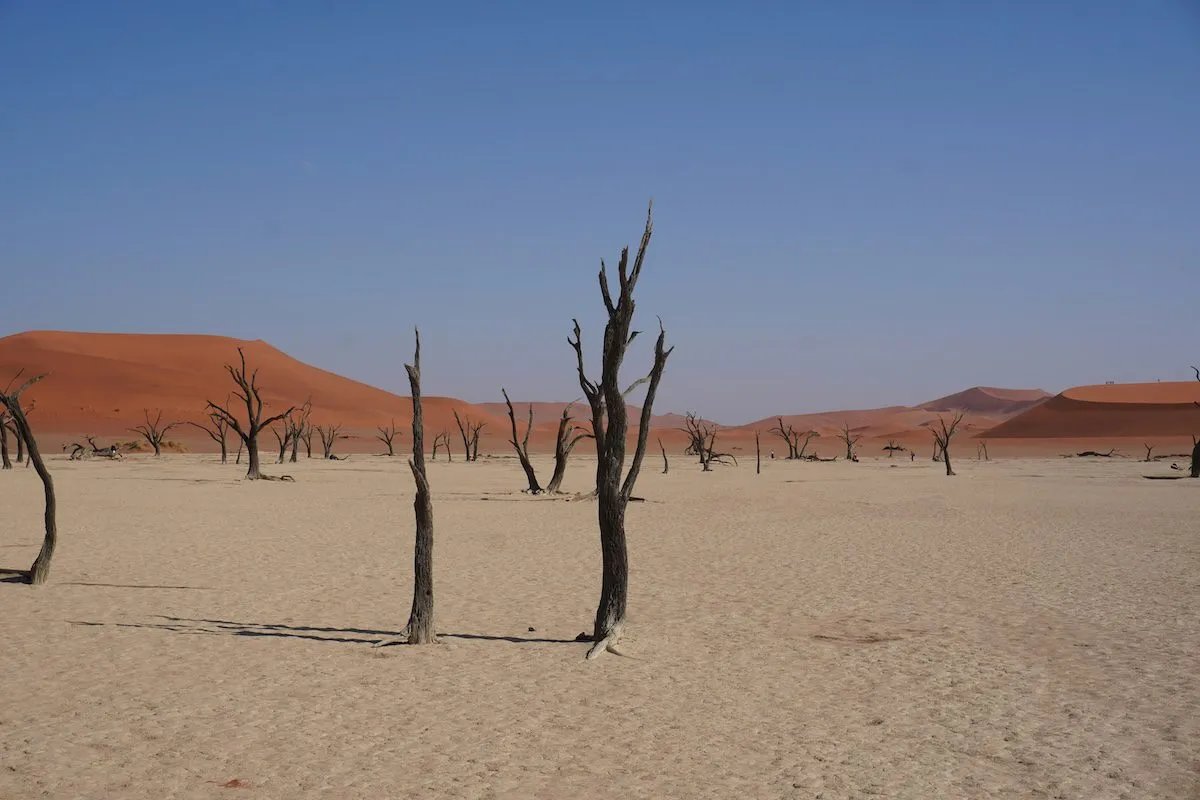
Photo by christian romei on Unsplash
Personally, I don’t approve of carbon capture and storage schemes, which are pushed by Big Oil to inspire false hope. There aren’t any feasible, affordable ways to remove huge amounts of CO2. Moreover, I don’t think it is safe to try to store CO2 gas underground. I remember the Lake Nyos disaster in Cameroon, when a release of subterranean carbon dioxide killed at least 1,700 people. UNEP is more positive toward this possibility, though they admit that there isn’t even enough storage space in the world to do this kind of storage plausibly.
On the other hand, they bring up a possibility that is more promising. Methane is 80 times more potent as a greenhouse gas than carbon dioxide. But it begins decaying in the atmosphere almost immediately and a lot of it is gone in 12 years. So if we halted CO2 emissions and simultaneously halted methane emissions, as the methane went away, global heating would decline a bit.
UNEP writes, “Non-CO2 emissions reductions are essential to limit warming. Reductions of short-lived greenhouse gases such as methane can reduce the rate of near-term warming and lower the peak. Deeper reductions can also help with further declining the post-peak temperature.”
Editor’s Note: At a moment when the once vaunted model of responsible journalism is overwhelmingly the play thing of self-serving billionaires and their corporate scribes, alternatives of integrity are desperately needed, and ScheerPost is one of them. Please support our independent journalism by contributing to our online donation platform, Network for Good, or send a check to our new PO Box. We can’t thank you enough, and promise to keep bringing you this kind of vital news.
You can also make a donation to our PayPal or subscribe to our Patreon.
Please share this story and help us grow our network!
