
[ad_1]
In one of the scariest moments in modern history, we're doing our best at ScheerPost to pierce the fog of lies that conceal it but we need some help to pay our writers and staff. Please consider a tax-deductible donation.
Austin Sarat ScheerPost
In recent years, diversity has become both a touchstone for judging colleges and universities and a
lightning rod for critics. Colleges seek to attract students by advertising the demographic diversity of
their student bodies. And the Trump Administration is on the lookout for signs that diversity for some
means discrimination for others.
Demographic diversity is sometimes used as a stand-in for diversity of viewpoints or of life experience.
Both are said to enrich the education colleges provide inside and outside the classroom. The Center for
American Progress puts it simply: “Diversity on college campuses enhances the educational experiences
of students of all backgrounds.”
University of Wisconsin Professor Anthony Hernandez elaborates on that claim. He argues, “A diverse
classroom fosters a dynamic exchange of experiences and perspectives, enhancing both the intellectual
and social atmosphere. This diversity promotes critical thinking and helps students connect with
individuals from various backgrounds, ultimately enriching their communities and future professional
environments.”
But achieving diversity is very costly for higher education institutions as they face increasing demands
from underrepresented groups to change their ways or make accommodations so that everyone feels
like they belong. Colleges and universities have learned that talking about diversity is much easier than
realizing it in practice.
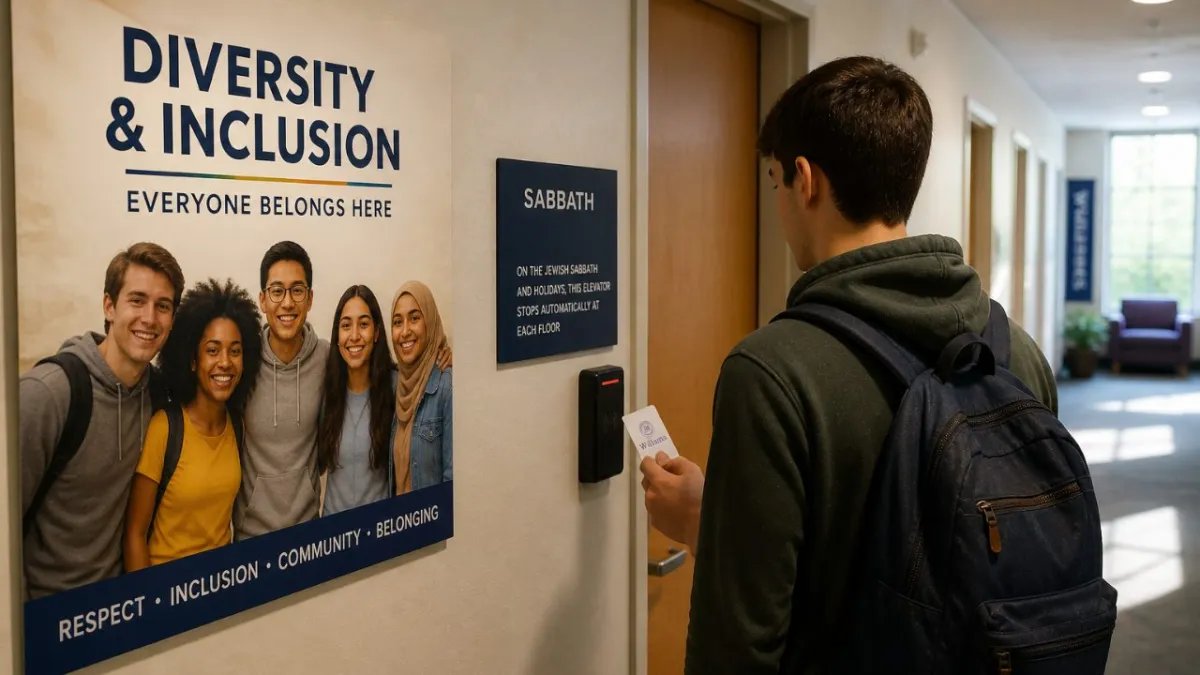
An example of that difficulty came to light on April 23, when news broke that an Orthodox Jewish
student at Williams College, an elite private school in Massachusetts, had filed a complaint with the
federal government “alleging that (it)… denied him ‘full and equal access’ to campus housing and meals
because of his religious faith.” It noted that “Even before [redacted] arrived on campus, the College
discouraged him from living on campus due to his religion, telling him not to come to Williams if he
could not ‘deal with’ challenges he would face observing his religious practice.”
Williams says it “is committed to building and sustaining a community of students, staff, and faculty that
is broadly diverse and respectful of all social identities. Diversity refers to all the many ways in which
people differ, encompassing the characteristics that make one individual or group different from
another, including, …religion/spirituality…”.
The diversity that colleges, like Williams and other institutions, value is easier to accommodate when it
is not disruptive of traditional ways of doing things. And, Orthodox Judaism and the needs of Orthodox
Jews are not among those easy cases, as the Williams case illustrates.
That is why it is worth examining.
The complaint was filed on the Orthodox student’s behalf by The Louis D. Brandeis Center for Human
Rights Under Law. The Brandeis Center calls it “a first-of-its-kind complaint…alleging that the college
violated Title VIII – also known as the Fair Housing Act (FHA) – by discriminating against the student due
to his religion.”
“According to the complaint, the school did not give the student full and equal access to required on-
campus housing and meal plans.” It claims that “the student has been unable to freely access his
dormitory on weekends, as his religious observance prevents him from using the electronic key device
provided by the College during the Sabbath. The student has been effectively locked out of his
residential building on numerous occasions, forced to wait outside, at times in freezing Northeast winter
weather for over an hour, in the hope that another student who lives in the building will let him inside.”
“The student,” it says, “has suffered embarrassment, humiliation, social stigma and emotional distress
as a result, and he is often confined to his dorm room on Saturdays to avoid being locked out of his
building if he leaves.” In addition, “Williams College also discriminated against the student in his request
for kosher food, a service offered by the College in connection with mandatory on-campus housing.”
According to a report in the Jewish News Syndicate, the college “suggested that during Shabbat, the
student could knock on the door of a campus office and ask for an escort to his building….” It adds that
“The complaint described that recommendation as “equally, if not more, uncertain, inconvenient and
lengthy than the untenable process he was already enduring.”
Williams College issued a statement that the school has “no tolerance” for discrimination or
antisemitism and that it is “devoted to ensuring that all students have access to appropriate living
spaces, dining options, and our full range of learning opportunities.”
The keyword, of course, is “appropriate.”
Colleges often look to the law as they figure out what to do and treat requests like the one made by the
Wesleyan student as a risk management issue. Title VII of the 1964 requires that colleges and
universities offer “reasonable accommodations for sincerely held religious beliefs, practices, or
observances unless doing so poses an undue hardship” to student employees. For students who are not
employed in any way, the relevant laws are the First Amendment’s Free Exercise Clause, Title VI of the
Civil Rights Act, and state education laws.
As one example of how a university understands what accommodations those laws require, Washington
State University offers the following guidance: “A reasonable religious accommodation is a modification
to a policy or practice within an academic, housing, or extracurricular environment to enable students to
avoid conflict with their sincerely held religious beliefs or practices. A religious accommodation is
reasonable if it does not cause undue hardship to WSU operations; factors include safety, cost,
efficiency, academic requirements, business needs, and the rights of others.”
“Reasonable religious accommodations,” it says, “are individualized to the needs of the students who
request them and the settings for which they are requested.”
The kinds of accommodations typically made in higher education include excused absences for religious
holidays, rescheduling exams, allowing students to wear attire required by their religion, and offering
food options. On the other hand, undue hardships might include requiring changes to course content,
creating safety hazards through accommodations, violating other students’ rights, or imposing severe
financial or administrative burdens on the university.
The complaint filed by the Williams student also alleges that the college violated the Fair Housing Act,
which prohibits discrimination “against any person in the terms, conditions, or privileges of sale or rental
of a dwelling, or in the provision of services or facilities in connection therewith, because of…religion.”
But the question of when and how colleges accommodate diversity should not be reduced to a question
of compliance with the law. It is, more importantly, a question of the kind of places they aspire to be.
Inclusion requires institutions of higher education to rethink their taken-for-granted notions of what
constitutes an appropriate accommodation and what hardships are “undue.” It now looks like Williams
is leaning into that question.
The college is to be congratulated on its expressed willingness to “work with the student and the
Brandeis Center….” The Williams Record quotes a spokesperson for the college who says, “’The college’s
leaders and chaplains are strongly committed to working with students and their families to address
student concerns. We welcome the opportunity to continue that dialogue with the student and the
Brandeis Center in order to ensure a welcoming and inclusive educational environment.’”
Achieving that won’t be easy, but trying to do so is much better than telling an Orthodox Jewish student
to either accept an unacceptable status quo or not attend Williams College.
Austin D. Sarat is the William Nelson Cromwell Professor of Jurisprudence and Political Science at Amherst College. He is an internationally renowned scholar whose interdisciplinary work examines law in relation to culture, violence, and the liberal arts. His academic foundation includes a B.A. from Providence College (1969), an M.A. (1970) and Ph.D. (1973) from the University of Wisconsin, and a J.D. from Yale Law School (1988). He has also received honorary degrees, including an LL.D. from Providence College (2008) and an A.M. from Amherst College (1984). Sarat has also been awarded the Jeffrey B. Ferguson Memorial Teaching Prize at Amherst in 2022 and the Ronald Pipkin Service Award as well as many others
For more about our original academic freedom collection—including additional work from Professor Sarat—visit here. Here is our latest on the subject:
Editor’s Note: At a moment when the once vaunted model of responsible journalism is overwhelmingly the play thing of self-serving billionaires and their corporate scribes, alternatives of integrity are desperately needed, and ScheerPost is one of them. Please support our independent journalism by contributing to our online donation platform, Network for Good, or send a check to our new PO Box. We can’t thank you enough, and promise to keep bringing you this kind of vital news.
You can also make a donation to our PayPal or subscribe to our Patreon.
Please share this story and help us grow our network!
[ad_2]
Source link
