
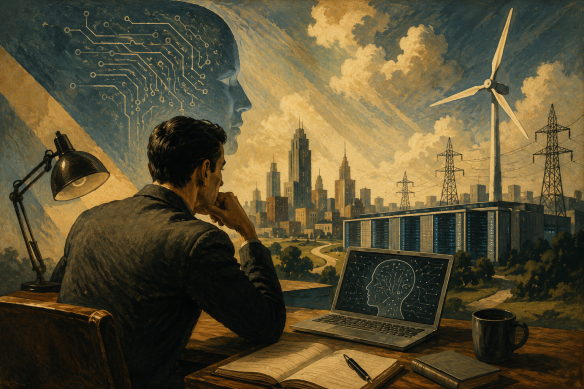
After using ChatGPT for less than two weeks, I’ve already come to a conclusion that differs from both the fear and the hype surrounding artificial intelligence. Before I started using AI, I mostly heard two competing stories. One claimed AI would soon replace millions of workers, become more intelligent than humans, and eventually create dangers beyond our control. The other presented AI as the next technological revolution that would transform the economy, create enormous wealth, and usher in a new era of prosperity. After spending time actually working with it, I don’t think either story captures what AI really is or where its greatest value lies.
What surprised me most wasn’t what AI could do. It was what it revealed about how I naturally think. I discovered that I tend to think in systems instead of isolated ideas and in visuals instead of lists. For years, I had accumulated projects, research, writing ideas, and observations that all competed for attention inside my head. The challenge wasn’t a lack of ideas—it was organizing them well enough to act on them.

AI didn’t replace my thinking. It gave my thinking structure.
Instead of trying to hold dozens of ideas in my working memory, I began using AI as an external thinking partner. It helped me organize projects, sort brain dumps into useful categories, identify recurring themes, and connect ideas that had previously been scattered across notebooks and random documents. Most importantly, it reduced the mental friction that often kept me from getting started. Instead of spending my energy trying to manage everything in my head, I could focus on developing ideas and actually producing work.
That experience changed how I viewed artificial intelligence. Its greatest strength is not replacing human intelligence but helping people organize and apply the intelligence they already possess. I no longer think of AI primarily as a machine that gives answers. I think of it as a tool that helps people think more clearly, connect ideas more effectively, and spend more time creating instead of organizing.
Because of that experience, I also changed my opinion about who benefits the most from AI. At first I thought it primarily helped talented people. I don’t think that’s quite right anymore. I think it helps people who are actively building something. Whether someone is writing a book, teaching a class, running a business, designing a product, conducting research, or creating art, AI becomes valuable because it removes friction from meaningful work. It doesn’t replace their expertise. It amplifies it.
This distinction matters because history shows that the greatest tools have always multiplied human ability rather than eliminated it. A calculator doesn’t replace the mathematician. A microscope doesn’t replace the scientist. A paintbrush doesn’t replace the artist. Likewise, AI doesn’t replace judgment, creativity, wisdom, or experience. Those qualities remain uniquely human. Artificial intelligence simply allows us to apply them more efficiently.
There is another reality that often gets overlooked. AI is not simply software running somewhere “in the cloud.” Every interaction depends on physical infrastructure. Data centers require enormous amounts of land, electricity, water, specialized hardware, and network infrastructure. Every question asked of an AI model ultimately depends on resources drawn from the physical economy.
That reality deserves more attention than it receives. Communities across the country are already questioning whether large data centers justify the demands they place on local infrastructure. Whether those concerns grow or not, they remind us that artificial intelligence is not free. Every technological advance consumes resources, and those resources should produce meaningful human value. If society is going to dedicate enormous amounts of energy, water, land, and capital to AI, then it should improve people’s lives rather than simply generating more digital content or increasing quarterly profits.
Ironically, I don’t believe the greatest obstacle to AI’s future is its technology or even its subscription cost. A twenty-dollar monthly subscription is relatively inexpensive compared to the amount of value it can provide. The real obstacle is trust.
People are not evaluating artificial intelligence in isolation. They are evaluating it through the lens of everything that came before it. Over the past several decades we have lived through one technological revolution after another. Personal computers, the internet, smartphones, social media, and cloud computing all promised to improve work, expand opportunity, and make life better. In many ways they succeeded. Communication became easier. Information became more accessible. Entire industries were created that would have been unimaginable a generation earlier.
At the same time, many ordinary workers experienced those same decades differently. For them, each technological revolution often meant learning another platform, adapting to another system, and becoming dependent upon another corporation. Productivity increased, yet financial independence remained out of reach for many families. Much of the wealth created by these innovations appeared to flow toward investors, executives, and the largest technology companies while millions of workers continued living paycheck to paycheck.
Whether that perception is completely accurate is almost beside the point. Perception shapes trust. If people believe previous technological revolutions failed to improve their own economic lives, they naturally become skeptical when they hear similar promises attached to the next innovation.
That skepticism has also been reinforced by the behavior of many technology companies themselves. Consumers have watched companies collect personal data, track online behavior, build advertising businesses around surveillance, and sometimes place shareholder value ahead of customer trust. Privacy controversies, data breaches, and concerns about manipulation have left many people wondering whether new technology exists to serve them or simply to make someone else wealthier.
As a result, AI inherits a trust deficit that it did not create on its own. People are not simply asking whether artificial intelligence works. They are asking whether the people building it deserve their trust.

There is another issue that receives far less attention than it deserves: technological fatigue. Modern workers are expected to continually learn new software, business systems, programming languages, and digital tools. Every few years the landscape changes again. Skills that once provided career security gradually lose their value, forcing people to retrain simply to remain employable.
Over time that cycle creates frustration. People begin asking whether learning the next technology is worth the investment when history suggests another disruption may arrive before they have fully benefited from the last one. Resistance to new technology is often less about fear of innovation than exhaustion from continually starting over. When people no longer believe today’s expertise will still matter tomorrow, they naturally become more cautious about embracing the next wave of change.
For all of these reasons, I believe trust—not technological capability—will determine the future of artificial intelligence. The companies building these systems face a challenge that is much larger than creating better algorithms or building larger data centers. They must demonstrate that AI genuinely improves people’s lives, that productivity gains benefit society more broadly, and that they are responsible stewards of people’s data, attention, and confidence.
My first two weeks using AI have convinced me that artificial intelligence has extraordinary potential. It has already changed the way I organize projects, develop ideas, and approach writing. More importantly, it has helped me understand something about my own mind that I had never fully recognized before. By reducing mental friction and serving as an external thinking partner, it has allowed me to spend less time managing information and more time creating meaningful work.
Artificial intelligence is an impressive technological achievement, but history suggests that technological capability alone has never been enough to change society. Every major innovation ultimately succeeds or fails according to something much less visible than hardware or software. It succeeds when people trust the institutions behind it, believe the benefits will be shared broadly, and see that the technology genuinely serves humanity rather than asking humanity to serve the technology.
In the end, AI’s greatest challenge is not becoming more intelligent. Its greatest challenge is becoming more trustworthy.
[ad_2]
Source link
