
[ad_1]
Ben Soodavar, King’s College London The Conversation
(The Conversation) – Less than a month after a ceasefire was signed between the US and Iran, conflict has returned to the Middle East. The peace agreement Donald Trump signed at the palace of Versailles in France on June 18 – which he hailed as Iran’s “unconditional surrender” – is now, in the US president’s own words, “over”.
I recently argued that the memorandum of understanding (MoU) between Washington and Tehran was best understood not as a peace agreement but as a “deferred crisis” – a ceasefire with a built-in detonator. That detonator has now gone off.
Trump’s declaration that further talks with Tehran are “a waste of time”, which he made on the sidelines of the Nato summit in Ankara, Turkey, on July 8, follows an escalation spiral that will feel grimly familiar to anyone following this conflict.
Iran attacked three commercial vessels in the Strait of Hormuz on Tuesday. The US responded with what one unnamed US official described as “punishment” strikes on more than 80 Iranian targets and reimposed sanctions on Iranian oil sales – stripping away Tehran’s central gain from the deal.
Iran, in turn, launched retaliatory strikes on US military installations in Bahrain and Kuwait. Oil prices have surged, reviving the very economic pressure – rising prices at the American gas pump – that dragged Trump to the negotiating table in June.
None of this should come as a surprise. The agreement signed at Versailles did not resolve the contradictions that produced the war. It institutionalised them and inadvertently created the very conditions under which escalation becomes more likely.
The structural flaw in the ceasefire deal was visible from the outset. The MoU rested on Iran reopening the Strait of Hormuz in return for the lifting of sanctions on Iranian oil – almost the only lifeline sustaining the Iranian economy. But nothing in the agreement resolved the question of Lebanon.
Iran had made clear that one of its core objectives was to prevent further Israeli strikes against Hezbollah – an attempt to salvage its proxy network in the region. Israel, for its part, cannot permanently suspend its right to self-defence as the price of a US diplomatic agreement. Reports suggest the Israeli prime minister, Benjamin Netanyahu, was “fuming” over the MoU agreement, which Israel was not party to when it was drafted and signed.
This has produced the cycle now on full display: continued Israeli military action in Lebanon, Iran flexing its leverage over the Strait of Hormuz and US strikes on Iranian assets to save face – even as Washington pressures Israel to stand down. Each iteration intensifies the conviction in Tehran, Jerusalem and Washington that restraint is no longer a viable course of action.
Leaders abandon restraint not simply when threats grow, but when holding back stops feeling like a way of acting at all. Restraint survives only while it seems to be working, points towards a better future and feels like a choice rather than something imposed. When those conditions fail, restraint starts to look like paralysis and escalation becomes the only way of restoring control.
For Trump, all three of these conditions have collapsed. Iran is attacking commercial shipping despite the deal. Oil prices are climbing as the US midterm elections approach. And every Iranian strike demonstrates that Tehran, not Washington, is setting the tempo and direction of the ceasefire. This dynamic is fundamentally unsustainable for the US.
For Netanyahu, this collapse is not a failure but a confirmation of his lack of conviction in the ceasefire deal. Israel never accepted the premise of the MoU. Its security establishment has maintained throughout that the war with Iran was paused, not concluded, and that any framework granting Iranian-backed forces impunity in Lebanon was unsustainable.
Shortly after the deal was signed in June, Netanyahu said that Israel’s “struggle is not over” and its military will “remain in these security zones for as long as necessary to defend our country”.
What comes next
Two scenarios now present themselves and, in both, the Strait of Hormuz decides the outcome. In the first, the US continues its bombardment of Iranian military assets while attempting to keep the strait open by force. This is a formidable task.
Iran does not need to defeat the US Navy to close the waterway; it merely needs to make transit unsafe enough that insurers refuse to cover vessels. Sustained airstrikes may degrade that capacity, but they cannot eliminate it. This raises the question of whether ground forces would eventually be required, though this development would probably be challenged by Congress.

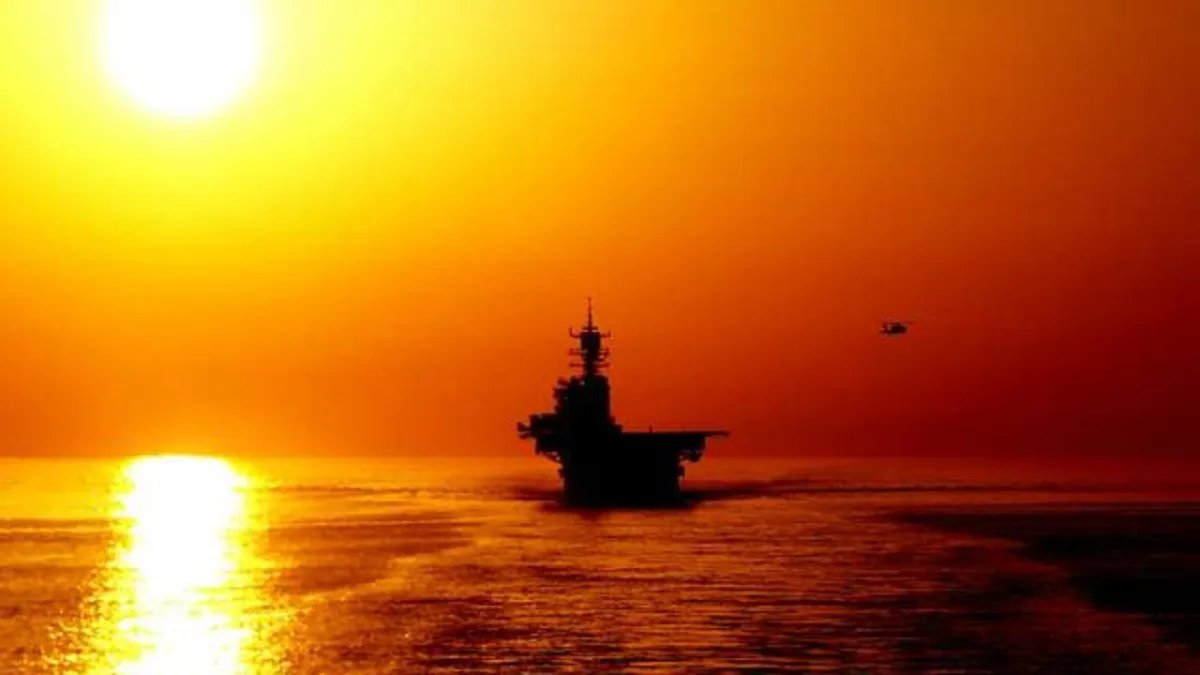
Strait of Hormuz (U.S. Navy photo by Quartermaster 1st Class Thomas E. Dowling)
In the second, Trump limits the strikes and uses them as leverage to renegotiate the ceasefire. But this path has its own problem. Without the ability to guarantee free navigation of the strait, it is hard to see how Trump extracts a better deal than the one he has just abandoned – from a belligerent and emboldened Iran that has absorbed enormous punishment and survived.
Either way, Trump’s off-ramps are narrowing. Until Iran loses its leverage over the strait, the cycle we are currently witnessing makes a prolonged conflagration more likely.
Ben Soodavar, Lecturer, Department of War Studies, King’s College London
Editor’s Note: At a moment when the once vaunted model of responsible journalism is overwhelmingly the play thing of self-serving billionaires and their corporate scribes, alternatives of integrity are desperately needed, and ScheerPost is one of them. Please support our independent journalism by contributing to our online donation platform, Network for Good, or send a check to our new PO Box. We can’t thank you enough, and promise to keep bringing you this kind of vital news.
You can also make a donation to our PayPal or subscribe to our Patreon.
Please share this story and help us grow our network!
[ad_2]
Source link
