
[ad_1]
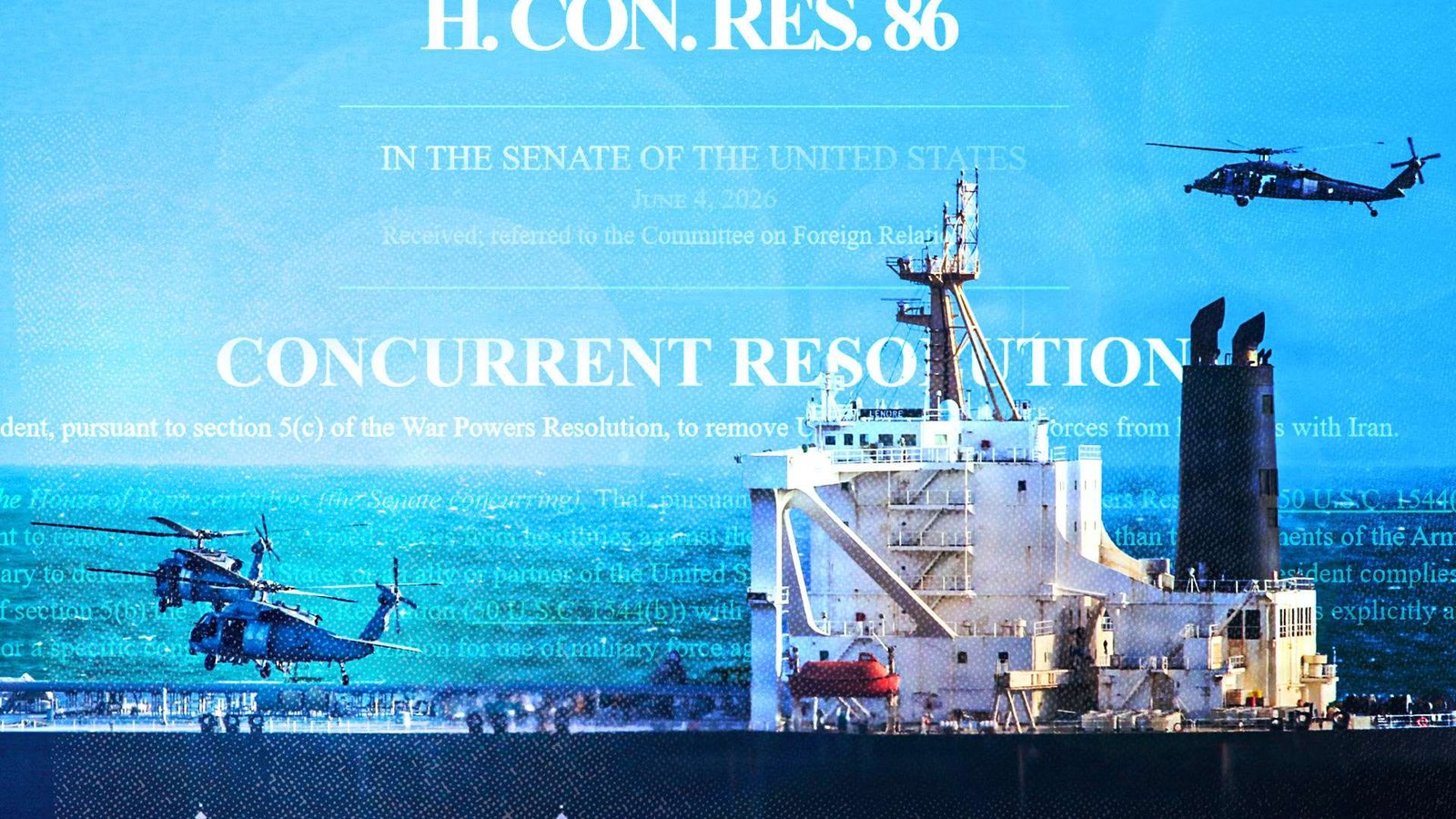
Better late than never. Both houses of Congress have passed a war powers resolution on Tuesday to end the U.S. war with Iran—nearly three months after the shooting stopped, and a week after the U.S. and Iran agreed on a peace memorandum. The resolution passed the Senate on the 10th try, after four Republicans voted for it and war hawks Mitch McConnell (R–Ky.) and Dave McCormick (R–Pa.) were no-shows.
Despite the war already being over, President Donald Trump lashed out at the resolution for restraining his powers. He wrote on Truth Social that the “poorly timed and meaningless” vote by “Dumocrats” and “Four Republican Losers” told “the Number One Sponser [sic] of Terror in the World that the United States doesn’t like what I am doing to them, and I must stop, and by so doing has provided aid and comfort the Enemy.”
The long wait for a war powers vote was not just a matter of Congress moving slowly. Although Sen. Rand Paul (R–Ky.) supported it from the beginning and Sen. Susan Collins (R–Maine) fulfilled her promise to vote for the resolution after 60 days—the original War Powers Act requires the president to get congressional permission within 60 days of a war starting—it took more time for Sens. Lisa Murkowski (R–Alaska) and Bill Cassidy (R–La.) to flip.
And Democratic leaders engaged in more subtle tactics to delay a war powers resolution in order to avoid a testy political fight.
“Republicans didn’t want to stand up to Trump, the ones who put this over the top were ones who lost their primaries; and Democratic leadership played nice with Republicans, likely to protect their own members who didn’t want to vote against [the American Israel Public Affairs Committee] but who eventually saw the writing on the wall and voted for the resolution,” says Etan Mabourakh, national organizing manager at the National Iranian American Council, a nonprofit diaspora organization.
Before the war began, Democratic leadership privately discouraged Rep. Ro Khanna (D–Calif.) from introducing a resolution—alongside libertarian-leaning Rep. Thomas Massie (R–Ky.)—to prevent Trump from attacking Iran. They eventually agreed to schedule a vote in the first week of March, which turned out to be a few days after Trump started the war. The Khanna-Massie resolution failed due to Democrats defecting, and Rep. Josh Gottheimer (D–N.J.) tried to supplant it with his own resolution giving Trump a month to end the war.
Meanwhile, House Foreign Affairs Committee Ranking Member Gregory Meeks (D–N.Y.) refused to force a vote on any war powers resolution for the first 60 days, telling Drop Site News on March 27 that “we can’t win. When you see me put a vote on the floor, that means we’re going to win.” He eventually agreed to hold a vote in mid-April, but was proven right, as the resolution failed by one vote, with four Republicans abstaining.
In May, when Meeks was confident he had the votes, House Speaker Mike Johnson (R–La.) called an early recess to delay the vote by several more weeks.
It’s worth adding that the war is much less popular with Americans than it is inside Congress. The war started with a historically small minority of Americans supporting it, and it only got more hated from there. A recent CBS News poll found that only 31 percent of Americans thought the war was worth it, and 78 percent of Americans want to end it now.
“While some may suspect that Democrats were able to wait until the war was over to pass this, what actually took place was that activists pressured Democrats to expedite the votes, and then the disastrous nature of the war and economic impact moved up the timeline,” says a staffer at an antiwar organization involved in the legislation, who spoke to Reason on condition of anonymity.
He adds that the fight to pass the resolution was valuable because it gave “doves within the administration, to the extent that they exist, more leverage, more of a talking point, more of an ability to tell Trump that now is the time to wrap it up to avoid an embarrassing fight with Congress over an unpopular war.”
Mabourakh, meanwhile, says that the resolution is important to “prevent Trump from backsliding into this one again.” Trump has been threatening to restart the war if Iran does not give in to his demands, though peace talks seem to be going well for now.
And the struggle in Congress isn’t over. Sen. Tim Kaine (D–Va.) is pushing for a resolution with more strongly binding legal language, which would require a two-thirds majority to override a presidential veto. If Congress reflected public opinion, it would pass in a landslide—but the last six months show that Congress doesn’t work that way.
[ad_2]
Source link
