
[ad_1]

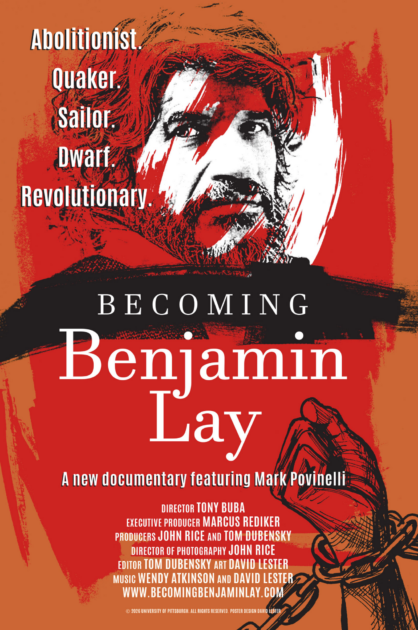
Becoming Benjamin Lay isn’t a documentary about an actor portraying dwarfism, actor Mark Povinelli explains. It’s about portraying one of the great figures of history—who happened to be a dwarf.
The documentary is a behind-the-scenes story of how a play named The Return of Benjamin Lay was performed in London (2024), and later in New York, Pittsburgh, and Philadelphia (2025).
So, who was this great figure of history? An 18th-century abolitionist who stood about four feet tall and made quite a splash in the 1700s—before sliding into obscurity. In the words of University of Pittsburgh professor Marcus Rediker, “the most fascinating and one of the most important historical figures that you’ve never heard of.”
Rediker got in touch with the president of Little People of America. Would anyone in LPA be keen to attend a ceremony in Abington, just north of Philadelphia? Abington, Marcus explained, was the final resting place of the great agitator, and the Quaker minister he married, Sarah Smith Lay. It was time for a rededication of Benjamin’s remains to the Quaker communities that kicked him out of their ranks three centuries ago.
LPA’s president, the actor Mark Povinelli, was unable to make the trip. But Abington had captured Mark’s attention.
Kindred Souls
In a few years, the historian from Pittsburgh would ask the actor from L.A. about working together on a play about Benjamin’s life. Marcus and Mark are kindred souls; and their kin includes an abolitionist Quaker, buried at Abington, whom they both call Ben. And, together with playwright Naomi Wallace and director Ron Daniels, they created a remarkable play.The work won the “Best Production” Standing Ovation Award from London Pub Theatres. Mark Povinelli is amazing, wrote longtime Guardian drama critic Michael Billington. Mark was also made a finalist for “Best Solo Performance” by the New York Drama Desk Awards.
In the documentary Becoming Benjamin Lay, Mark Povinelli can be seen presenting the play at an annual meeting of Little People of America. Mark views his role as a tribute to his community’s historical ancestry. “Refreshing,” says Erin Pritchard, who teaches Disability Studies at Liverpool Hope University. “I was proud when I walked out.”
To Mark, that pride alone makes the project deeply meaningful. (Early in his career in L.A., Mark recounts in the documentary, he successfully handled a major role and later got a call from the casting director, who praised Mark’s performance and then asked if the actor “and some of your friends” would come and entertain guests by serving drinks at a forthcoming party.)
Mark is delivering a redemptive ancestor to Quakers, too. And to today’s reparationists, feminists, workers’ advocates, animal liberationists… Benjamin’s 18th-century life stands as a precursor to them all. And yes, Benjamin subverted standard gender distinctions by sitting in the women’s section of the meetinghouses. Repression is repression; Benjamin rejected it across the board.
No Serenity
Documentary filmmaker Tony Buba focuses on Mark, sitting on a bench, head bowed, bathed in the silence of the Abington Meetinghouse. Mark ponders the power of “disrupting this level of serenity” and the impact it must have had in the 1700s. On one occasion, Benjamin plunged a sword through a bible, causing fake blood to splash out of the book and onto the weighty Quakers in the front benches. It was a rebuke of their involvement in human trafficking.
“There is no serenity,” Mark declares, “Until your goal is achieved.”
Sensing that Ben’s work is not yet complete, Mark adds: “I want people to feel uncomfortable that they might be—that I am—complicit in the world that we’ve built.”
Abington Quaker elder George Schaefer leads Mark to a nearby wild cave. Mark walks in. It’s a sturdy place beneath the boulders. A place that could withstand the elements for centuries. Benjamin lived in this cave in his later years, say the locals. Some modern members of Abington Meeting knew that their 18th-century peers revoked Benjamin Lay’s Quaker membership back in the day.
In the early part of the film, playwright Naomi Wallace had articulated a key question in the dramatic writing: What would happen if Benjamin Lay came back from the grave, walked into a Quaker meetinghouse, and asked to be taken back? As it turns out, a Friends’ Meeting cannot reestablish membership of an erstwhile Quaker who has died and cannot participate in the process.
Ultimately, Abington Meeting’s formal minute on Benjamin Lay recognized Benjamin as “a Friend of the Truth.” Philadelphia Yearly Meeting, the umbrella group for area Quakers, acknowledged that this was “in unity with the spirit of our Philadelphia Yearly Meeting.” All four meetings that had once disowned Benjamin recorded reparative minutes by the end of 2018.
But the Abington congregation, as described by Abington Friends Meeting Administrator Loretta E. Fox, started with mixed feelings about reclaiming Ben. A third-generation Quaker, Ben channelled the radical, first-generation Quakers who lived through the English Revolution in the 1650s. Ben’s method of guerrilla theatre castigated the wealthy Quakers who kept people enslaved. Some Quakers in the Philadelphia suburbs may not have come to terms with their forebears’ history. And some say Benjamin went too far.
Er, hm, maybe let’s not take back the kidnapper!?
Yes, said Marcus Rediker, Benjamin did once spirit off a local landowner’s child, and keep the youngster amused and away from home just long enough for the parents to become frantic. Benjamin returned the child with a message: Your child is fine; but now you know the anguish that the parents of the little child you keep as a slave must feel, with no relief!
For it was quite OK, in 18th-century Pennsylvania, to kidnap people’s children—legally OK—if their ancestry was African.
The Friends who came to North America, as Quaker preservationist Avis Wanda McClintock puts the point, fled oppression… to oppress?
What did they come in this house of God for, when they was playing God with my people?
The Most Disowned Quaker
Committed to peace, Benjamin Lay nevertheless insisted that “a tongue is for saying no when a no is required.” And for that, Marcus Rediker tells the audience, Benjamin Lay was the most disowned Quaker of the 18th century.
One day in 1742, Ben began smashing a set of fancy teacups in Philadelphia’s main marketplace. Sugar-sweetened tea contained the blood of workers in sugar colonies, including Barbados, where Ben previously lived and worked. The blood of the enslaved who fell into the vat. Becoming Benjamin Lay uses artist David Lester’s depictions of such scenes to illustrate Benjamin’s haunting memories.
Ben would not wear dyed clothing. Indigo came from the fields of the slavers. Crimson dye came from carmine—crushed beetles. And although he’d once been a shepherd, Ben could neither eat mutton nor wear wool. For Benjamin’s love and respect for all Earthly lives was deep, visceral, all-encompassing. Benjamin, Mark tells the documentary viewer, was convinced that all—a beetle, a human, a sheep—all had value. Ben didn’t rank them. Some speak of animal equality, Mark notes, “but he really believed it, and I think that was borne out of his own experiences.” A working-class intellectual with the wrong kind of body, the playwright Naomi Wallace says. One whose holistic sense of ethical living is what we need today, more than we have ever needed it before.
Mark thinks so too. He tells the documentary audience that Ben has changed him.
“He’s always on my shoulder,” Mark muses. “We make decisions throughout the day, hundreds of seemingly innocuous decisions, that we think nothing about.” Clicking a button on the computer, filling our tanks, choosing the food we buy…
“Ben now does not let me make decisions,” says Mark, “Without being like Really? Who’s that affecting now? Who are today’s enslaved people being brutalized by me?”
Mark’s introspection speaks to the integrity of the dramatic production. Director Ron Daniels recounts being astonished at how Mark becomes Benjamin, inhabiting the 18th-century language of the script. Perhaps it’s no wonder.
What Wilt Thou Do?
During the time he spent running a shop in Barbados, Benjamin Lay came to see enslavement as a demonic system. He would later talk of what enslaved workers taught him, and how they created everything in the colonies—even their freedoms, “in spite of us.”
Ben and Sarah left Barbados in 1720, and returned to Colchester, England, where Ben had grown up. In 1732, the pair sailed from London to Philadelphia, excited by the prospect of life in a freedom-focused community. When they arrived, they were appalled to learn that William Penn, known as one of the most politically enlightened people of the 18th century, personally owned 12 enslaved people.
And there was the auction at Front and Market Streets. Ben describes the scene. “I can smell the slave ship before I see it.” One Quaker owns the ship, and another runs the auction.
Very late in Ben’s life, a friend brought the news that this would be put to an end. The Philadelphia Yearly Meeting would begin a process to formally expel Quakers who engaged in the buying and selling of human beings. Quakers thereby took their first key step to the forefront of the North American abolitionist movement. Of course, for Benjamin, that was not a heroic commitment; it was simply a matter of basic respect. But it did mean Ben could die in peace, after a life well lived.
And now, Marcus asks: “Who is excluded, and who is included, in history? Whose history is it?” Why is Penn, not Ben, on the top of City Hall? For history replicates itself in broad daylight, in the paintings, the murals, the statues of our cities. (A petition to replace the statue of William Penn with one of Benjamin Lay arose from a group called the Benjamin Lay Society, which formed soon after Marcus Rediker penned an August 2017 New York Times op-ed calling for fair recognition of Benjamin Lay’s historical impact and current relevance.)
Robin D.G. Kelly, a UCLA American history scholar, speaks through Becoming Benjamin Lay about what we lost when Ben was lost to history. Benjamin was saying, before the advent of industrial capitalism, that we have another path. What would have happened had Western civilization followed that path? Colonialism, enslavement, dictatorships… These things would’ve ground to a halt. The present oppression in Gaza, in the Congo, in the U.S. city streets—all could have been forestalled. Our Earth could have been spared from our ravages.
And what would Benjamin Lay say about the debt we owe to other living beings today, as the smoke from unnatural fires descends on the continent? There is no serenity in climate crisis. Other animals cannot retreat to rooms with filtered air. Benjamin, in the open cave, would have accompanied them in their plight. Can we hear Benjamin’s call across history for them?
By the time Mark’s performance concludes, we’ve witnessed an evolution of the play’s dramatic purpose. The question was never so much about allowing this revolutionary to rejoin Quaker society; the question is whether principled people can become ready to join Benjamin. Perhaps it’s not too late. Ben leaves us with this invitation:
Join me; let’s talk. Let’s have a good long look at one another and keep looking until we see. Keep listening until we hear.
Friends, what dost thou say? Better yet, what wilt thou do?
To schedule a screening of Becoming Benjamin Lay, please contact Tony Buba and Marcus Rediker at [email protected].
[ad_2]
Source link
