
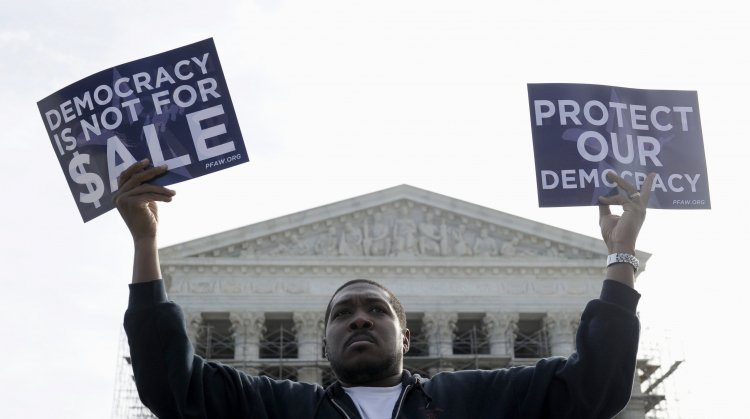
Washington has spent years debating money in American politics while ignoring a simpler question: Should voters have the right to know who is spending that money to influence their elections?
Today, the answer is too often no.
Billions of dollars flow through an ecosystem of wealthy donors, corporations, special interests, nonprofits, and super PACs. Much of it is perfectly legal. But legal and ethical are not the same thing.
The system has become so complex and intentionally opaque that voters can be bombarded with millions of dollars in political advertising without knowing who ultimately supplied the money. Both parties use the system to their advantage. Neither should defend it simply because it benefits them in the moment.
My recent campaign for the United States Senate gave me a firsthand view of how the system operates. I invested roughly $2 million of my own money, and South Carolinians contributed another $1 million to support our campaign. Those dollars came from people willing to put their names behind what they believed in. Every voter could see who was supporting us and where our campaign’s money came from.
At the same time, millions more poured into South Carolina from outside groups for one purpose: to attack me and defeat our campaign. About half came from groups aligned with Republican politics. The other half came from Democratic groups spending millions to influence a Republican primary. These were not disinterested observers. Much of that money came from special interests and industries with billions of dollars riding on decisions made by the federal government.
Some original sources could be identified. Others were difficult, sometimes impossible, to determine from public campaign finance records. We have all heard the term “dark money.”
But what is remarkable is how many layers can be deliberately placed between the money and its original source. An individual, corporation, or special interest can give to a nonprofit that does not disclose its donors. That nonprofit can transfer the money to another nonprofit, then to a super PAC. Add an LLC and the trail becomes even harder to follow.
This is not money-laundering in the criminal sense. But the effect can look remarkably similar: Pass the money through enough entities and, by the time it emerges, its original source has all but disappeared.
Eventually, the super PAC reports the contribution and the advertisements begin. Voters see the message and the organization’s vaguely patriotic name, but not necessarily the person or interest whose money started the journey. If that sounds like a system designed to obscure rather than disclose, that is because it is. And Washington knows exactly how it works.
Congress helped create this system.
Congress also benefits from this system.
Campaign finance laws built its architecture, court decisions reshaped it, and Washington learned how to exploit it. Politicians denounce dark money when it is spent against them and quietly accept its benefits when it is spent on their behalf.
However, following the letter of the law does not make the system right.
The consequences extend beyond elections. Members of Congress watch millions materialize almost overnight against colleagues who cross powerful interests. They understand the message: The same thing can happen to you. But a member of Congress should be thinking about the people back home before casting a difficult vote, not wondering which anonymous group might spend $5 million against him in the next primary.
Meanwhile, an enormous industry benefits. Lobbyists get paid. Consultants get paid. Nonprofits collect undisclosed money. Super PACs spend it. Everyone in the political money machine knows how the system works. The voters are left in the dark.
The stakes are enormous. Congress makes decisions involving defense, energy, health care, artificial intelligence, taxes, regulation, and trillions in federal spending. When an industry stands to gain or lose billions, voters deserve to know when its money is influencing those decisions.
The answer is not limiting political speech. The answer is sunlight.
Congress should examine greater disclosure of the original sources of significant funds used to influence federal elections while protecting constitutional rights to free speech and association. Moving money through multiple organizations should not magically erase its origin. If millions are being spent to influence an election, voters should be able to follow the money.
The standard must apply equally – whether it’s a liberal billionaire, conservative billionaire, corporation, labor organization, Republican group, or Democratic group. It should not matter.
Political speech should remain free. Political money should not be deliberately untraceable.
My experience in South Carolina did not create this problem. It gave me a closer look at a system Washington has tolerated, and too often benefited from, for far too long.
This is not about one candidate or one election. It is about whether elected officials answer to the people who sent them to Washington or to the special interests spending millions to keep them there.
Follow the money. Disclose the interests. Expose the relationships. Then trust the American people to decide.
No party owns Washington. No special interest should be able to buy it.
And no American should need a subpoena to find out who is trying.
