
[ad_1]
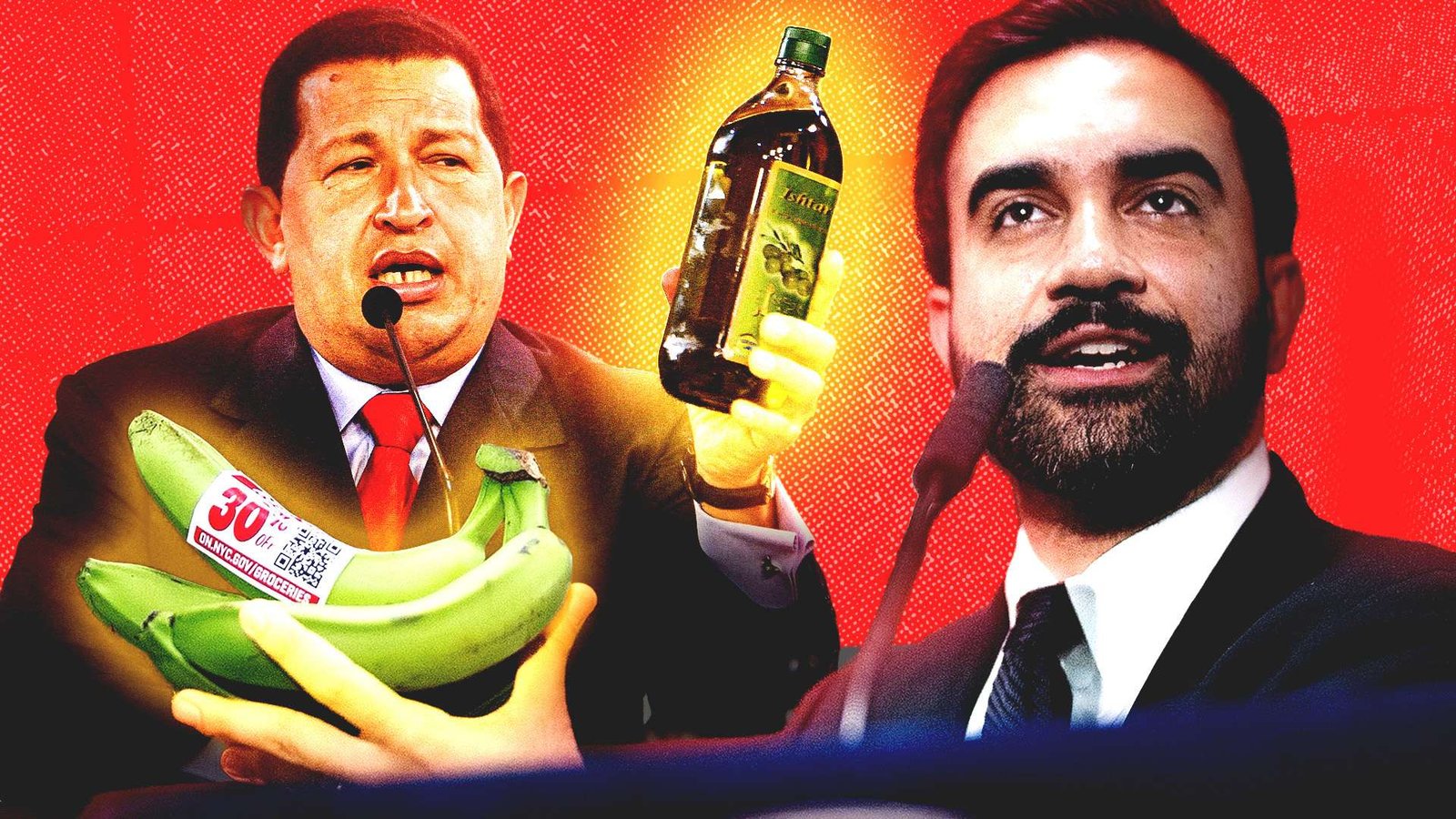
New York City Mayor Zohran Mamdani held up a bunch of plantains at a press conference on Monday and promised that New York City shoppers would pay 30 percent less than “typical retail prices” when the city opens five government-run grocery stores at a cost to taxpayers of $70 million.
“How are you going to keep people from taking advantage of that deal?” one reporter asked the mayor. “Is there going to be a limit on the number of items that someone can take?”
“Our RFP [Request for Proposals] makes very clear that this is a program for New Yorkers to be able to put food on the table, not a program for people to be able to make a quick buck through reselling,” the mayor responded, before turning it over to Jeanny Pak, the interim president of the New York City Economic Development Corporation. She said the city was looking into a “library card-esque” system that would allow the city “manage who’s buying,” with a focus on “everday New Yorkers.”
The city’s plan rests on the assumption that it can control who buys subsidized goods. Yet Venezuela’s experience with government-run grocery stores suggests that assumption deserves scrutiny.
When Venezuela’s socialist president, Hugo Chávez, created a nationwide network of government-run grocery stores called “Mercal” in 2003, he faced the same conundrum of how to control excess demand when prices are set artificially low.
At first, Mercal seemed to work. It quickly became one of Chávez’s most popular social programs. In a 2007 episode of his talk show, Aló Presidente, Chávez compared Mercal’s prices with those at a nearby grocery store. A kilo of sugar at Mercal cost 740 bolívares, compared with a price of 1,300 bolívares elsewhere. Chicken sold for 1,900 bolívares instead of 4,550. The discounts were roughly 43 percent to 62 percent below prices already regulated by the government. Chávez called Mercal an instrument for building “socialist commerce.”
More than 70 percent of households reported buying at least one item at Mercal during the program’s peak in popularity in 2005. But eventually artificially low prices led shoppers to clear out the shelves, and the stores became famous for lines that would wind around the block. The share of households shopping at Mercal plummeted below 40 percent by 2014.
The gap between Mercal’s subsidized prices and prices at other grocery stores created an obvious resale opportunity. There were complaints of diverted goods, fictitious purchases, store clerks allowing their friends and relatives to jump the line, and corruption in procurement and distribution. Hauling food across the border to resell at market prices in Colombia became a booming industry. Black-market reselling even spawned a new profession: bachaqueo.
The government responded to the shortages with tighter controls. It capped purchases, assigned shoppers a weekday based on the final digit of their national ID number, and registered sales by ID and fingerprint. Some stores required shoppers to bring a baby or present a birth certificate before they could buy diapers.
Centralized procurement created another set of problems. In 2010, Venezuela’s Comptroller General audited the state food distributor and found unjustified direct awards, food containers stored outdoors, damaged products, and major discrepancies between inventory and port warehouse records.
Mercal alone did not cause Venezuela’s food shortages. It operated inside a larger system of national price and exchange controls, subsidized imports, expropriations, precarious property rights, monetary financing of government deficits, and declining oil production.
Thankfully, Mamdani’s program is limited to New York City.
New York’s experiment is local, far more limited, and therefore, lower-stakes. Private contractors will operate the stores, while auditors, courts, reporters, and the public can scrutinize the results. Chávez, by contrast, clamped down on the free press and suppressed reporting on his failed policies.
New Yorkers will also have plenty of alternatives. The city’s five municipal stores will become part of a food retail market that includes more than 1,100 grocery stores and 10,000 bodegas.
But the comparison is still useful because, like Chávez, Mamdani will find that he can’t escape the laws of supply and demand. His evasive response to the reporter’s question suggests that he hasn’t given much thought to how the city would manage high demand for cheap groceries. One way or another, the program will require quotas. The alternative is to tolerate price-sensitive shoppers lining up outside stores to buy discount plantains.
The spectacle of food lines would be a public relations disaster for the media-savvy mayor, who has pointed to his policies as evidence that “socialists not only understand economics, just as well as the capitalists who came before.” Mamdani’s rhetoric evokes Chávez’s, who called Mercal “an instrument” for proving that socialism works and that Adam Smith’s theory of the invisible hand was a capitalist lie.
Like Chávez, Mamdani is a socialist, an economic populist, and a gifted politician. He understands the rhetorical power of holding up a bushel of plantains. A government can dictate the price, but it cannot guarantee that the plantains will still be there.
[ad_2]
Source link
