
[ad_1]
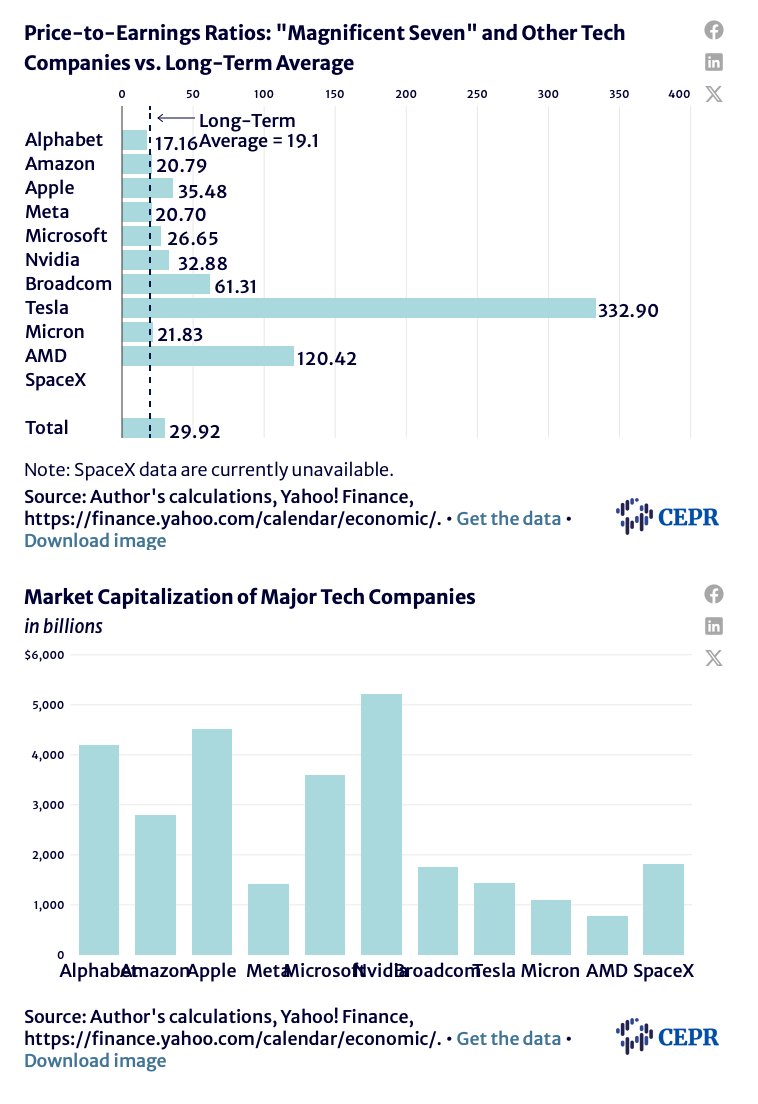
Here are the most recent price-to-earnings and market cap numbers:
What Does AI Tell Us About the AI Bubble?
I know I have been screaming about an AI bubble for some time, but I also do think that the tech can do useful things. In that sense, the tech bubble of the ‘90s is a good analogy. The Internet has had a huge impact on the economy and our lives, but the price of most tech stocks in the late 1990s made no sense. To my view, the same story is likely to apply to AI.
To show my appreciation for AI (and also out of laziness), I decided to ask it what it thinks about the bubble. I gave three leading AI systems the following prompt.
“If a pension fund manager knows there is an AI bubble, but they also know they will suffer no career consequences if the bubble bursts and costs the fund a large share of its assets, how will they manage the fund’s portfolio?”
Here’s what they had to say. (The answers are all literally verbatim. I just cut and pasted.)
Google Gemini
A pension fund manager in this situation will continue to buy AI stocks and ride the market wave to capture short-term gains, rather than trying to avoid the crash.
This behavior happens because of standard financial incentives and psychological safety. Here is how and why they will manage the portfolio this way:
Chasing the Boom
Buy popular assets: They will overweight their portfolio with leading AI companies, chips, and tech giants.
Ignore high prices: They will ignore traditional valuation warnings (like high price-to-earnings ratios) because prices can keep climbing for a long time.
Match the benchmark: They will track major market indexes closely so they do not fall behind other funds while the bubble is growing.
Avoiding Short-Term Pain
Fear of missing out: If a manager avoids AI and the bubble keeps growing for two more years, their fund will look terrible compared to competitors.
Peer pressure: In finance, it is safer to fail with the crowd than to succeed or fail alone. If everyone loses money together when the bubble bursts, it is blamed on market conditions rather than poor individual skill.
The Logic of “No Consequences”
Asymmetric payoff: If the bubble grows, the fund wins prestige and high returns. If the prompt states there are zero career consequences when it bursts, the manager has zero incentive to protect the long-term capital.
Surviving the present: A manager’s immediate danger is underperforming today. Since the crash carries no penalty, they have every reason to maximize the upside right now.
GROK
They will continue holding (or even overweighting) AI-related assets, riding the bubble rather than exiting or hedging it away. The decisive factor is the manager’s personal incentive structure, not the fund’s long-term interests or the manager’s private knowledge that AI valuations are unsustainable. With no career penalty for large absolute losses when the bubble bursts, the dominant risk for the manager becomes relative underperformance while the bubble is still inflating.
+ Staying invested (or matching the peer/benchmark exposure) means the manager keeps pace if prices keep rising. When the eventual collapse occurs, the losses are shared with other managers who behaved the same way; the absence of career consequences removes the usual personal downside.
+ Exiting or underweighting early creates immediate relative underperformance if the bubble continues. In institutional settings this typically triggers client outflows, board scrutiny, or job risk—risks that remain even when absolute losses later carry no personal cost.
The result is classic agency-driven herding: the portfolio is managed to minimize the manager’s career variance rather than the fund’s long-horizon risk-adjusted return. Exposure to the bubble assets is maintained (or increased to stay competitive), diversification or hedges that would reduce participation are avoided, and any “prudence” language is subordinated to benchmark-relative positioning. The fund therefore remains vulnerable to a large drawdown once the bubble deflates, precisely because the manager’s payoff does not penalize that outcome.
CHAT GPT
If the manager knows an AI bubble exists and also knows that being wrong will not hurt their career, the portfolio can look quite different from the portfolio of a manager who is personally accountable for the downside.
The key is that the manager has an asymmetric incentive: the upside from participating in the bubble may accrue to the manager through performance, reputation, or compensation, while the downside is borne primarily by the pension beneficiaries.
The basic logic
Suppose the manager believes:
+ AI-related assets are substantially overvalued.
+ There is a meaningful probability of a large crash.
+ But not participating in the boom creates career risk if the bubble continues to inflate.
+ Participating in the bubble creates little or no career risk if it subsequently collapses.
Then the manager has an incentive to remain heavily invested in AI even while believing it is a bubble.
Why? Because their relevant objective isn’t simply:
“What portfolio maximizes the pension fund’s long-run risk-adjusted return?”
It is closer to:
“What portfolio maximizes my expected career outcome, given that I won’t be punished if the risky bet goes badly?”
A simple example
Imagine two possible strategies:

If the second column has a career benefit and the third column has no career penalty, the manager rationally chooses the second strategy—even if they privately believe the bubble will eventually burst.
This is a classic principal-agent problem. The pension beneficiaries are the principal; the portfolio manager is the agent. The manager’s incentives aren’t aligned with the beneficiaries’ interests.
What would the portfolio actually look like?
The manager might:
1) Maintain a large allocation to AI-related equities rather than aggressively shorting them.
2) Avoid being dramatically underweight the benchmark, because that creates tracking-error and relative-performance risk while the bubble continues.
3) Own the broad market, which gives them substantial indirect exposure to AI through the largest technology companies.
4) Describe the position as a strategic allocation rather than making an explicit “AI bubble” bet.
5) Potentially buy some downside protection, but not enough to sacrifice much of the upside if the bubble continues.
6) If they have discretion, shift risk toward assets where the consequences of being wrong are less visible or less attributable to the manager.
There’s an important distinction here between knowing something is overvalued and having an incentive to bet against it.
A manager can rationally think:
“I give AI assets only a 20% chance of producing the returns the market expects, but I am still going to own them.”
That isn’t necessarily irrational from the manager’s perspective.
The really interesting implication
If many institutional managers face this incentive structure, you can get a situation where almost everyone privately thinks an asset is overvalued but nobody wants to be the person who gets out first.
That can help explain why bubbles can persist.
Each manager thinks:
“Yes, this is probably a bubble. But if I sell and the bubble continues for another three years, I’ll underperform everyone else. If I stay invested and it crashes, I’ll be able to say that nobody could have predicted the timing—and I won’t lose my job.”
In other words, the absence of career consequences for the downside can actually make the manager more willing to hold the bubble asset, not less.
This is closely related to the phenomenon sometimes described as “career risk” or “benchmark risk” in institutional asset management: a manager may prefer a portfolio that is privately believed to be wrong but is conventionally wrong, rather than one that is unusually positioned and therefore exposes the manager to being blamed for underperformance.
And if the pension fund’s compensation system rewards relative performance against other pension funds or a benchmark, the incentive can become particularly strong: being wrong together is safer than being right alone.
AI Seems to Get the Bubble Right
Okay, I did load the deck by specifying there will be no career consequences for fund managers that sink their funds when the AI bubble bursts, but does anyone think this is wrong? To be as specific as possible, if AI-related losses cause pensions, endowments, or other funds to lose 30-40 percent of their value, does anyone believe that there will be mass firings of the managers who determined the holdings?
We sure didn’t see anything like that after the collapse of the tech bubble in the ‘90s or the housing bubble and the financial crisis of the ‘00s. If there is a mass firing (good thing in my view) it would be radically different than what happened the last two times.
My bet is that all the highly paid fund managers will get a collective “who could have known?” amnesty and leave others to suffer the consequences of their failures. In any case, my guess is that they are operating with that expectation —and therefore the bubble persists, as AI says.
This first appeared on Dean Baker’s AI Bubble Monitor blog.
[ad_2]
Source link
